
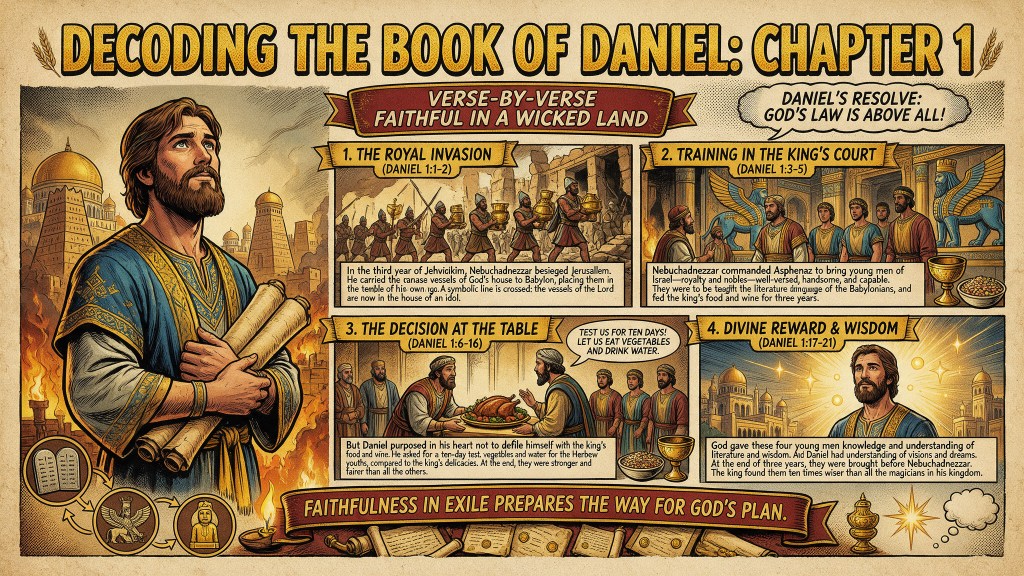
Daniel 1 shows a young man from Judah taken into captivity in Babylon (the land of Shinar). Babylon corresponds to modern-day Iraq, a nation currently under Islamic rule. The chapter establishes Daniel (and his companions) as examples of those who serve the Lord while operating in a wicked, idolatrous environment.
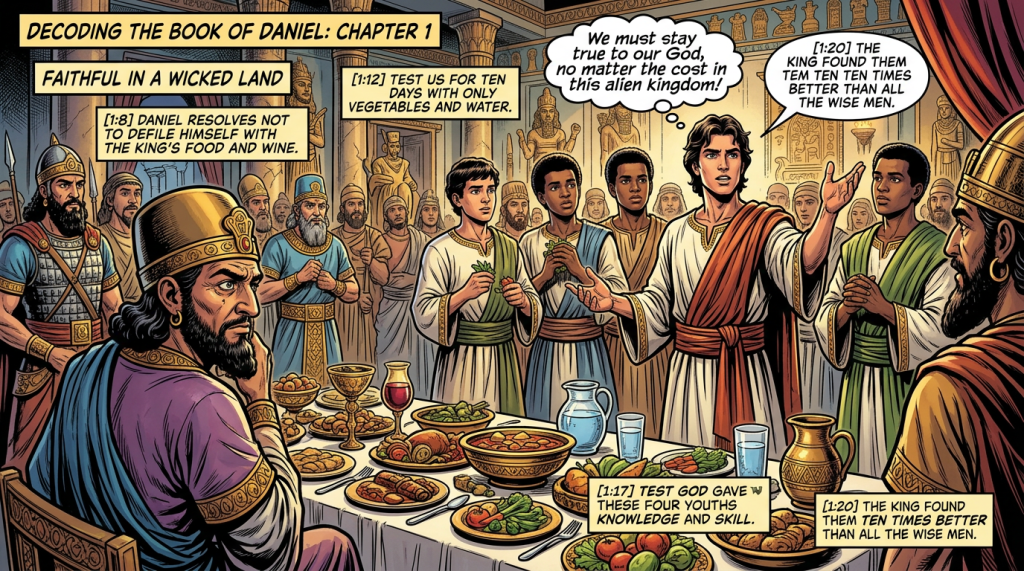
The focus here is biblical lessons of resolve, non-compromise, and God’s sovereignty rather than later theological systems.
Verses 1–2
“In the third year of the reign of Jehoiakim king of Judah came Nebuchadnezzar king of Babylon unto Jerusalem, and besieged it. And the Lord gave Jehoiakim king of Judah into his hand, with part of the vessels of the house of God: which he carried into the land of Shinar to the house of his god; and he brought the vessels into the treasure house of his god.”
God sovereignly delivered Judah’s king and temple vessels into the hand of the Babylonian king. The vessels went into the treasure house of a false god in Shinar/Babylon. This fulfills prior prophetic warnings of judgment for Judah’s unfaithfulness (cross-referenced in the biblical record with the captivity context). Lesson: Even when a righteous remnant is trapped in a land of unbelievers, the Lord remains in control of nations and outcomes. Defeat of the nation does not mean abandonment of His people who remain faithful.
Verses 3–5
And the king spake unto Ashpenaz the master of his eunuchs, that he should bring certain of the children of Israel, and of the king’s seed, and of the princes; Children in whom was no blemish, but well favoured, and skilful in all wisdom, and cunning in knowledge, and understanding science, and such as had ability in them to stand in the king’s palace, and whom they might teach the learning and the tongue of the Chaldeans. And the king appointed them a daily provision of the king’s meat, and of the wine which he drank: so nourishing them three years, that at the end thereof they might stand before the king.
This is a program of selection, re-education, and cultural assimilation. The best of the captive youth are immersed in Chaldean (Babylonian) language, learning, and lifestyle, including food from the royal table. Lesson for the righteous in an unbelieving land: Pressure to adopt the language, wisdom, and practices of the surrounding culture (whether ancient pagan or modern Islamic/unbelieving environments) is real and systematic. Ability and favor can be used by the world for its own purposes.
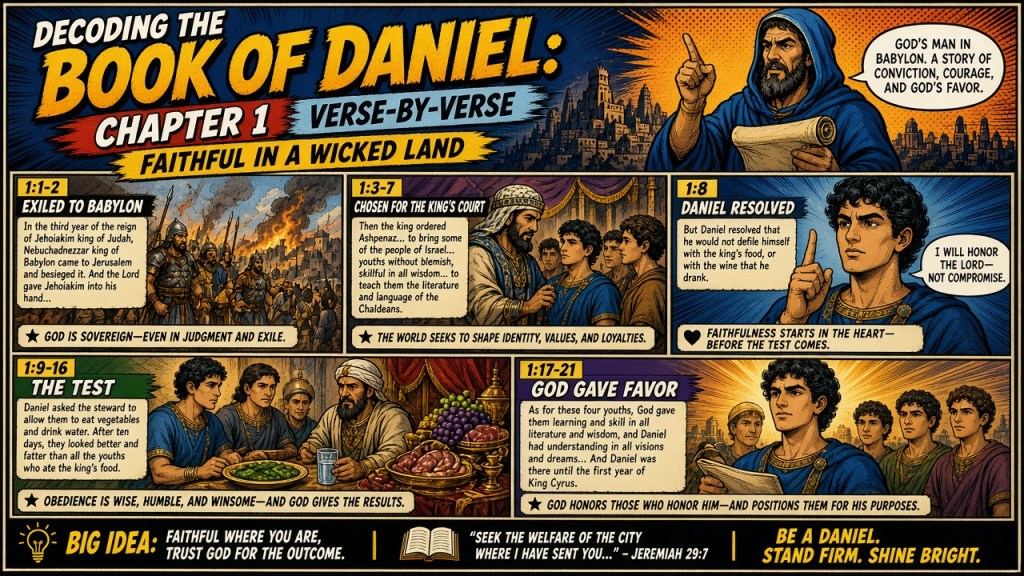
Verses 6–7
Now among these were of the children of Judah, Daniel, Hananiah, Mishael, and Azariah: Unto whom the prince of the eunuchs gave names: for he gave unto Daniel the name of Belteshazzar; and to Hananiah, of Shadrach; and to Mishael, of Meshach; and to Azariah, of Abednego.
Their Hebrew identities are overwritten with names tied to the Babylonian environment. Lesson: Attempts to redefine identity occur in lands of unbelief. The text records the names but shows the men continue to be known and act according to their original calling before God.
Verse 8
“But Daniel purposed in his heart that he would not defile himself with the portion of the king’s meat, nor with the wine which he drank: therefore he requested of the prince of the eunuchs that he might not defile himself.”
Daniel made an inward decision of purpose before acting outwardly. The king’s meat and wine would have involved defilement relative to the standards God had given His people (dietary distinctions and separation from idolatry). He requests permission rather than rebellious confrontation. Lesson: The righteous man in a wicked land begins with heart-level resolve not to defile himself, then seeks a practical path consistent with that resolve. This is the pivotal verse of the chapter for personal application today in any environment that pressures compromise.

Verse 9
“Now God had brought Daniel into favour and tender love with the prince of the eunuchs.”
God acted to give Daniel favor with the official over him. Lesson: The Lord works on behalf of those who purpose not to defile themselves. Favor with men is secondary to favor from God and can follow faithful resolve.
Verses 10–16
And the prince of the eunuchs said unto Daniel, I fear my lord the king, who hath appointed your meat and your drink: for why should he see your faces worse liking than the children which are of your sort? then shall ye make me endanger my head to the king. Then said Daniel to Melzar, whom the prince of the eunuchs had set over Daniel, Hananiah, Mishael, and Azariah, Prove thy servants, I beseech thee, ten days; and let them give us pulse to eat, and water to drink. Then let our countenances be looked upon before thee, and the countenance of the children that eat of the portion of the king’s meat: and as thou seest, deal with thy servants. So he consented to them in this matter, and proved them ten days. And at the end of ten days their countenances appeared fairer and fatter in flesh than all the children which did eat the portion of the king’s meat. Thus Melzar took away the portion of their meat, and the wine that they should drink; and gave them pulse.
Literally, a short, observable test is proposed and granted. The outcome is better physical appearance and continued provision of the non-defiling food. Lesson: In an unbelieving environment, practical, limited tests of faithfulness can be requested. God can vindicate separation from defilement even in measurable ways, without requiring open rebellion. The text does not present a universal dietary rule for all ages but shows specific non-compromise in the face of royal provision that would have defiled.

Verse 17
“As for these four children, God gave them knowledge and skill in all learning and wisdom: and Daniel had understanding in all visions and dreams.”
Literally, God Himself supplied superior knowledge, skill, learning, and wisdom. Daniel additionally received understanding in visions and dreams. Lesson: Faithfulness in the matter of not defiling oneself is met with divine enablement. This understanding in visions and dreams is the biblical foundation for the prophetic revelations that occupy the rest of the book. A righteous man who will not compromise in small matters is positioned by God for greater insight.
Verses 18–20
Now at the end of the days that the king had said he should bring them in, then the prince of the eunuchs brought them in before Nebuchadnezzar. And the king communed with them; and among them all was found none like Daniel, Hananiah, Mishael, and Azariah: therefore stood they before the king. And in all matters of wisdom and understanding, that the king enquired of them, he found them ten times better than all the magicians and astrologers that were in all his realm.
Literally, they excel in the very training the Babylonian system provided, by a factor of ten, above the professional practitioners of that system. Lesson: Operating faithfully in a wicked land does not require ignorance or inability; God can make His servants superior even by the world’s own measures, while they remain undefiled. This distinguishes true divine wisdom from the magicians and astrologers of the unbelieving culture.
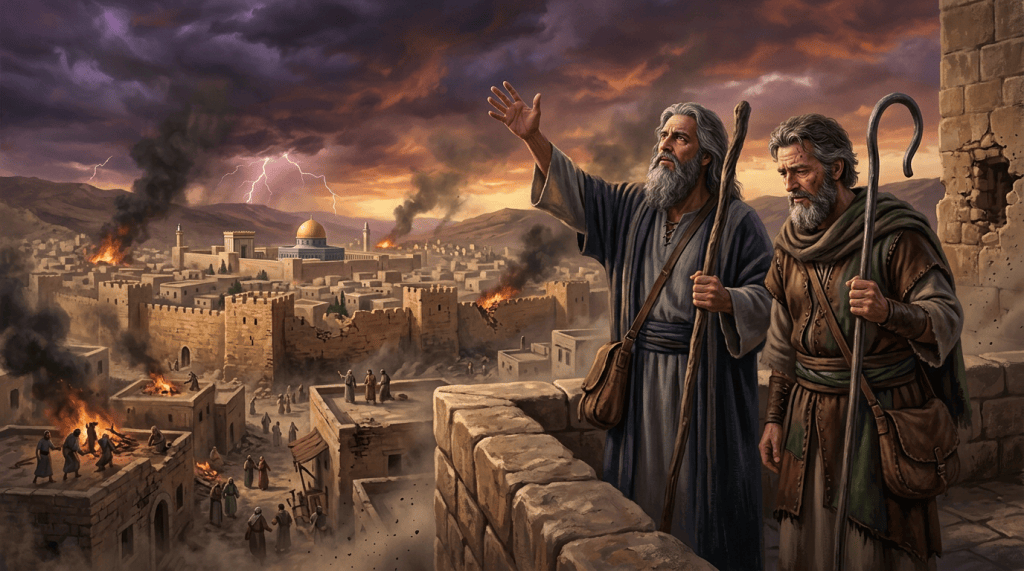
Verse 21
“And Daniel continued even unto the first year of king Cyrus.”
Literally, Daniel’s service spans the Babylonian period into the beginning of the Persian (Cyrus) era. Persia corresponds to modern-day Iran, also currently Islamic. Lesson: A righteous man who purposes not to defile himself can endure and serve across changing kingdoms and rulers in lands of unbelief. His longevity and continuity set the stage for the successive prophetic empires that follow in the book.
Summary lessons for the righteous in a land of unbelievers
Daniel 1 demonstrates, by the text itself, that captivity and immersion in an idolatrous environment (Babylon/Iraq) do not compel defilement. The sequence is heart purpose (v. 8), divine favor (v. 9), practical testing and better outcome (vv. 10–16), God-given knowledge and prophetic understanding (v. 17), and superior standing (vv. 18–20), lasting across empires (v. 21).

The Lord is sovereign even when He gives His people into the hand of an unbelieving king. These principles of non-compromise and divine enablement prepare the reader for the prophetic decoding of kingdoms and times that begins in earnest in later chapters, where the same geographic regions (Iraq, Iran, Turkey, Syria, Egypt, Rome) reappear under successive rulers.




Leave a Reply