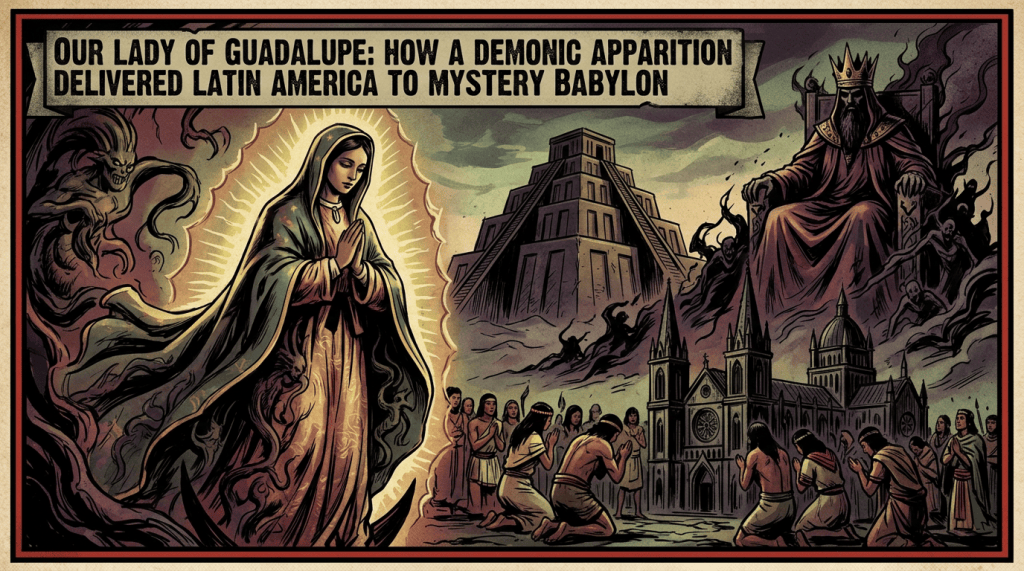
In December 1531, on a hill north of the recently conquered Aztec capital, a Nahuatl-speaking convert named Juan Diego reported seeing a radiant woman who identified herself as the mother of God. She left her image on his tilma, spoke words of maternal comfort, and requested a shrine.
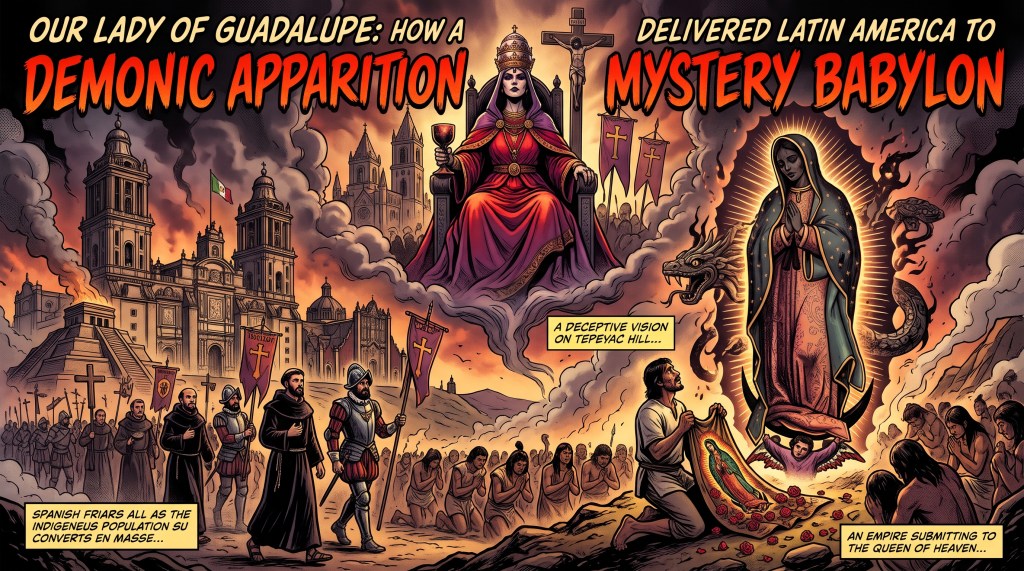
Within years, Catholic chroniclers claimed that eight to ten million indigenous people had accepted baptism. The event, celebrated today as the apparition of Our Lady of Guadalupe, is treated by the Roman Catholic Church as a providential miracle that created a Catholic civilization in the Americas. A closer examination of the historical record and the biblical standard reveals something far less edifying: a carefully leveraged demonic counterfeit that accelerated the implantation of a hierarchical, image-centered religion and secured Rome’s long-term control over the spiritual and political life of Latin America and its diaspora.
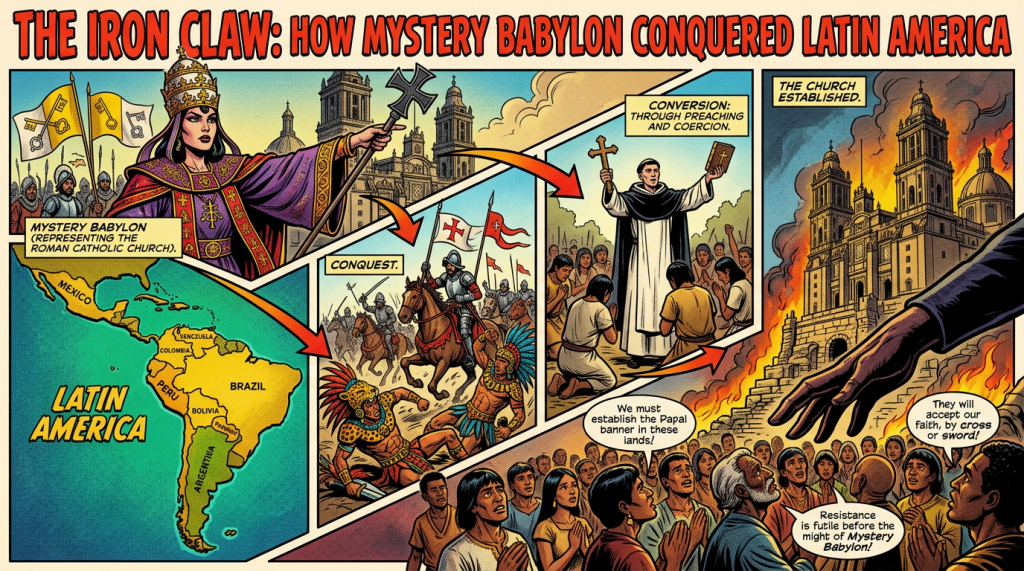
The timing and location were not accidental. Ten years earlier, Hernán Cortés had toppled the Aztec Empire. Spanish friars were already destroying temples and performing mass baptisms under the legal cover of papal bulls that had authorized the conquest in exchange for the conversion of the natives.
Tepeyac itself had been a sacred site devoted to Tonantzin, the Aztec mother goddess whose name means “Our Sacred Mother.” The figure who appeared to Juan Diego claimed the same protective maternal role, stood upon a crescent moon wreathed in solar rays (symbols familiar to Nahua cosmology), and addressed him in his own language. Indigenous pilgrims continued for generations to address the shrine as Tonantzin. What the Church presented as conversion was, in substantial measure, the transfer of an existing goddess cult to a new image under Catholic supervision. Churches rose on or near former temple platforms; the old devotion was not extinguished but redirected.
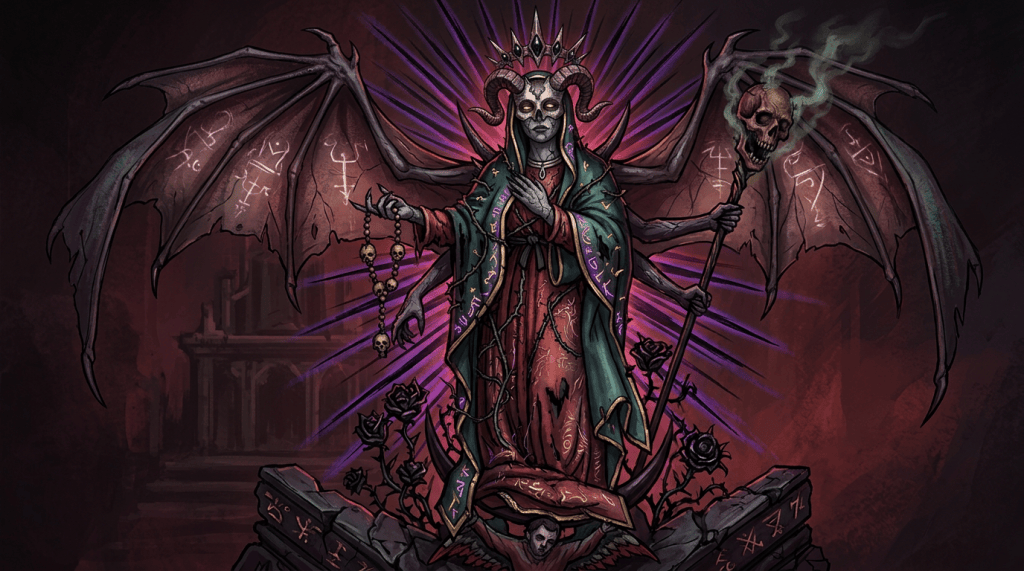
Catholic sources continue to cite the figure of eight to ten million baptisms between 1531 and the early 1540s as proof of the apparition’s power. Contemporary Franciscan estimates, such as those associated with Motolinía, supply the number, yet modern historians note that the baptisms were frequently collective, minimally catechized, and conducted amid demographic catastrophe caused by epidemic disease. More importantly, early missionary records do not treat the Guadalupe image as the decisive instrument of conversion in the manner later tradition asserts.
The devotion grew in importance over subsequent decades as a tool of colonial stabilization. By providing a shared maternal figure who appeared to mediate between conqueror and conquered, it reduced resistance and legitimized Spanish ecclesiastical structures. The Crown’s Patronato Real already gave Spanish monarchs decisive control over appointments and resources; the Guadalupe cult supplied the popular loyalty that made that control durable.
The message delivered by the apparition matches the pattern Scripture identifies as demonic deception. 2 Corinthians 11:13–15 warns that Satan transforms himself into an angel of light and that his servants appear as ministers of righteousness. The figure claimed the role of mother and protector in language that elevated her to a mediatory status Scripture reserves exclusively for Christ (1 Timothy 2:5). She demanded a shrine and thereby established image veneration on a site of prior idolatry, contradicting the plain prohibition of Exodus 20:4–5.

No New Testament text authorizes post-ascension appearances of Mary; the biblical Mary is presented as a humble believer who required a Savior (Luke 1:47) and who disappears from the narrative after Acts 1. The practical result was the displacement of the apostolic gospel—repentance and faith in the finished work of Christ alone—with a system of sacramental baptism, priestly mediation, and devotion to a created image. Deuteronomy 13 supplies the test: a sign or wonder that leads the people away from exclusive allegiance to the God of Scripture is to be rejected, however impressive the display.
Once established, the cult became self-reinforcing. The image was declared patroness of New Spain and later of the Americas. It supplied the emotional center of Mexican national identity, appearing on banners in the wars of independence and remaining the single most visited shrine in the hemisphere. Across the Spanish colonial world the same pattern repeated: Marian devotion, often localized and syncretic, served as the accessible face of a hierarchical Church whose doctrines of works, purgatory, and papal authority had no foundation in the apostolic writings.
The result was not the free proclamation of the gospel recorded in Acts but the creation of the largest Catholic population outside Europe—one whose religious practice centered on the very elements the Reformation had rejected as unbiblical.
The demographic consequences remain visible. Latin America is still the region with the highest concentration of nominal Catholics. In the United States, Hispanic immigration has significantly increased the Catholic share of the population; surveys consistently show that Guadalupe devotion remains a powerful marker of cultural and religious identity among Mexican-Americans and other Latin American communities.
Political and ecclesiastical actors continue to invoke the image when addressing Hispanic voters or migrants. The spiritual system planted in 1531 therefore continues to shape both the religious landscape of the hemisphere and the political calculations of institutions that benefit from a large, sacramentally oriented Catholic electorate.
None of this requires denying the scale of the historical event or the sincerity of those who venerate the image. It requires only that the event be measured against the biblical standard rather than against institutional self-interest. The Bible presents one mediator, one finished sacrifice, and one way of salvation by faith alone. The apparition at Tepeyac introduced a competing maternal intercessor, sanctified an image on a former pagan site, and facilitated the mass incorporation of peoples into a Church that has historically suppressed vernacular Scripture and elevated tradition and hierarchy above the written Word. In the language of Revelation 17, it helped seat the harlot over new multitudes of peoples, nations, and tongues.
The enduring control of Latin American Catholicism by Rome is not an accident of history. It is the predictable fruit of a counterfeit that arrived precisely when imperial power and missionary zeal were prepared to exploit it. Scripture’s warning remains unchanged: test the spirits, reject any message that adds mediators or objects to the gospel, and refuse the angel of light who offers a softer, more maternal path than the narrow way of Christ alone.


Leave a Reply