
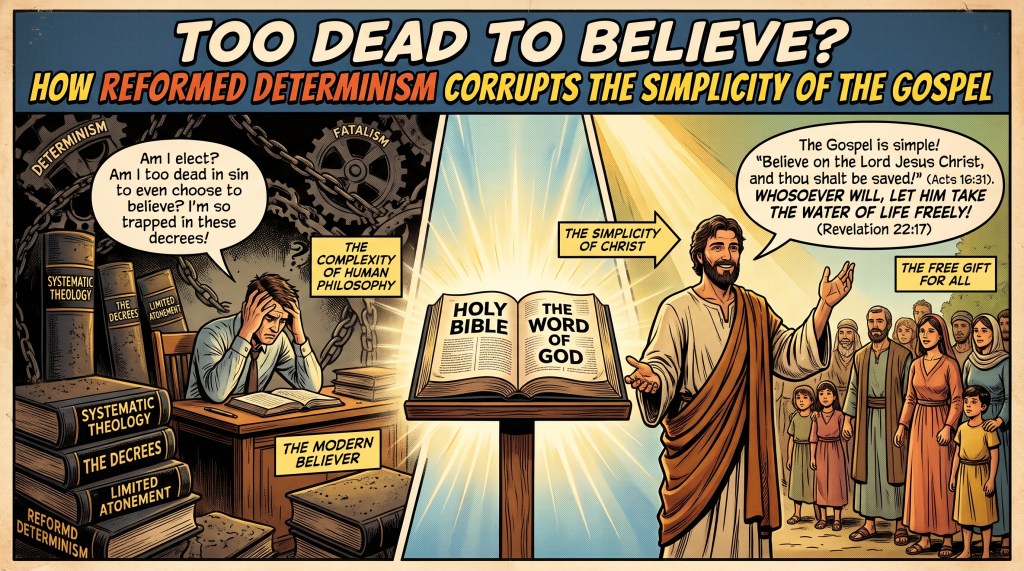
Calvinism’s most enduring claim is that no sinner can believe the gospel until God has first elected him, regenerated him, and deposited faith as an irresistible gift.
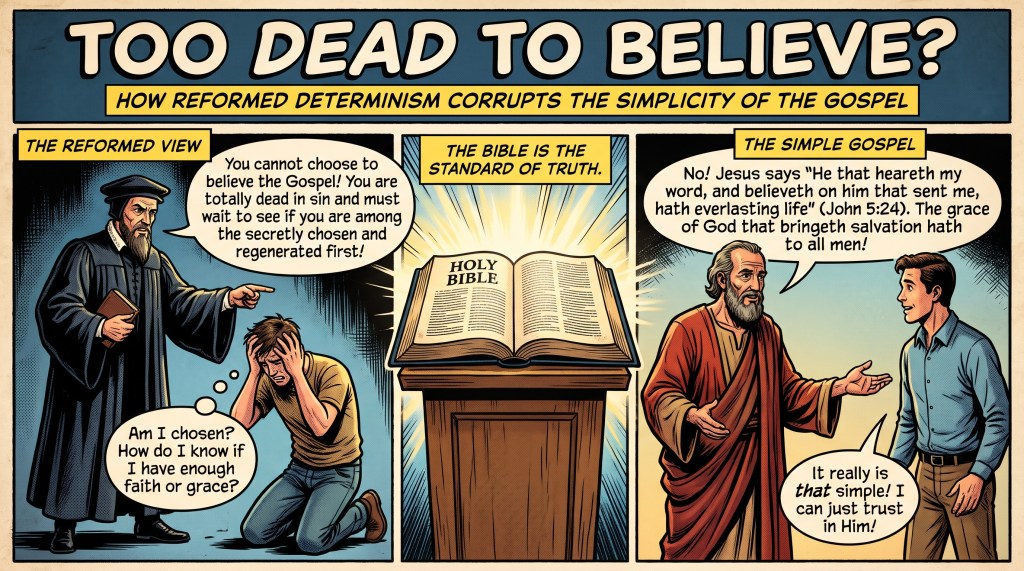
The doctrine is presented as a high view of divine sovereignty. In practice it produces the opposite of clarity. It replaces the simple, present-tense promise of John 5:24 with a system that makes genuine assurance contingent on subsequent performance. What begins as a denial of free response ends as a back-loaded works religion in which believers are told to examine their fruit to discover whether they were ever among the elect.
John 5:24 states the matter with unusual directness: “He that heareth my word, and believeth on him that sent me, hath everlasting life, and shall not come into condemnation; but is passed from death unto life.” The verbs are present and perfect. The one who hears and believes already possesses everlasting life, is already free from condemnation, and has already passed from death to life. There is no probationary period, no subsequent test of perseverance required to confirm the transaction, and no secret prior decree that must be reverse-engineered through self-examination. The text treats belief as the decisive human response that receives the gift already offered.
Calvinist theology cannot leave the verse standing. Total Depravity is defined so absolutely that the unregenerate person is said to lack even the capacity to hear and believe. Faith itself must therefore be the gift that precedes and produces belief; otherwise the sinner would be credited with a positive contribution. Once that move is made, John 5:24’s plain sequence is inverted. A person does not believe and thereby receive life; he receives life and is thereby made able to believe. The difference is not semantic. It relocates the ground of assurance from Christ’s finished work received by faith to an internal change that only the elect experience. The ordinary hearer of the gospel is left without a reliable way to know whether the faith he thinks he has exercised is the real article or a merely temporary, non-saving approximation.
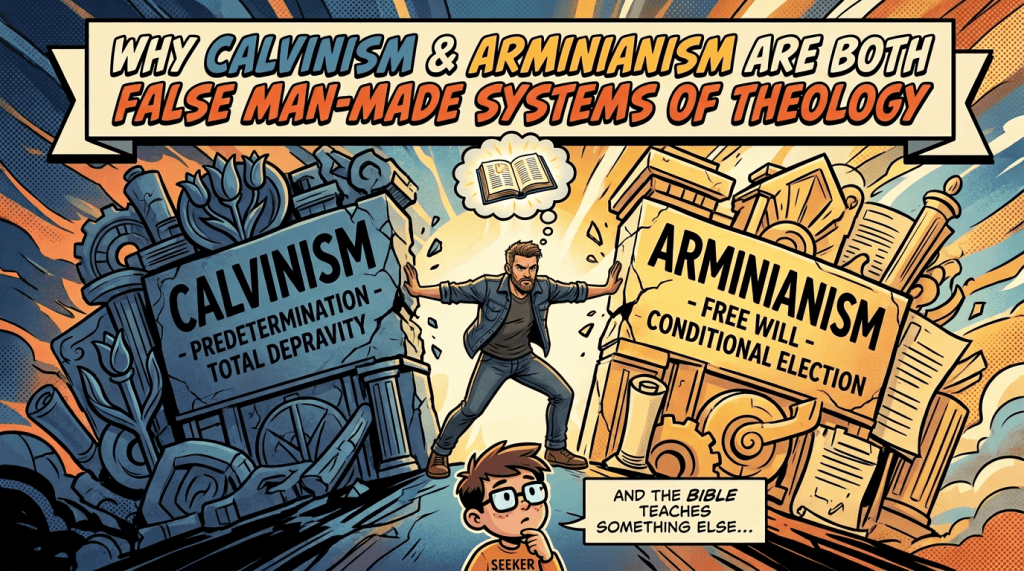
The practical consequence is immediate confusion about how a person is actually saved. The New Testament repeatedly answers the question in the simplest terms. When the Philippian jailer asked what he must do to be saved, the reply was “Believe on the Lord Jesus Christ, and thou shalt be saved” (Acts 16:31). Romans 10:17 locates the origin of faith in hearing the word, not in a prior regenerative act. The same pattern appears across the Old Testament narratives Calvinism must explain away: Abraham believed God and it was counted to him for righteousness; Noah, warned of things not seen, prepared an ark by faith; Joshua called the people to choose whom they would serve. In each case the text presents a response to divine speech rather than an irresistible internal renovation that guarantees the response.
Calvinism answers that these examples are either exceptional or that the individuals in view were already elect and therefore already enabled. The maneuver saves the system at the cost of the text’s ordinary meaning. Commands to believe, to choose, and to repent become either theatrical or effective only for those already chosen. The universal language of Scripture—“whosoever believeth,” “all men,” “the whole world,” “every man”—must be systematically narrowed. Once the narrowing is complete, the gospel invitation is no longer a genuine offer that places responsibility on the hearer. It is an announcement of what God has already decided to do in a select number. The person who wants to know whether he is saved is no longer directed to the promise of John 5:24. He is directed to look for the evidences of election in his own life.
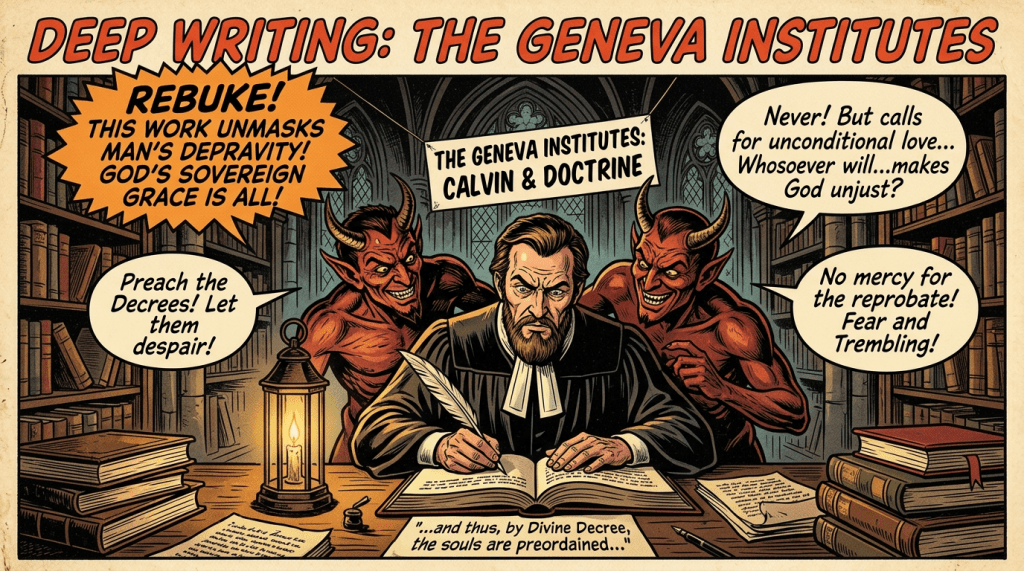
That redirection is what converts the system into a back-loaded works religion. Because only the elect receive the gift of faith that produces true belief, and because true belief always produces perseverance and visible fruit, the absence of sufficient fruit becomes evidence that the faith was never genuine.
Lordship Salvation, the popular practical outworking of this logic, insists that a person cannot accept Christ as Savior without also submitting to Him as Lord in every area of life, and that ongoing obedience is the necessary proof that the transaction occurred. The person who struggles with sin, whose growth is uneven, or who cannot point to dramatic transformation is told he may not be saved at all. Assurance is no longer grounded in the finished work received by faith; it is grounded in the quality and consistency of the believer’s subsequent works.
The result is a perpetual inspection regime. Believers are encouraged to examine themselves to see whether they are in the faith, but the examination is conducted according to criteria the system itself supplies. Fruit is redefined as the visible marks of election. Those who display the marks congratulate themselves on having been given true faith.
Those who do not are left in doubt or are quietly reclassified as never having been elect. The system thereby recovers a form of works-righteousness under the language of grace. Justification is said to be by faith alone, yet the faith that justifies is said to be known only by the works it produces. The ordinary believer is left oscillating between presumption and despair, never certain that the faith he has exercised meets the standard of the elect.

John 5:24 refuses this arrangement. It locates the possession of everlasting life, the absence of condemnation, and the passage from death to life in the act of hearing and believing. It does not postpone these realities until fruit appears, nor does it make them contingent on a prior secret decree that can be inferred only from later performance. The text treats the one who believes as already secure.
Warnings about falling away, when they appear elsewhere in Scripture, address profession without reality, carnal living that forfeits reward, or the danger of apostasy from a merely external connection. They do not undo the perfect tense of John 5:24 for those who have actually believed.
Calvinism’s defenders reply that the system protects against easy-believism and preserves the seriousness of discipleship. The reply concedes the practical problem while refusing to acknowledge its source. When the condition for being able to believe is an invisible divine act that only some receive, the only public evidence left is the life that follows. Discipleship is then pressed into service as the proof of election rather than the grateful response of those already justified.

The confusion about how to be saved is not an accidental byproduct; it is the logical consequence of denying that a sinner can respond to the gospel until God has already elected him and granted him faith. The back-loaded works religion is not a distortion introduced by careless preachers; it is the system’s ordinary pastoral application.
The New Testament does not require this apparatus. It presents a Christ who died for the sins of the world, a gospel that is the power of God unto salvation to everyone who believes, and a promise that the one who believes has everlasting life and shall not come into condemnation.
Election, properly understood, does not cancel that promise or convert it into a puzzle to be solved by inspecting one’s own fruit. The Reformed insistence that no one can believe until God first elects and enables him is not a higher view of grace. It is a redefinition of grace that leaves the ordinary hearer of the gospel without a reliable answer to the most basic question: what must I do to be saved?

John 5:24 still supplies the answer. The system that must qualify it has substituted a later construction for the text itself.





Leave a Reply