
Modern discourse about the Middle East often treats the region’s peoples as the product of relatively recent migrations, colonial borders, or twentieth-century nationalism.
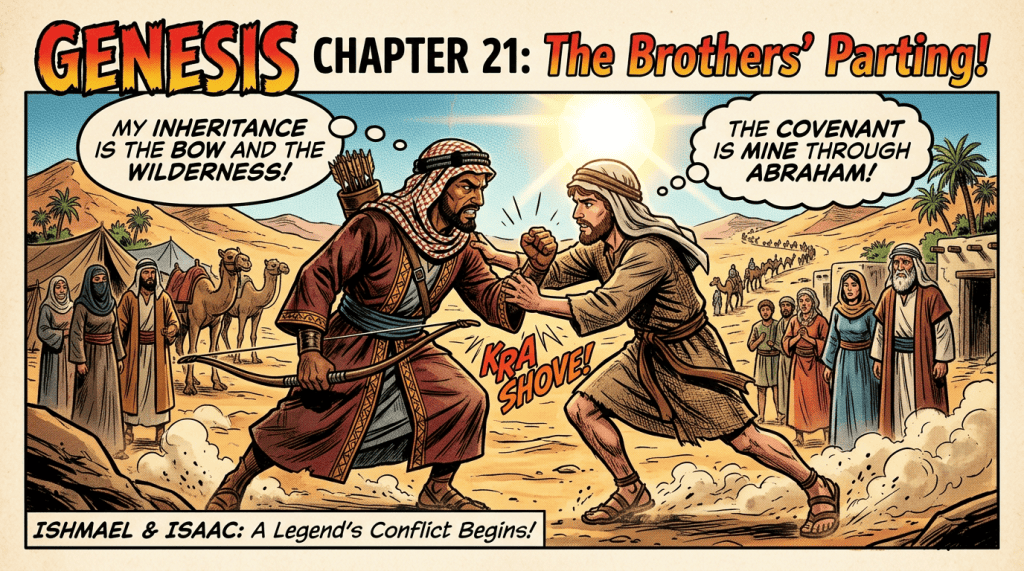
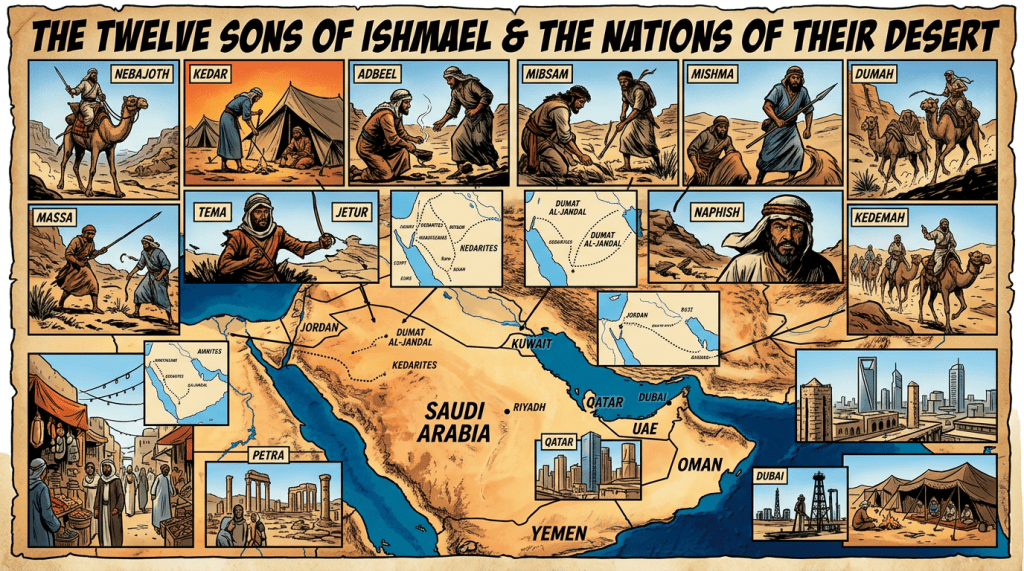
A literal reading of Genesis supplies an older and more specific account. Genesis 25 names the twelve sons of Ishmael—Abraham’s son by Hagar the Egyptian—and identifies them as the founders of twelve nations whose territory ran from Havilah to Shur before Egypt as one goes toward Assyria. That corridor corresponds today to the core of Saudi Arabia together with portions of Jordan, Syria, Iraq, the Sinai Peninsula of Egypt, the Negev of Israel, and the desert fringes of Lebanon and Kuwait. Scripture thereby records the earliest continuous written origin for the Arab peoples of the northern Arabian Peninsula and its adjacent desert lands.
The text is deliberate. “Now these are the generations of Ishmael, Abraham’s son, whom Hagar the Egyptian, Sarah’s handmaid, bare unto Abraham: And these are the names of the sons of Ishmael, by their names, according to their generations: the firstborn of Ishmael, Nebajoth; and Kedar, and Adbeel, and Mibsam, And Mishma, and Dumah, and Massa, Hadar, and Tema, Jetur, Naphish, and Kedemah: These are the sons of Ishmael, and these are their names, by their towns, and by their castles; twelve princes according to their nations.” The identical list appears in 1 Chronicles 1:29–31. These are not vague tribal memories. They are named princes, each associated with towns and castles, and collectively designated as nations within a defined geography.

Genesis 25:18 fixes the location: “And they dwelt from Havilah unto Shur, that is before Egypt, as thou goest toward Assyria: and he died in the presence of all his brethren.” Havilah here functions as a northern or north-central Arabian boundary. Shur is the wilderness immediately east of Egypt, the same region mentioned in the flight of Hagar and in the early stages of the Exodus. The directional phrase “as thou goest toward Assyria” traces the eastward desert route across northern Arabia into the approaches of Mesopotamia. The same range is applied to the Amalekites in 1 Samuel 15:7, confirming that the Ishmaelite settlement occupied the continuous desert corridor linking the Egyptian frontier with the Assyrian sphere.
Later Old Testament passages locate individual sons inside that zone and nowhere else. Kedar is the desert people of tents and archers. Isaiah 21:16–17 pronounces the end of “the glory of Kedar” and its remaining bowmen within a year. Isaiah 42:11 places the inhabitants of Kedar among those who lift up their voice from the desert. Jeremiah 49:28 and Ezekiel 27:21 list Kedar among the Arabian trading partners who supplied lambs, rams, and goats to Tyre. Nebajoth is paired with Kedar in Isaiah 60:7, their flocks and rams offered in a future restoration.
Dumah is the subject of the brief oracle in Isaiah 21:11–12, a voice calling out of Seir, the mountain country that borders the northwestern Arabian desert and Edom. Tema is the oasis caravan station named in Job 6:19, Isaiah 21:14, and Jeremiah 25:23; it is the modern site of Tayma in northern Saudi Arabia. Jetur and Naphish appear in 1 Chronicles 5:18–19 as allies of the Hagrites whom the Reubenites, Gadites, and half-tribe of Manasseh defeated in the territory east of the Jordan. The remaining sons—Adbeel, Mibsam, Mishma, Massa, Hadar, and Kedemah—receive no separate narratives, yet they are numbered among the twelve princes whose collective domain is fixed by the Havilah-to-Shur description.

When these markers are set against the modern map, the correspondence is geographical rather than speculative. Saudi Arabia contains the largest share: the oases of Tayma (Tema) and Dumat al-Jandal (Dumah), the northern Hijaz, and the broad desert expanses once occupied by Kedar. Jordan holds the northwestern sector, including areas historically linked to Nebajoth and the Transjordanian margins where Jetur and Naphish fought. Syria includes the Syrian Desert and the northern reaches that point toward the old Assyrian direction. Iraq occupies the eastern desert approaches that fulfill the phrase “as thou goest toward Assyria.” Egypt’s Sinai Peninsula and the immediate approaches east of the Nile constitute the Shur limit.
Israel’s Negev Desert falls inside the same band described for both the Ishmaelites and the Amalekites. Lebanon’s eastern highlands and southern fringes overlap the later territory of Jetur, known in classical sources as Iturea. Kuwait sits at the far eastern edge of the northern Arabian desert near the head of the Persian Gulf. Yemen lies outside the described range. Southern Arabia is associated in Genesis 10 with the Joktanite line (Sheba, Hazarmaveth, and related peoples), and the biblical notices of Kedar, Tema, and Dumah remain firmly northern.
This scriptural geography is the earliest written frame for the history of the Arab peoples who inhabit the northern peninsula and the Levantine desert margins. The twelve princes are presented as already settled nations in the generation after Abraham, possessing towns and castles inside a defined territory. Subsequent books of the Old Testament treat their descendants as a permanent feature of the landscape: caravan traders, tent-dwellers, and occasional military actors who interact with Israel, Edom, and the empires of the Fertile Crescent.

The text records both their kinship through Abraham and their distinct territorial destiny. It does not collapse them into Israel, nor does it erase the promise of multiplication given to Ishmael.
Later Arab genealogical tradition largely preserved the distinction between northern tribes, frequently traced through Adnan to Ishmael, and southern tribes traced through Qahtan. While those medieval chains are elaborations, they are consistent with the biblical separation of the Ishmaelite range from the more southerly Joktanite peoples.
The modern nation-states that occupy the Havilah-to-Shur corridor are therefore the political successors of the twelve princes named in Genesis 25. Continuity is first of all geographical: the same oases, the same desert tracks, and the same approaches to Egypt and Mesopotamia that Scripture assigned to the sons of Ishmael remain the inhabited landscape of those states.
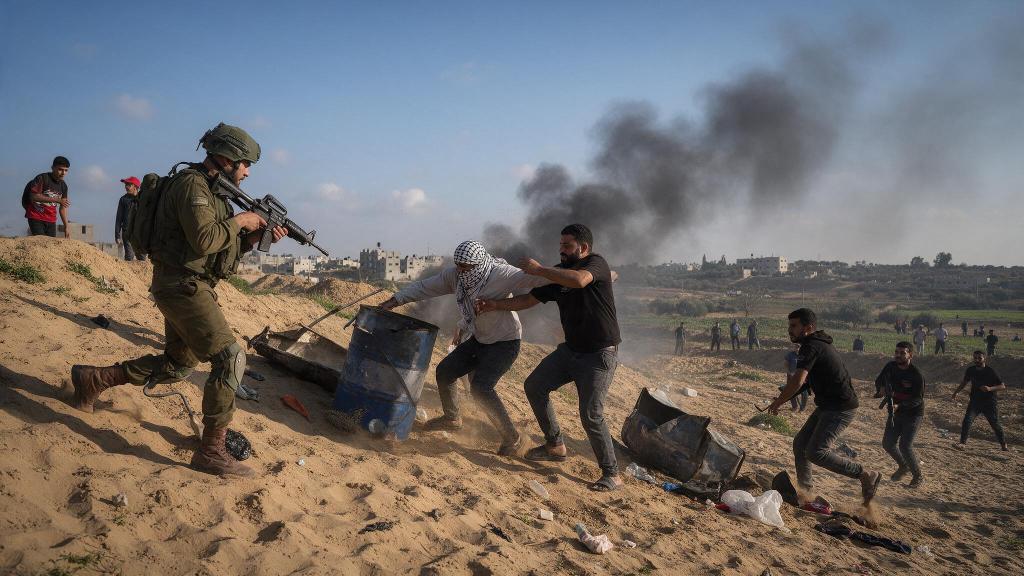
Twelve named princes established nations inside a defined desert corridor, and that corridor is still the territory of the Arab states of the northern peninsula and the Levantine desert. In an era when those states remain central to global affairs, the oldest continuous account of their origins is the brief, precise paragraph in Genesis 25. The twelve sons of Ishmael, their towns and castles, and the land that runs from Havilah to Shur before Egypt as one goes toward Assyria constitute the biblical starting point for any account of the peoples who still dwell there.





Leave a Reply