
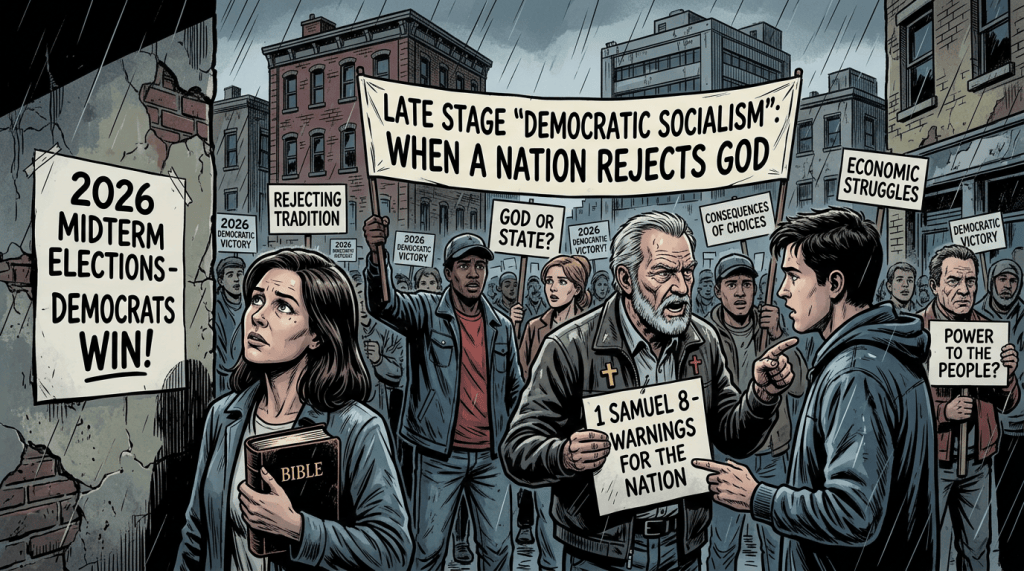
The November 2026 midterms delivered a decisive transfer of power. Democrats captured both chambers of Congress, flipped at least seven Senate seats (including Texas, Ohio, Iowa, Kansas, Maine, North Carolina, and South Carolina), took multiple governorships (Texas, Iowa, Ohio, Georgia, Nevada), and made extensive gains in state legislatures, establishing new trifectas in several states.
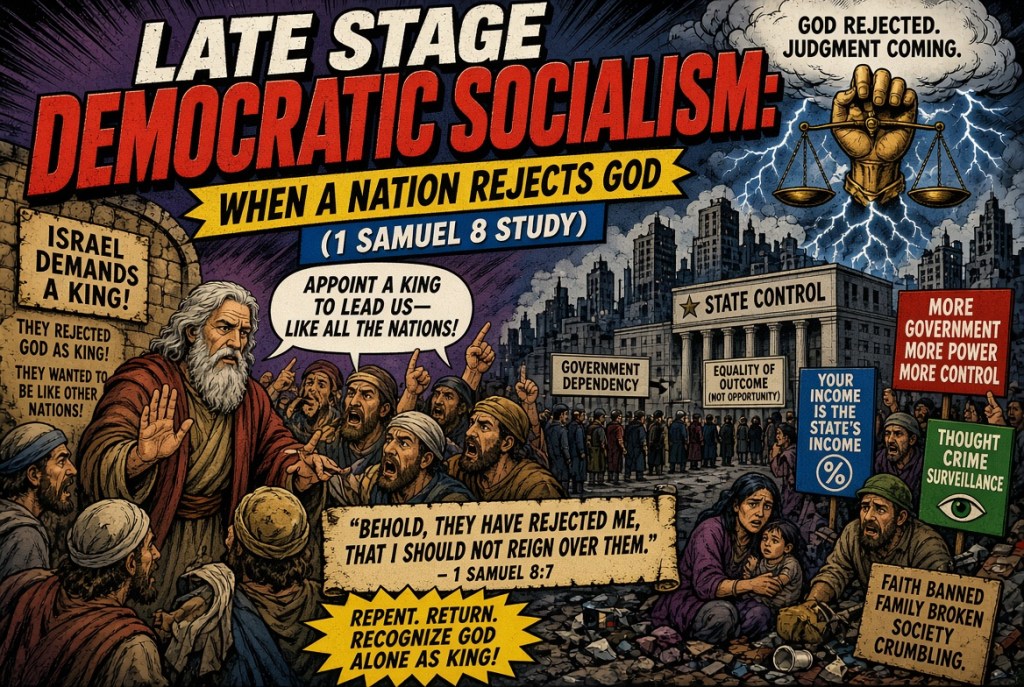
Contemporary accounts described the outcome as a broad repudiation of the prior Republican majorities. From the standpoint of a literal reading of the Bible, the results also illustrate an older and more fundamental pattern: what occurs when a people reject the LORD as their King and demand human rule patterned after the surrounding nations.
1 Samuel 8 records the moment Israel made that demand. Samuel was old. His sons, whom he had appointed judges in Beersheba, “walked not in his ways, but turned aside after lucre, and took bribes, and perverted judgment.” The elders of Israel gathered at Ramah and said to him, “Behold, thou art old, and thy sons walk not in thy ways: now make us a king to judge us like all the nations.” The request was not merely for administrative continuity. It was a request to be governed as the surrounding peoples were governed.
The LORD’s diagnosis was direct. He told Samuel: “Hearken unto the voice of the people in all that they say unto thee: for they have not rejected thee, but they have rejected me, that I should not reign over them. According to all the works which they have done since the day that I brought them up out of Egypt even unto this day, wherewith they have forsaken me, and served other gods, so do they also unto thee.”

The demand for a king “like all the nations” was not a rejection of Samuel’s personal failings. It was a rejection of the LORD’s own reign. It continued a long pattern of forsaking the God who had delivered them and turning to other gods.
God did not refuse the request outright. He instructed Samuel to protest solemnly and to “shew them the manner of the king that shall reign over them.” The warning that followed was concrete and exhaustive. The king would take their sons and appoint them for chariots, horsemen, and captains; he would set them to plow his ground, reap his harvest, and make instruments of war. He would take their daughters to be confectionaries, cooks, and bakers. He would take their fields, vineyards, and oliveyards—the best of them—and give them to his servants. He would take the tenth of their seed and vineyards and give it to his officers and servants. He would take their menservants, maidservants, goodliest young men, and asses and put them to his work. He would take the tenth of their sheep. “And ye shall be his servants.” Then, “ye shall cry out in that day because of your king which ye shall have chosen you; and the LORD will not hear you in that day.”
The people refused the warning. “Nay; but we will have a king over us; That we also may be like all the nations; and that our king may judge us, and go out before us, and fight our battles.” Samuel rehearsed their words before the LORD. The LORD replied, “Hearken unto their voice, and make them a king.” The chapter closes with Samuel sending the men of Israel back to their cities. The request was granted. The costs were left to be paid.

The text is precise about the sequence. A nation under the LORD’s direct rule rejects that rule in favor of human kingship modeled on the nations. God identifies the act as rejection of Himself. He issues a detailed warning of the practical burdens that will follow: conscription of sons and daughters, seizure of the best property, taxation of produce and flocks, reduction of the people to servants of the chosen authorities. The people persist. God permits the choice. When the burdens arrive and the people cry out, the LORD does not hear them, because the king is the one they chose.
This is not a general lesson about imperfect human government. Every human regime is imperfect. The chapter isolates a specific act: the deliberate preference for rule “like all the nations” over the LORD’s kingship, accompanied by the explicit rejection of His warnings. The consequences enumerated are not abstract. They are the ordinary operations of concentrated human power once the people have asked for it—taking labor, taking land, taking a portion of every increase, and treating the subjects as resources for the king’s projects.
The 2026 midterms supply a contemporary illustration of the same preference. The platforms and candidates that prevailed in multiple states and in both chambers of Congress advanced, and in many cases expanded, policies that treat biblical categories as optional or oppressive. Unrestricted abortion is framed as reproductive healthcare and autonomy. Distinctions of male and female are treated as social constructs subject to medical and legal revision. Marriage and family are redefined away from the one-flesh union of Genesis 2. Private property and the fruits of labor are subjected to expanding claims of equity and public ownership. Speech and association that retain biblical standards on sexuality or the uniqueness of Israel are increasingly classified as harm.

These are not marginal positions; they are central planks of the progressive program that the election empowered. In the language of 1 Samuel 8, this is the demand to be “like all the nations.” The surrounding cultures of the ancient Near East practiced child sacrifice to Molech, ritualized sexual inversion in the service of Ishtar/Ashtoreth, and temple systems that extracted tribute for the gods and their servants. The biblical text identifies those practices as the worship of devils (Deuteronomy 32:17; 1 Corinthians 10:20).
When a modern electorate repeatedly elevates leaders and platforms that invert the same created order—treating the unborn as disposable, the sexes as fluid, property as a collective resource, and the covenants with Israel as an inconvenience—it is performing the functional equivalent of the elders’ request. The preference is for governance ordered by the prevailing moral consensus of the age rather than by the standards the LORD has revealed.
The costs enumerated in 1 Samuel 8 are already visible in outline. Sons and daughters are claimed for the state’s projects: through education that teaches gender fluidity as settled fact, through military or service requirements that make no distinction of sex, through policies that treat parental authority as provisional. The best of the fields and vineyards—productive land, accumulated capital, the surplus of labor—are redirected by taxation, regulation, and redistribution schemes whose stated purpose is equity. A tenth, and often more, is taken from seed, income, and inheritance.
The people are increasingly treated as servants of the administrative state rather than as free subjects under a limited government. These are not novel observations; they are the ordinary mechanisms by which concentrated power operates once the people have asked for rulers who will “judge us, and go out before us, and fight our battles” according to a standard other than the LORD’s.
The text is equally clear about what follows the cry. “Ye shall cry out in that day because of your king which ye shall have chosen you; and the LORD will not hear you in that day.” The unanswered cry is not a failure of divine compassion in the abstract. It is the stated consequence of the choice. When the burdens of the chosen system become heavy—whether through debt, scarcity, demographic decline, loss of competence in the institutions, or the social costs of treating the created order as optional—the people will look for relief.
The chapter records that the relief will not come from the God they rejected when they demanded the system.
None of this requires the claim that every voter who supported the winning candidates consciously rejected the LORD. 1 Samuel 8 does not require that either. The elders spoke for the people; the people confirmed the demand. The chapter treats the collective act as the rejection. In the same way, the repeated electoral preference for platforms that systematically set aside biblical categories on life, sex, family, property, and the covenants constitutes, on the terms of the text, a rejection of the LORD’s kingship in favor of rule “like all the nations.”
The chapter does not end with restoration. It ends with permission. God grants the request after the warning has been given and refused. The later narrative of Samuel, Saul, and the monarchy shows the costs arriving in full. The people receive the king they asked for. The taking begins. The cry comes. The pattern is not obscure. It is written in plain language and left as a standing record of what happens when a nation rejects God.


Leave a Reply