
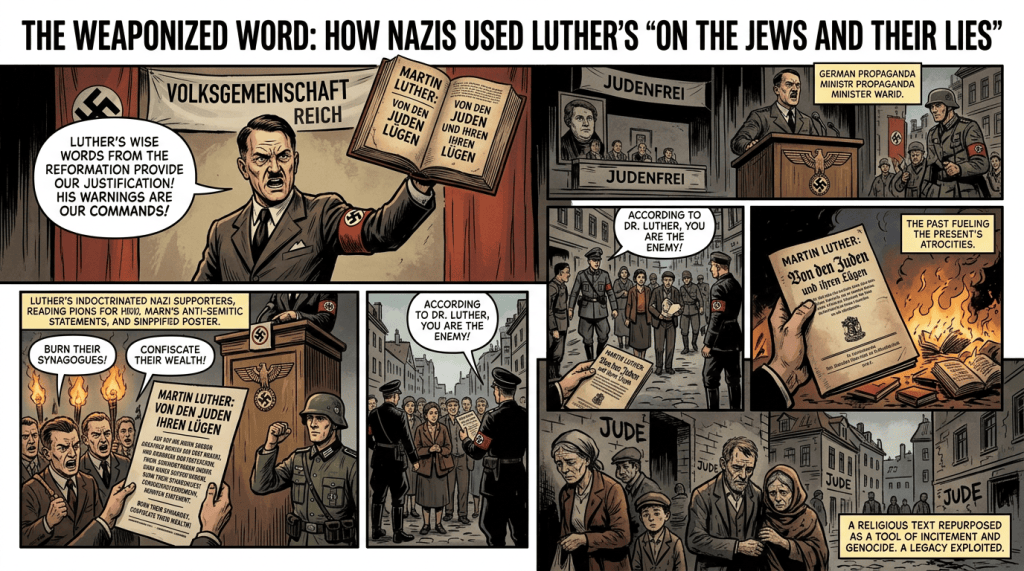
Martin Luther’s 1543 treatise On the Jews and Their Lies did not invent European antisemitism, nor did it single-handedly produce the Holocaust. What it did supply, however, was a prestigious Protestant text that Nazi propagandists and a minority of German Protestant clergy selectively revived, displayed, and applied to justify escalating measures against Jews. The historical record of that appropriation is concrete, not speculative.
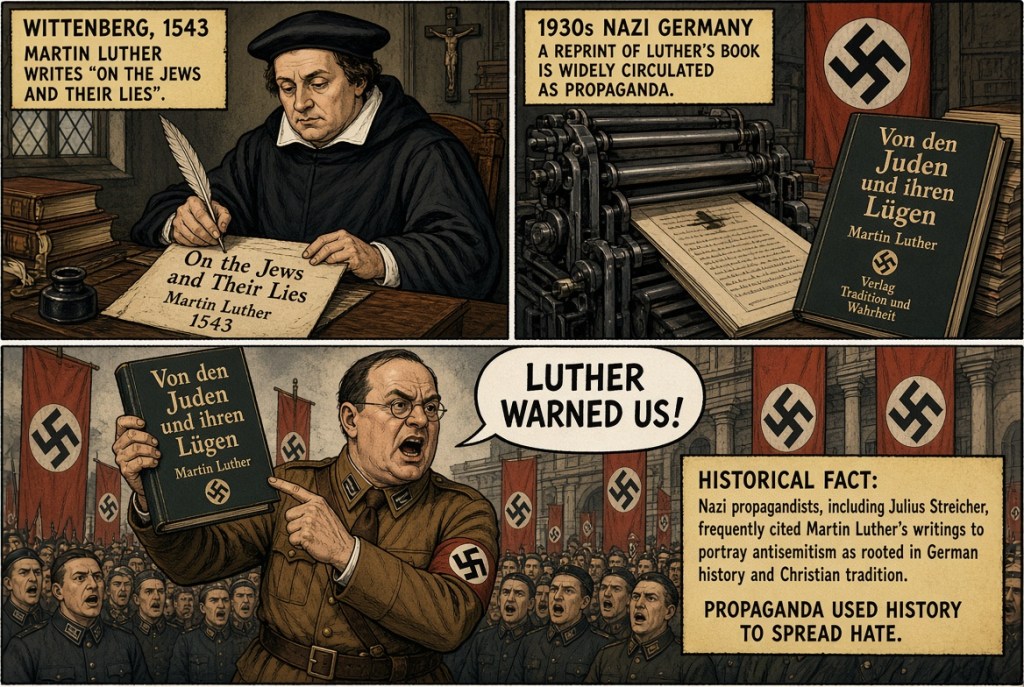
Luther’s late work is unambiguous in its recommendations. After earlier hopes that a purified gospel would convert Jews failed, he advised Christian rulers to burn synagogues and schools, raze Jewish houses, confiscate prayer books and Talmudic writings, forbid rabbis from teaching under threat of death or mutilation, abolish safe-conduct, seize money and valuables, and subject able-bodied Jews to forced labor or expulsion.
He framed these steps as “sharp mercy” to stop blasphemy against Christ. The language is crude and the program practical. For centuries the treatise was not continuously central in German culture; some scholars note it was largely neglected in the eighteenth and nineteenth centuries. That changed in the Weimar and Nazi periods.
With the rise of National Socialism, the text regained currency. Copies appeared at Nuremberg rallies. In 1937 the city of Nuremberg presented a first edition to Julius Streicher, editor of Der Stürmer, which described it as the most radically antisemitic tract ever published. Streicher later invoked Luther at Nuremberg, arguing that the reformer would likely have stood in the defendants’ dock had the prosecution examined the 1543 work. Heinrich Himmler privately praised the sharpness of Luther’s judgments on the Jews. Propagandists such as Dietrich Eckart quoted the treatise. These were not isolated gestures; they formed part of a broader effort to root Nazi policy in German Protestant heritage.
The German Christian movement, the pro-Nazi faction within Protestant churches, made the connection explicit. Theologians and pastors drew on Luther’s writings to reinforce both traditional anti-Judaism and contemporary racial antisemitism. Wolf Meyer-Erlach and others portrayed National Socialism as the fulfillment of Luther’s designs. In 1934 and afterward, lectures and publications treated Luther’s counsel as relevant to the “Jewish Question.” While the majority of Protestant clergy were not German Christians, a significant minority used the reformer’s anti-Jewish texts to normalize early Nazi measures.
The most striking public alignment came after Kristallnacht. On the night of 9–10 November 1938, synagogues burned across Germany. The violence fell near Luther’s birthday on 10 November. Martin Sasse, the Nazi Party member who served as Lutheran bishop of Thuringia, immediately published a short compilation titled Martin Luther and the Jews: Away with Them! In the preface he wrote that on Luther’s birthday the synagogues were burning, and that the German people should hear the voice of “the greatest anti-Semite of his time, the warner of his people against the Jews.” The pamphlet reprinted Luther’s seven practical measures and circulated widely. Other regional church bodies later issued statements supporting the yellow badge and expulsion, citing Luther’s experience as warrant.
These actions occurred within a larger context. Germany was majority Protestant in the north and east, and Luther remained a national cultural icon. The Nazi regime celebrated the 450th anniversary of his birth in 1933 with state-sponsored events that fused the reformer with ethno-nationalist themes. Hermann Göring described Germany as the leading Protestant country from which Luther’s ideas had flowed. At the same time, the regime’s core ideology was biological racial antisemitism, not sixteenth-century theological anti-Judaism. Luther’s concern was rejection of Christ and alleged blasphemy; the Nazis added blood, race, and conspiracy theories. The continuity was real but selective. Many of Luther’s other teachings—on justification by faith, the authority of Scripture, and the limits of secular power—were ignored or subordinated when they conflicted with the regime.

Not every Lutheran followed this path. The Confessing Church opposed the German Christians and the regime’s attempts to control the churches. Dietrich Bonhoeffer and others rejected racial ideology on biblical grounds and, in some cases, aided Jews. After the war, major Lutheran bodies formally repudiated the 1543 treatise. The historical fact remains that a usable Protestant text existed, was promoted by the regime and by willing clergy, and helped blunt broader Christian resistance during the period of escalating persecution.
The episode illustrates how a religious document can be extracted from its original context and redeployed for modern political ends. Luther wrote as a frustrated sixteenth-century theologian within a Christian commonwealth that still treated heresy and blasphemy as civil matters. The Nazis operated a racial state pursuing elimination. The gap is wide, yet the practical recommendations—destruction of places of worship, confiscation, forced labor, expulsion—overlapped enough for propagandists to claim continuity. Accurate history requires both acknowledging that overlap and refusing to collapse four centuries of intervening developments into a single causal line.
Germany’s path to the Holocaust involved nationalism, economic crisis, modern racial theory, and a totalitarian regime willing to use every available cultural resource. Luther’s late writings were one such resource. Their documented use by Nazi officials, German Christian theologians, and at least one bishop after Kristallnacht is a matter of record, not interpretation.

That record does not make Luther the architect of 1940s policy, but it does show how a Reformation-era tract was pressed into service against the Jews of Nazi Germany.


Leave a Reply