
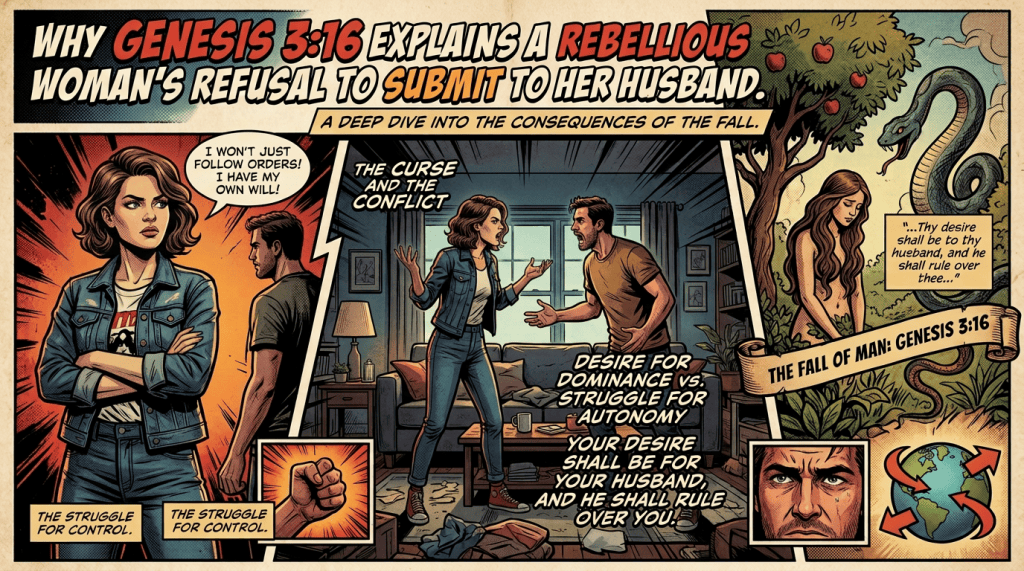
The refusal of wives to submit to their husbands is not a modern cultural accident or a reasonable response to imperfect men. It is the direct, predicted outworking of the judgment pronounced on the woman in Genesis 3:16 of the Bible: “thy desire shall be to thy husband, and he shall rule over thee.”
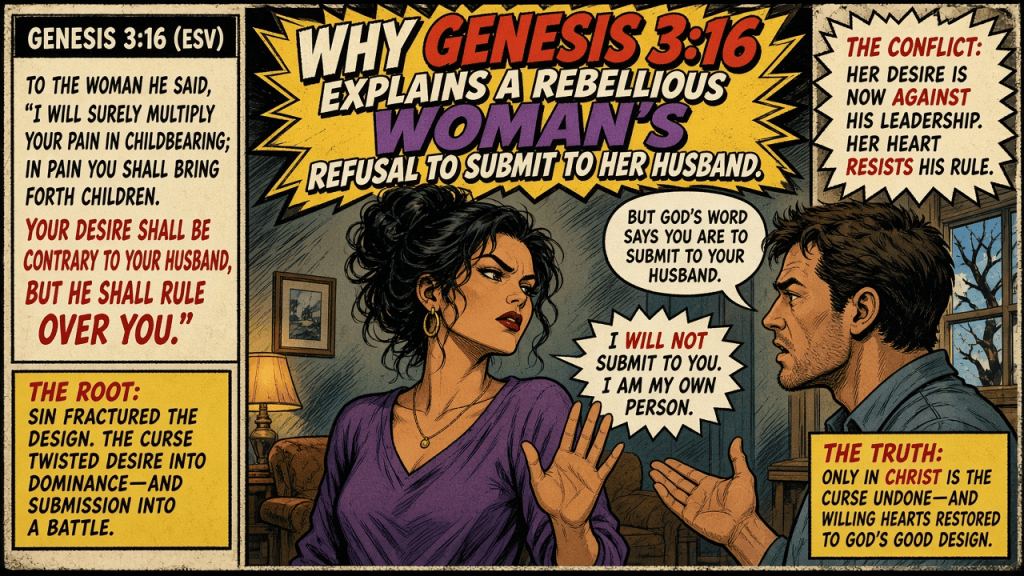
That verse does not describe mutual aspiration or romantic longing. The Hebrew construction is identical to the one used in Genesis 4:7, where the Lord tells Cain that sin’s “desire shall be to thee, and thou shalt rule over him.” The desire is the adversarial inclination to control, reverse, or master the other party.
After Eve saw that the tree was good for food, pleasant to the eyes, and to be desired to make one wise, she took of the fruit and ate, then gave also unto her husband with her, and he did eat (Genesis 3:6). God then addressed her personally and imposed the order that her desire would be toward her husband and that he would rule over her. The rebellious refusal of modern Christian women to obey that order is simply the desire continuing to operate unrestrained.
The creation narrative had already established the framework before the Fall. Adam was formed first; the woman was made from him as a help meet for him (Genesis 2:18–23). She was not an independent equal in authority. The serpent addressed her, she listened, she took, and she ate. The New Testament does not treat this as an incidental detail. First Timothy 2:11–14 commands that the woman learn in silence with all subjection, forbidding her to teach or to usurp authority over the man, and grounds the prohibition in two facts: Adam was first formed, then Eve, and Adam was not deceived, but the woman being deceived was in the transgression. The silence and the subjection are not temporary accommodations to culture. They are the ongoing application of the judgment that followed the woman’s specific act of rebellion.

Ephesians 5:22–24 states the command without qualification: “Wives, submit yourselves unto your own husbands, as unto the Lord. For the husband is the head of the wife, even as Christ is the head of the church: and he is the saviour of the body. Therefore as the church is subject unto Christ, so let the wives be to their own husbands in every thing.”
The analogy is absolute. The church does not submit to Christ only when He feels sufficiently “safe,” only when He is perceived as “rooted,” or only after He has first met a list of conditions drawn up by the subordinate. The text says “in every thing.” First Peter 3:1–6 requires the same subjection even when the husband “obey not the word,” so that the wife’s chaste conversation may win him, and it points to Sarah, who obeyed Abraham and called him lord.
The modern practice of adding terms—“I will submit if he is safe,” “if he is truly rooted in Christ,” “if he does not act like a dictator”—is not submission. It is the desire of Genesis 3:16 negotiating the terms under which the husband may be allowed to rule.
Proverbs 7 supplies the portrait of that desire in action. The strange woman is “loud and stubborn; her feet abide not in her house.” She is abroad, lying in wait at every corner, dressed in the attire of an harlot, subtil of heart. She catches the simple young man, kisses him with an impudent face, and flatters him with much fair speech until he yields and follows her to the chambers of death.
She even invokes religious observance—“I have peace offerings with me; this day have I payed my vows”—while her goodman is not at home. The loudness and the stubborn refusal to remain in the house are not personality traits. They are the practical rejection of the rule that Genesis 3:16 imposed. The same pattern appears when contemporary Christian women publicly declare that Ephesians 5 is “weaponized” whenever it is quoted without first rehearsing the husband’s duty to die to himself.
The text does not make the wife’s obedience contingent on the husband’s perfect performance. It places both commands side by side and requires the wife’s subjection “as the church is subject unto Christ.”

The churches that accommodate this refusal are repeating the error rebuked in Revelation 2:20. The church at Thyatira was condemned because it “sufferest that woman Jezebel, which calleth herself a prophetess, to teach and to seduce my servants to commit fornication, and to eat things sacrificed unto idols.”
Jezebel’s historical counterpart in 1 and 2 Kings promoted foreign gods, slaughtered the Lord’s prophets, and engineered the murder of Naboth so that the king’s desire could be satisfied. The modern counterpart is the systematic refusal to name the sins that cluster around the unruled desire: the initiation of the large majority of divorces, the withholding of the marital bed as leverage, the consumption of degrading entertainment, the quiet recourse to abortion, and the public redefinition of “submit in every thing” as optional or as legalism.
Pastors who will name a man’s pornography or failure to lead with precision, yet treat a wife’s refusal of Ephesians 5:22–24 as a mere reaction to his shortcomings, are practicing a respect of persons that Romans 2:11 forbids. Ezekiel 18:20 is unambiguous: “The soul that sinneth, it shall die.” The soul of the woman who will not submit is not excused by the imperfections of her husband.

The consequences follow the text. Luke 13:3 and 5 state that except men repent they shall all likewise perish. Revelation 2:21–23 records that space for repentance is given to the woman who teaches and seduces; when it is refused, she and those who commit adultery with her are cast into great tribulation.
Churches that remain silent so as not to offend the female majority of attendees and volunteers are not extending mercy. They are withholding the diagnosis that alone makes repentance possible. The result is the Laodicean condition of Revelation 3:16–17: a church that is neither cold nor hot, that says it is rich and increased with goods and has need of nothing, yet is wretched, miserable, poor, blind, and naked. When the whole counsel of God is no longer preached on the point that reverses the created order, the desire of Genesis 3:16 continues to operate inside the congregation itself.
The remedy is not further contextualization or additional conditions. It is the unsoftened recovery of the plain words. Eve took and ate. The desire was placed upon her. The husband was given the rule. The wife is commanded to submit in every thing as the church submits to Christ. The woman who is loud and stubborn and whose feet do not abide in her house leads the simple to death.

Until those sentences are spoken without qualification, without apology, and without the insertion of modern terms that empty them of force, the rebellious refusal will continue, and the souls that remain unrepentant will meet the judgment the text has already declared.





Leave a Reply