

The women who appear on platforms such as The Lila Rose Show, and the large majority of professing Christian women who share their assumptions, are not the godly women described in the rest of Scripture. They are the woman of Proverbs 7.
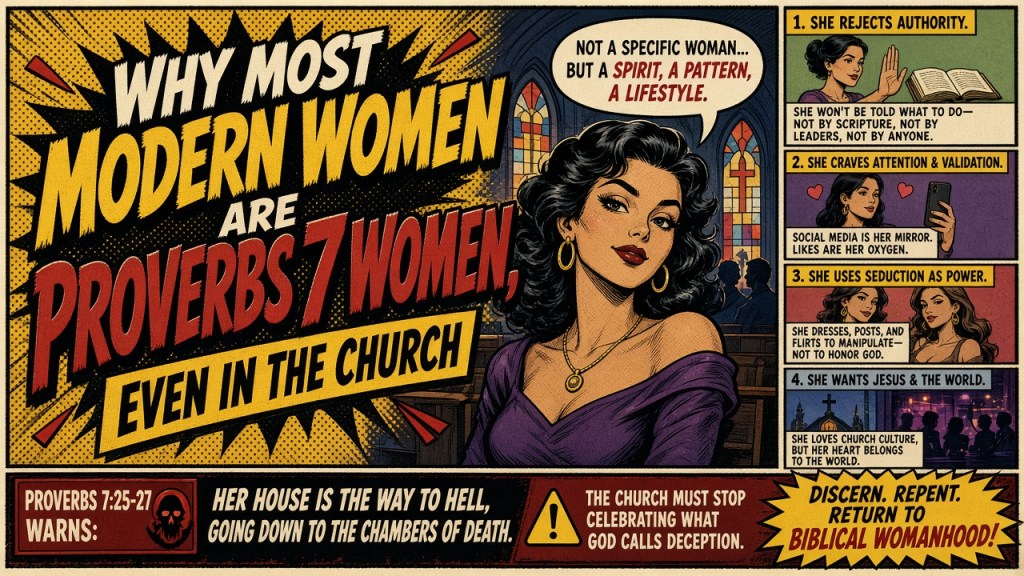
That chapter is not a narrow warning about street prostitutes. It is a precise portrait of the woman whose desire, fixed upon her by the judgment of Genesis 3:16, has never been ruled. She is loud and stubborn. Her feet do not abide in her house. She lies in wait, flatters with her words, and leads the simple to the chambers of death. The modern church has not confronted this woman. It has given her a microphone and called her a voice for the family.
Proverbs 7:10–12 supplies the description without ornament. The woman meets the young man “with the attire of an harlot, and subtil of heart.” The parenthetical judgment that follows is decisive: “She is loud and stubborn; her feet abide not in her house: Now is she without, now in the streets, and lieth in wait at every corner.” The Hebrew behind “loud and stubborn” denotes the woman who refuses restraint and makes a noise against the order of the house. She does not remain under the roof where her husband rules.
She is abroad, watching, ready to catch the one who is void of understanding. Her speech is the instrument. She catches him, kisses him with an impudent face, and with much fair speech causes him to yield (Proverbs 7:13, 21). She even invokes religious observance—“I have peace offerings with me; this day have I payed my vows”—while her goodman is not at home (Proverbs 7:14, 19).

The result is not mutual flourishing. The young man follows “as an ox goeth to the slaughter” until an arrow strikes through his liver and his life is lost. “Her house is the way to hell, going down to the chambers of death” (Proverbs 7:27).
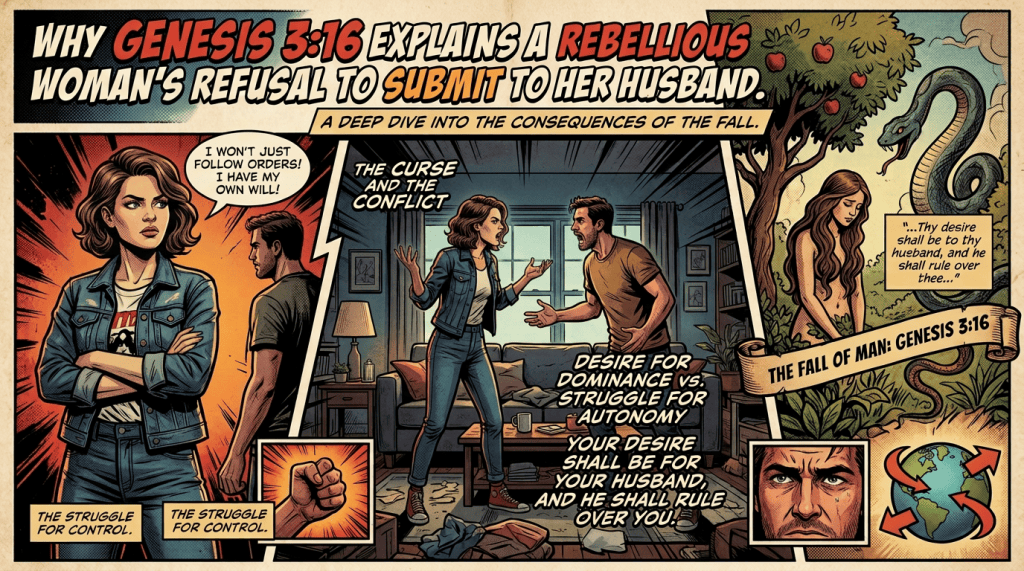
This is the woman produced by the unruled desire of Genesis 3:16. After Eve took of the fruit and ate, God declared that her desire would be to her husband and that he would rule over her. The parallel construction with Genesis 4:7 shows the desire as the inclination to master or reverse the other party’s place. The Proverbs 7 woman has never submitted to that rule. She is loud against it. Her feet will not stay where the husband is head. She uses flattering speech—including the language of piety—to reverse the order and draw the simple after her.
The New Testament does not leave this portrait in the Old Testament. Ephesians 5:22–24 requires the wife to submit to her own husband as unto the Lord, in every thing, as the church is subject unto Christ. First Timothy 2:11–14 forbids her to usurp authority and grounds the prohibition in the creation order and in the fact that the woman, being deceived, was in the transgression. The woman who will not remain in the house under that order is the woman Proverbs 7 describes.

The women on The Lila Rose Show embody the portrait with unusual clarity. One speaker states that women “long to submit” and “would love to submit” if they have “a safe man that’s like got our back and he’s safe,” and “when a man is truly rooted in Christ.” She immediately adds the caveat that if he is not truly rooted in Christ, “that’s where submission gets really messy.”
Another affirms that submission is beautiful yet insists that Ephesians 5 is “weaponized” whenever people speak of the wife’s duty without first rehearsing the husband’s call to die to himself. A third rejects the idea that the husband is “the dictator” and that she is “just supposed to be in the kitchen.” The plain words “in every thing” are treated as a distortion introduced by the world. These are not the statements of women whose feet abide in their houses. They are the statements of women who have already decided the conditions under which the husband may be allowed to rule, and who will publicly correct any man who quotes the text without those conditions.
The speech is fair. It invokes Christ, safety, and the beauty of submission. It is also the flattering speech that causes the simple to yield. The goodman is not at home in the sense that the husband’s headship has already been set aside by the terms the women themselves have written.
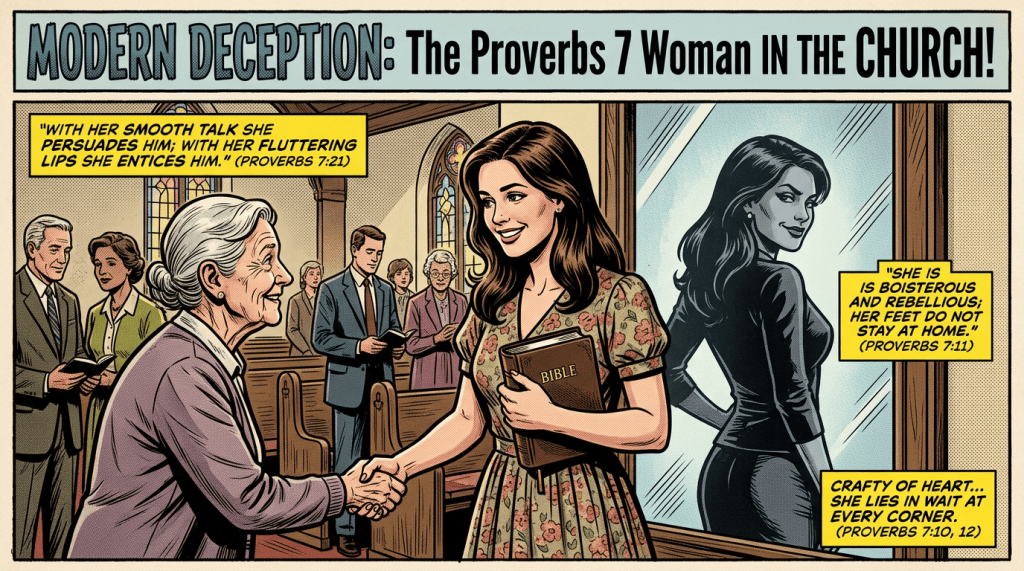
The same pattern governs the larger evangelical world that celebrates such voices. Women who refuse to submit “as the church is subject unto Christ” are not called loud and stubborn. They are called strong, discerning, or protective of the family. Pastors who will name a man’s failure to lead with precision remain silent when a wife withholds the marital bed, initiates divorce, or declares that Ephesians 5 applies only when the husband first meets her standard of safety and spiritual rooting.
The church at Thyatira was rebuked for suffering the woman who called herself a prophetess and taught and seduced Christ’s servants to commit fornication and to eat things sacrificed unto idols (Revelation 2:20). The modern church suffers the woman who calls herself a defender of marriage while teaching that the wife’s subjection is conditional. The religious language is present. The peace offerings have been paid. The goodman is absent from the actual authority of the house. The simple young men who listen are being led toward the same chambers of death.
A godly woman is the opposite of this portrait. She is the woman of Proverbs 31 whose husband is known in the gates because she does him good and not evil all the days of her life, whose feet remain occupied with the work of the household, and whose mouth is open with wisdom rather than with the flattery that reverses order. She is the wife of 1 Peter 3 who is in subjection even when the husband does not obey the word, who possesses a meek and quiet spirit of great price in the sight of God, and who follows the example of Sarah, who obeyed Abraham and called him lord.
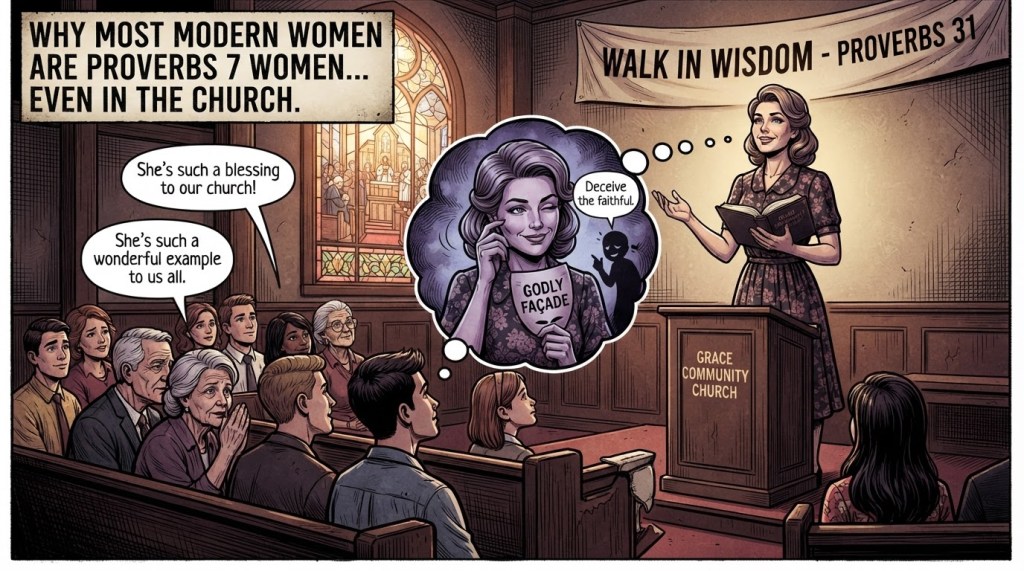
She is the older woman of Titus 2 who teaches the younger women to be obedient to their own husbands so that the word of God be not blasphemed. She does not add conditions. She does not call the command weaponized. She does not leave the house to lie in wait with fair speech. Her feet abide where her husband rules because the desire of Genesis 3:16 has been brought under that rule.
Most modern women in the church are not this woman. They are the woman of Proverbs 7. They are loud against the order that requires their subjection in every thing. Their feet do not abide in the house under their husband’s headship; they are without, in the streets of social media and conference platforms, lying in wait with the language of safety and mutuality. They flatter the simple with the claim that submission is beautiful only when the man first satisfies their assessment of his worthiness. They invoke the name of Christ while emptying the command of its force.
The result is the same as the proverb records. Strong men are drawn after them. Marriages end. The word of God is blasphemed. The house that should have been the place of order becomes the way to hell.

The text does not offer a softer reading for the feelings of those who fit the description. It offers a warning and a command. Keep the father’s words. Write them upon the table of the heart. They are given to keep the hearer from the strange woman who is loud and stubborn and whose feet do not abide in her house. Until the church stops celebrating that woman and starts naming her, the simple will continue to follow her, and her house will continue to be the way to the chambers of death.




Leave a Reply