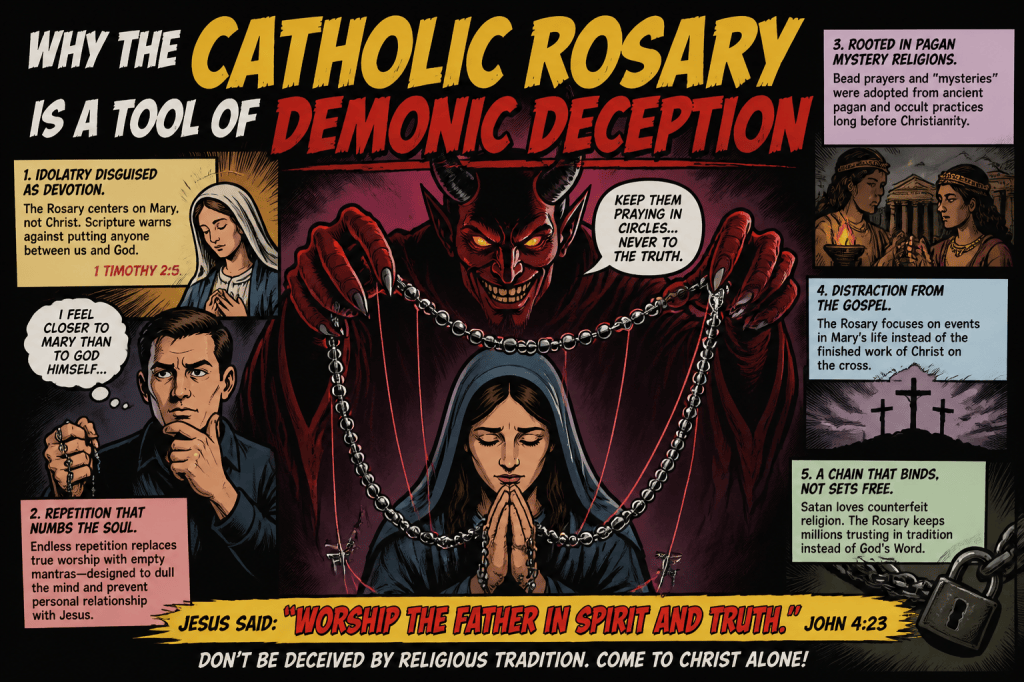
The Catholic Rosary is not a harmless devotion. Judged by the literal standard of the Bible, it is a structured instrument of false worship that diverts prayer, mediation, and glory from the one true God and His Son.
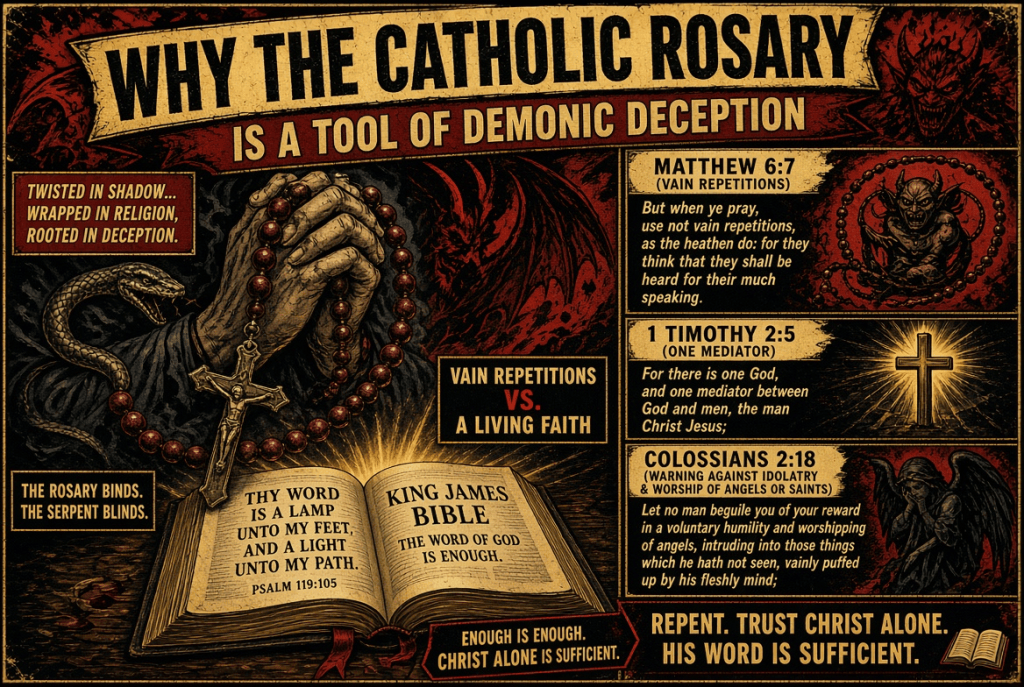
Its popular promotion rests on legendary origins and a pattern of post-biblical Marian apparitions that match Scripture’s warnings about Satan transforming himself into an angel of light.
The classic origin story claims that in 1208, while St. Dominic labored against the Albigensian heresy, the Virgin Mary appeared and handed him the Rosary as a spiritual weapon. This narrative has no contemporary support. Dominic’s early biographies, the acts of his canonization, and 13th-century Dominican sources are silent on any such event. The tale surfaces primarily in the 15th century through the Dominican promoter Alan de la Roche, centuries after Dominic’s death.
What actually developed was a gradual medieval practice of counting repetitive prayers—often Hail Marys—as a lay substitute for the 150 Psalms. The structured modern Rosary, with its mysteries and systematic decades, emerged later still. The 1208 claim is pious legend, not history. When an origin story depends on a purported heavenly appearance that cannot be historically verified, it already sits outside the biblical pattern of public, verifiable revelation given through prophets and apostles.
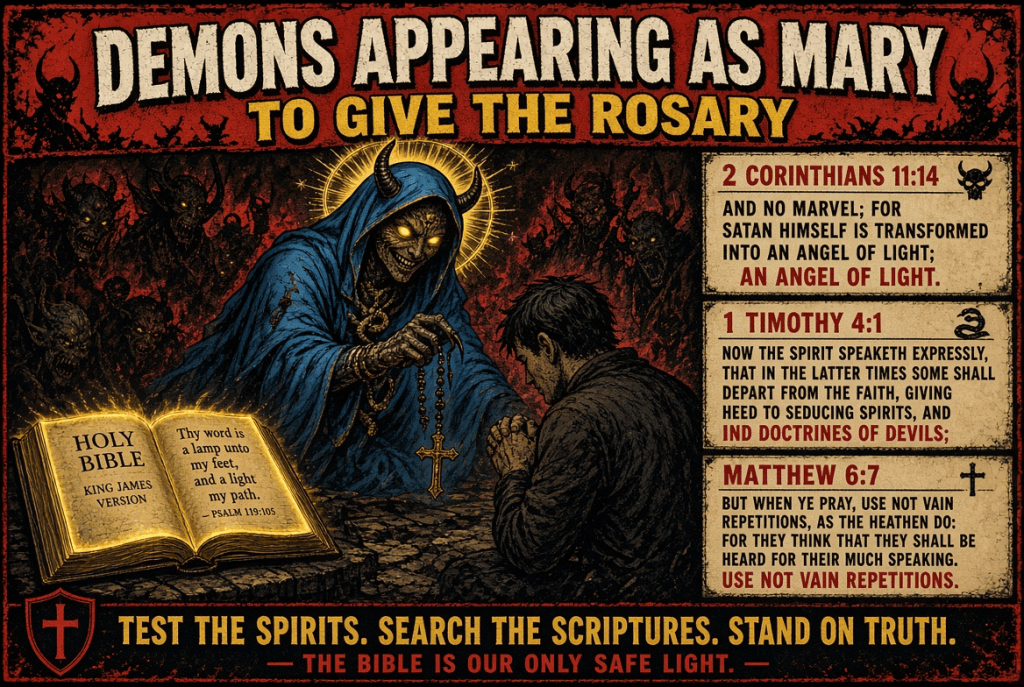
Later apparitions that explicitly champion the Rosary follow the same pattern. At Fatima in 1917, three children reported visions of a radiant “Lady” who identified herself as the Lady of the Rosary. She commanded daily recitation of the Rosary “in honor of Our Lady of the Rosary, in order to obtain peace for the world and the end of the war for she alone can help.” The messages asserted that God wishes to establish devotion to her Immaculate Heart, that this heart would triumph, and that the consecration of Russia to it—together with Five First Saturdays of reparation involving the Rosary—would bring conversion and peace.
Failure would bring wars, persecutions, and the annihilation of nations. A public “Miracle of the Sun” was offered as confirmation. The phenomenon was local, accounts of what was seen were inconsistent, and no astronomical observatories recorded any deviation in the sun. Psychological and optical explanations—prolonged staring at the solar disk, suggestion, and crowd expectation—account for the reports. Even if the sign were granted, Deuteronomy 13 warns that a sign that comes to pass does not validate a message promoting false worship.
The Immaculate Heart itself has no biblical warrant. Catholic teaching links it to the dogma of the Immaculate Conception, asserting that Mary was preserved from original sin and free from personal sin. Scripture records the opposite. Mary rejoiced in “God my Saviour” (Luke 1:47). “All have sinned, and come short of the glory of God” (Romans 3:23). Only Christ is the sinless one. Devotion that treats Mary’s heart as an object of reparation, consecration, and effective mediation for the salvation of souls and the conversion of nations assigns to a creature what belongs solely to Christ. “There is one God, and one mediator between God and men, the man Christ Jesus” (1 Timothy 2:5). Promises of assistance at the hour of death with the graces necessary for salvation, conditioned on First Saturdays and the Rosary, constitute another gospel.

Kibeho in Rwanda (1981–1989) continued the pattern. Approved visionaries reported a woman identifying as the Mother of the Word who urgently called for repentance while commanding regular prayer of the Rosary and the Chaplet of the Seven Sorrows. She is said to have taught or reintroduced the Seven Sorrows chaplet, promising that those who recite it while meditating would receive the strength to repent and other graces. A shared vision of a river of blood and unburied bodies was later read as a foreshadowing of the 1994 genocide.
Again the message centers on Marian devotion, repetitive prayer, and suffering as necessary for heaven. Again Scripture’s test is decisive: even a dramatic vision does not authorize a message that adds mediators and rituals.
Across these episodes the biblical prohibitions are consistent and explicit. Jesus forbade vain repetitions “as the heathen do: for they think that they shall be heard for their much speaking” (Matthew 6:7). The Rosary’s counted decades of Hail Marys are precisely such repetitions. Prayer is to be directed to the Father through Christ (Matthew 6:9; John 14:6, 13–14; Hebrews 4:14–16). The dead “know not any thing” in the relevant sense (Ecclesiastes 9:5); seeking contact with them is forbidden (Deuteronomy 18:10–11). The Lord declares, “my glory will I not give to another” (Isaiah 42:8).
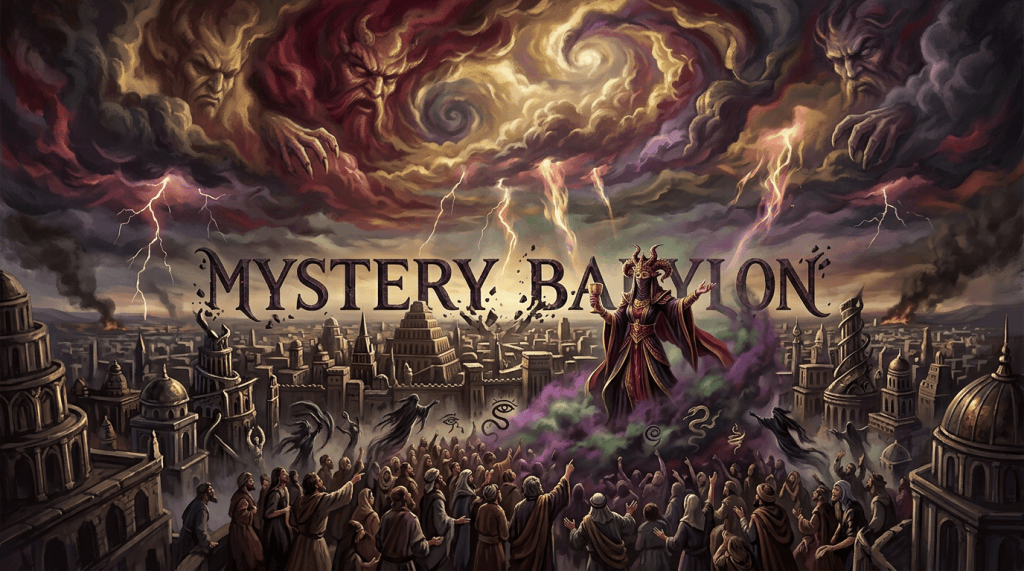
Paul warned that in the latter times some would depart from the faith, giving heed to seducing spirits and doctrines of devils (1 Timothy 4:1). Satan’s ministers transform themselves into ministers of righteousness, and Satan himself appears as an angel of light (2 Corinthians 11:13–15). The radiant Lady, the exaltation of Mary’s heart and sorrows, the tying of peace and salvation to specific objects and practices, and the promotion of another mediator all fit this pattern.
There is no countervailing biblical evidence. The New Testament contains no command, example, or institution of prayer to Mary, of counted beads, or of a structured sequence of Marian decades. The biblical Mary pointed people to her Son and needed a Saviour. The apostles prayed to God through Christ. The early church has no record of the Rosary. Its medieval development and later promotion through apparitions therefore stand as human tradition that nullifies the word of God (Mark 7:13).
The practical result is false worship. Millions of sincere people are taught that repeated petitions to Mary, consecration to her heart, and reparation for offenses against her are means of grace, peace, and salvation. This displaces the sole sufficiency of Christ’s finished work and the direct access believers have to the Father through Him. It multiplies mediators, objects, and conditions that Scripture never authorized. When such practices are recommended by claimed heavenly appearances that contradict the written Word, the biblical diagnosis is demonic deception.
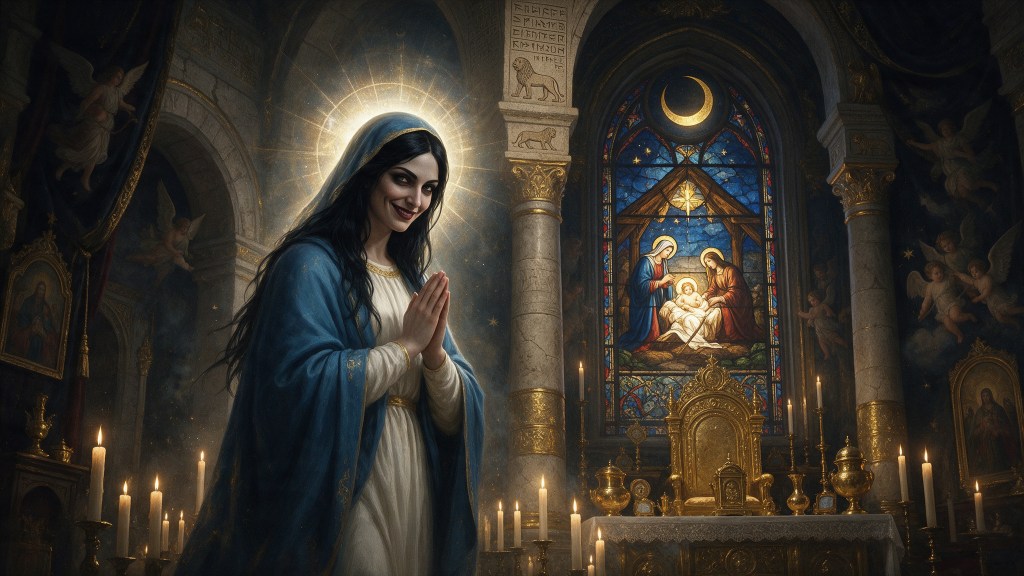
The remedy is not reform of the Rosary but rejection of it. Scripture calls believers to test all spirits and all messages by the written Word (1 John 4:1; 1 Thessalonians 5:21). It commands prayer to the Father in the name of Jesus. It insists on one Mediator. It warns against adding to the gospel. Those who have been drawn into these practices are invited to come out of the system that promotes them and to rest solely in the finished work of Christ. The Bible supplies the standard; by that standard the Rosary fails.



Leave a Reply