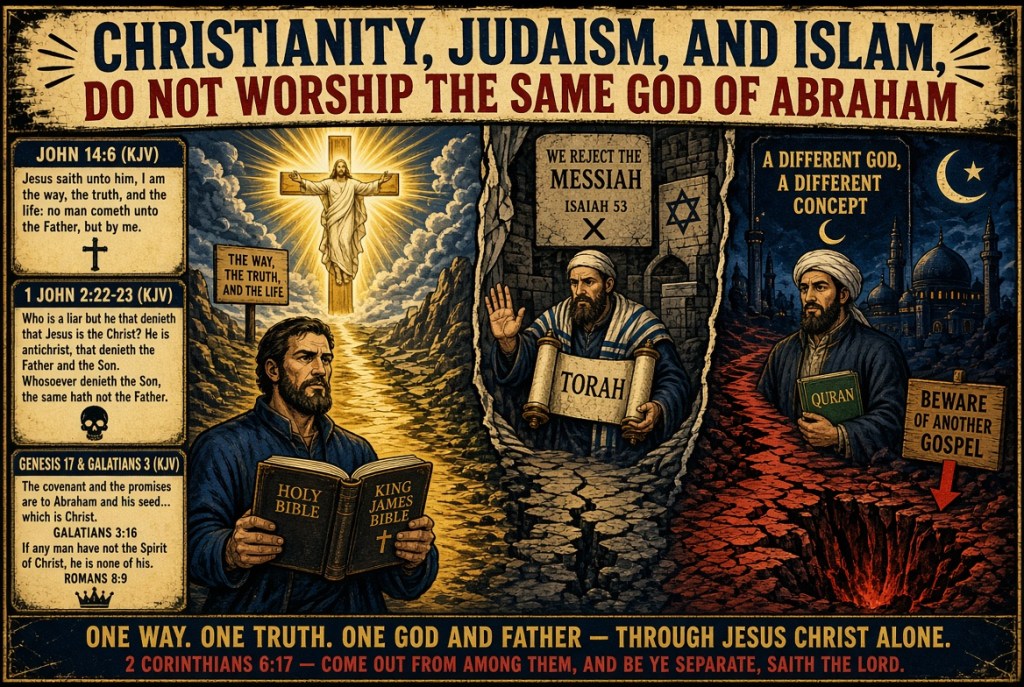
The modern insistence that Christianity, Judaism, and Islam constitute a shared “Abrahamic” family of faiths, all worshiping the same God of Abraham, is one of the more persistent and consequential deceptions of contemporary public discourse.
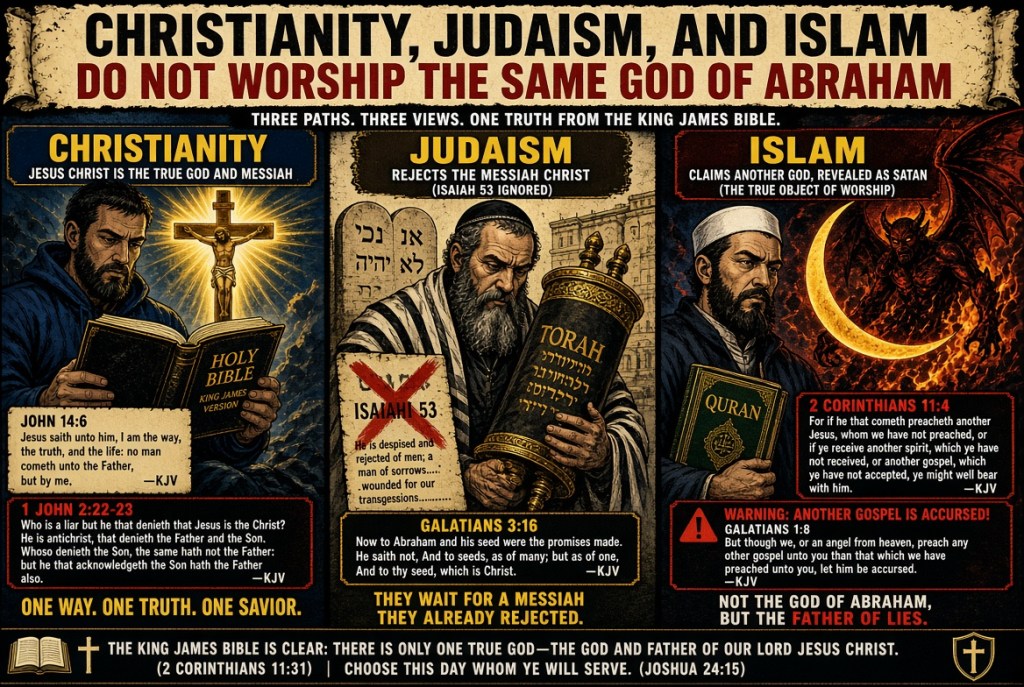
It is repeated in interfaith conferences, academic panels, and political speeches as though it were a self-evident historical fact rather than a theological claim that collapses under the weight of the texts each tradition actually affirms. When those texts are measured against the Bible—the standard the conversation has insisted upon—the differences are not peripheral. They concern the identity of God Himself.
The God of Abraham is not an abstract monotheistic principle. In the biblical record He identifies Himself repeatedly as “the God of Abraham, the God of Isaac, and the God of Jacob” (Exodus 3:6, 15). The covenant that defines His relationship to Abraham’s seed is established specifically with Isaac, not with Ishmael. Genesis 17:19–21 records the Lord’s direct response to Abraham’s plea for Ishmael: Sarah will bear a son named Isaac, and “I will establish my covenant with him for an everlasting covenant, and with his seed after him.” Ishmael is blessed and becomes a great nation, but the covenant line runs through Isaac.
The New Testament identifies that Seed as Christ (Galatians 3:16). The same God is further identified as the Father who “hath glorified his Son Jesus” (Acts 3:13). Jesus’ own statement is unambiguous: “no man cometh unto the Father, but by me” (John 14:6).
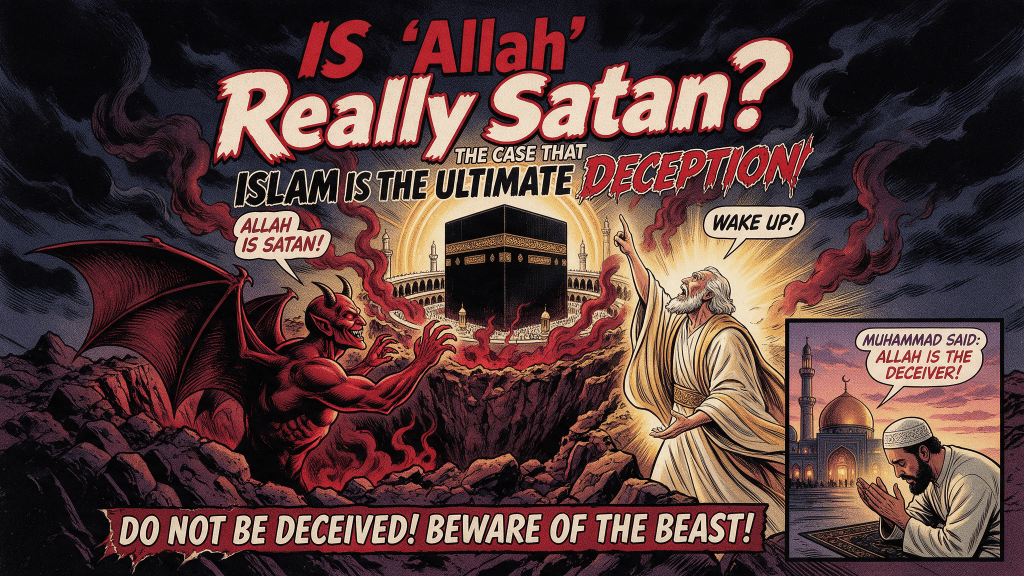
The apostolic test for whether a teaching is of this God is equally clear. “Who is a liar but he that denieth that Jesus is the Christ? He is antichrist, that denieth the Father and the Son” (1 John 2:22). “Every spirit that confesseth not that Jesus Christ is come in the flesh is not of God: and this is that spirit of antichrist” (1 John 4:3). These are not later ecclesiastical elaborations; they are first-century criteria applied to the claim that any system which systematically denies the Son can still be said to worship the Father of that Son.
Judaism, in its post-first-century form, fails this test by the plain record of the Gospels. The Pharisees, who “sit in Moses’ seat” (Matthew 23:2), functioned as the decisive religious authorities of the period. When Jesus claimed, “I and my Father are one” (John 10:30) and applied the divine name to Himself—“Before Abraham was, I am” (John 8:58)—they charged Him with blasphemy on the basis of Deuteronomy 6:4. They dismissed His miracles as the work of Beelzebub (Matthew 12:24), condemned Sabbath healings as violations of oral tradition (John 9:16), and enforced social exclusion against those who confessed Him: “if any man did confess that he was Christ, he should be put out of the synagogue” (John 9:22).
Jesus’ assessment was that they searched the Scriptures yet would not come to Him for life (John 5:39–40).
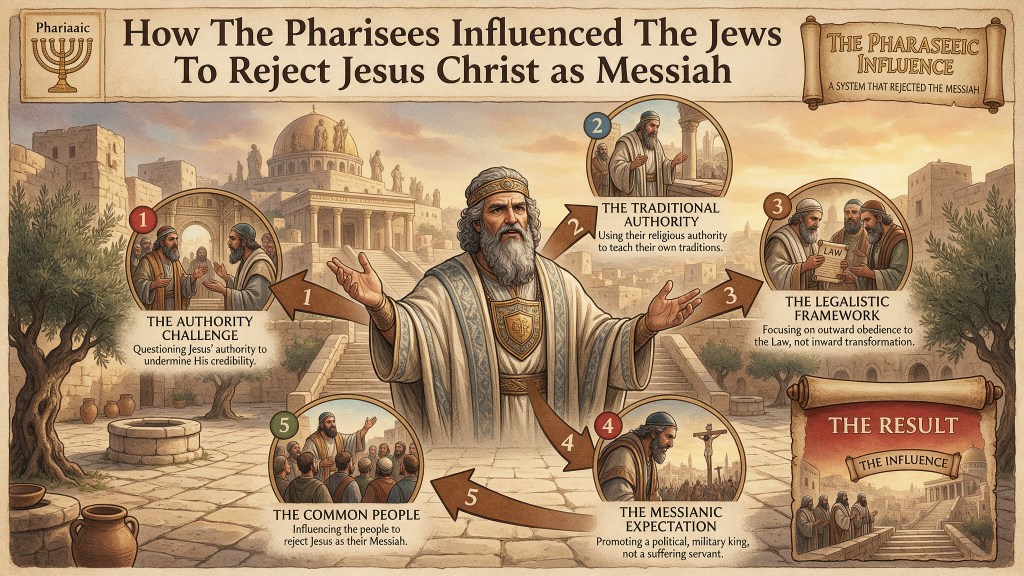
After the destruction of the Temple in 70 A.D., the Pharisaic emphasis on oral tradition and synagogue authority became the foundation of Rabbinic Judaism. That tradition continues to await a future Messiah and rejects the Jesus of the Gospels. Romans 11 describes the resulting condition as a partial hardening—“Israel hath not obtained that which he seeketh for; but the election hath obtained it, and the rest were blinded” (Romans 11:7)—while affirming that God has not permanently cast away His people.
The biblical text therefore treats the rejection as real and consequential. A system that retains the name of the God of Abraham while permanently refusing the Son that God glorified does not, by the New Testament’s own standard, have the Father (1 John 2:23).
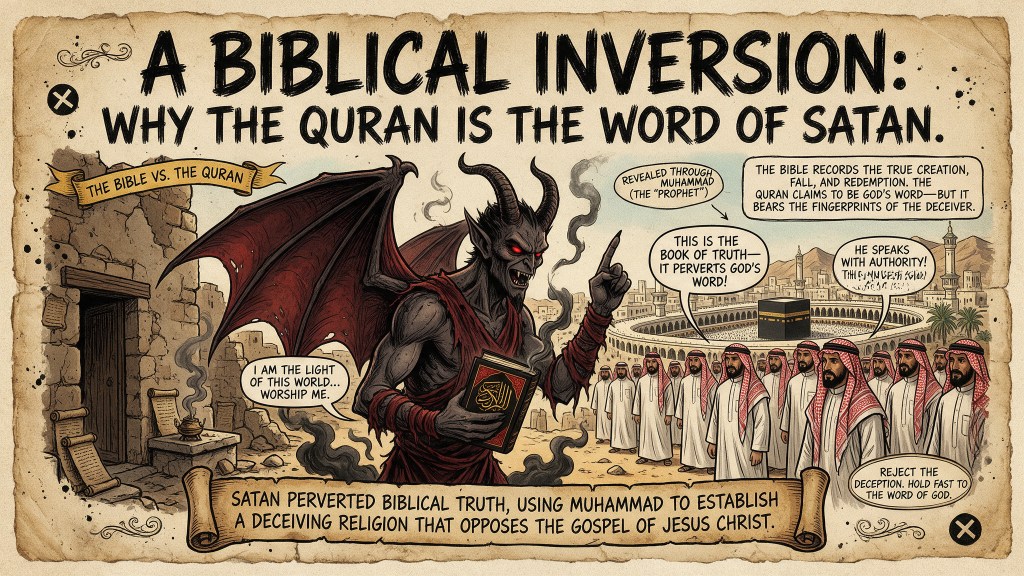
Islam fails the same tests more explicitly and adds further contradictions. The Quran states that Jesus was not crucified—“they slew him not, neither crucified him” (Surah 4:157)—and that He was only a messenger, not the divine Son (Surah 5:75). Surah 112:3 affirms that Allah “neither begets nor is begotten.” These statements are not minor variations; they are the precise denials John identifies as the spirit of antichrist. Islamic tradition further relocates the near-sacrifice of Genesis 22 from Isaac to Ishmael, inverting the covenant line God named in Genesis 17.
The early accounts of Muhammad’s encounter with the entity identified as Jibreel describe a violent, crushing appearance that produced terror and thoughts of suicide—contrasting sharply with the peaceful biblical angelic announcements (Daniel 9:21; Luke 1:26–38).
The pre-Islamic history of the Kaaba, including its association with Hubal and the retention of the Black Stone, is documented in early Islamic sources themselves. These elements do not establish continuity with the God of Abraham; they establish a different object of worship.
The site’s recent essays have argued, on the basis of these textual and historical points, that the entity called Allah corresponds to the Dragon of Revelation 12:9 and that Islam supplies the religious architecture of the antichrist system described in Revelation 13—a political ruler, a false prophetic enforcer, a speaking image, and a marking mechanism. Whether every eschatological parallel is exact is a separate interpretive question.
What is not in dispute is that Islam’s foundational texts deny the Son, the crucifixion, and the Isaac covenant while claiming the Abrahamic title. A system that does so cannot be the God who established that covenant and glorified His Son.
The claim that the three religions worship the same God therefore rests on a shared historical name rather than on shared doctrinal content. The biblical God of Abraham is the one who chose Isaac, promised a Seed identified as Christ, and is the Father of the Lord Jesus Christ who came in the flesh, died, and rose.
Judaism retains the Old Testament name but rejects the Son. Islam retains the name while explicitly denying the Son, the cross, the resurrection, and the Isaac line, and while presenting a different origin story for its revelation. Neither meets the tests the New Testament itself supplies for recognizing the Father.This is not a minor ecumenical quibble.
It is a question of whether public discourse will continue to treat as interchangeable three systems whose core claims about God are mutually exclusive when measured by the texts they each profess to honor. The Bible does not support the interchangeability.
The God it reveals is not the God of a system that denies His Son, nor the God of a system that relocates His covenant and denies the events by which that Son was glorified. The insistence otherwise is a deception that collapses the moment the actual documents are read.


Leave a Reply