

Jamal Harrison Bryant stands in the pulpit of New Birth Missionary Baptist Church in Stonecrest, Georgia, and tells people he is feeding them Christ. What he actually feeds them is a racially reconstructed figure who spent most of his life “wrong,” a gospel that changes meaning according to skin color, and open honor for a movement that denies the deity of Jesus.
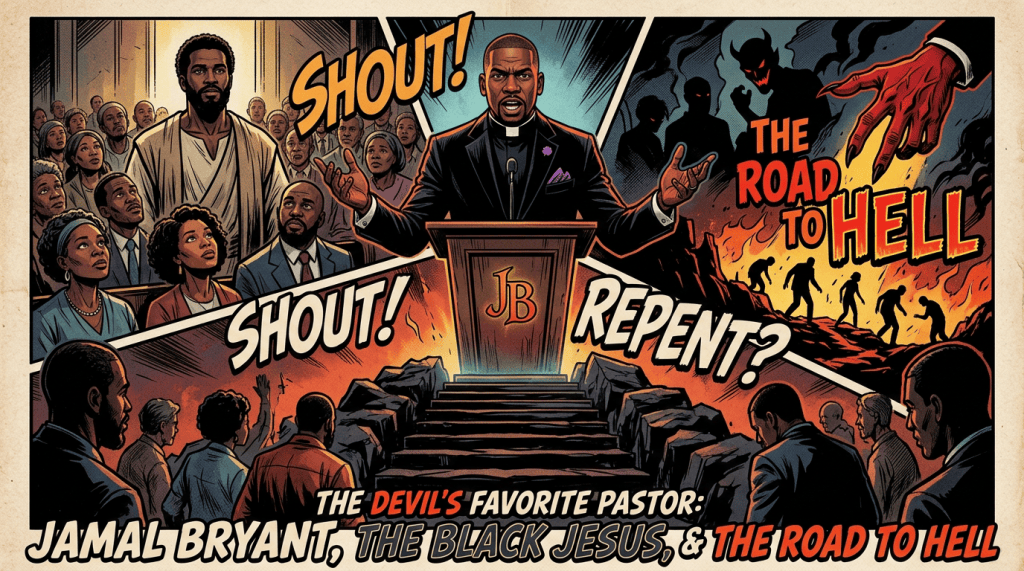
This is not a difference of emphasis. It is the substitution of another Jesus and another gospel. Scripture is not ambiguous about the result. Those who preach or receive a different gospel stand under anathema, and those who practice the works of the flesh—hatred, variance, strife, heresies—shall not inherit the kingdom of God.
Begin with Bryant’s own description of the Savior. In a 2019 sermon, he said, “At the risk of being heretical tonight, might I suggest to you, that 85% of Jesus’s life, He was out of order.” He continued: “Eighty-five percent of His life He was doing what He was not called to do.” Then: “For 85 percent of his life, he was not flowing in his God-given function. Eighty-five percent of His life, He is doing what His natural father wanted. But it did not line up with His defined DNA. Eighty-five percent of His life He’s anointed. He’s called. He’s chosen. And He’s wrong.”
That is not a bold illustration. It is a direct assault on the biblical Christ. The New Testament presents one who “knew no sin” (2 Corinthians 5:21), “who did no sin, neither was guile found in his mouth” (1 Peter 2:22), who was “in all points tempted like as we are, yet without sin” (Hebrews 4:15), and who said, “I do always those things that please him” (John 8:29). He is “holy, harmless, undefiled, separate from sinners” (Hebrews 7:26). A Christ who was substantially “wrong” and “out of order” for the bulk of his life cannot be the Lamb without blemish whose blood alone redeems.
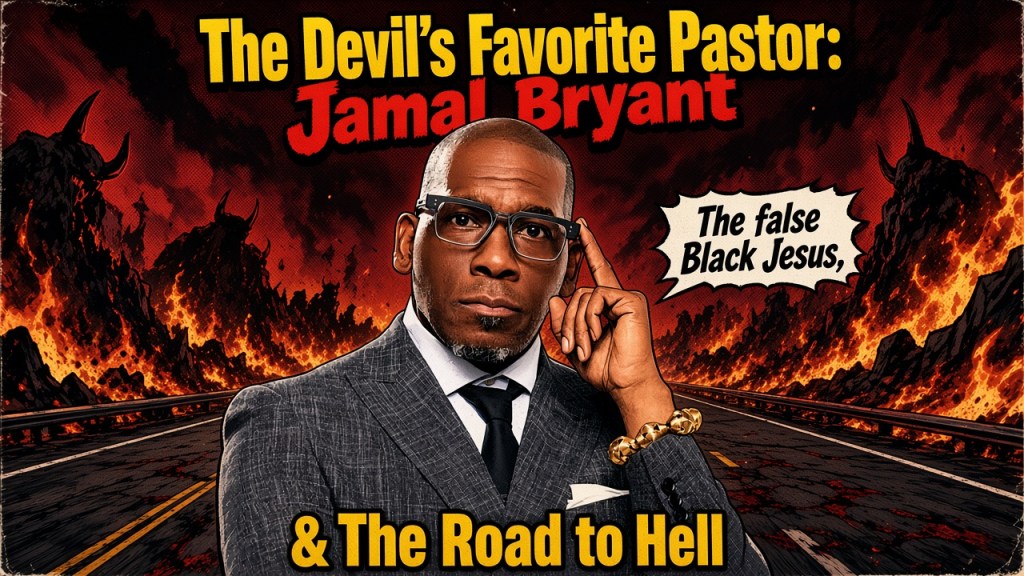
Bryant’s statement does not merely risk damnable heresy; it enacts it. Once the perfection of Christ’s life is denied, the substitutionary atonement collapses. There is no longer a sinless sacrifice. There is only a flawed man whose death cannot reconcile anyone to God.
Bryant compounds the error by racializing the same figure. Content he has platformed asserts, in the words of Black womanist theologian Jacquelyn Grant, that “a white woman’s Christ is a black woman’s Jesus,” arguing that the name conceals fundamentally different realities once race is applied. He has described American Christianity as “crafted in the image of whiteness” and spoken of two different Christianities.
Jesus is recast as an oppressed Black man whose experience is read primarily through contemporary racial grievance—arrested without a fair trial, identified with “the least of these” understood as a racial category. These are not historical notes about a first-century Jew. They are theological claims that the meaning of Christ shifts according to the race of the hearer.
Scripture forbids the move. “There is neither Jew nor Greek, there is neither bond nor free, there is neither male nor female: for ye are all one in Christ Jesus” (Galatians 3:28). God “hath made of one blood all nations of men for to dwell on all the face of the earth” (Acts 17:26). The church is one body in which ethnic distinctions do not determine standing or the content of the gospel (Colossians 3:11; Ephesians 2:14–16). Partiality is sin: “If ye have respect to persons, ye commit sin, and are convinced of the law as transgressors” (James 2:9).

When a pastor teaches that the Christ of the Bible is effectively different for Black and White believers, he is not applying the gospel. He is replacing it with a racially particular idol. That idol cannot save, because it is not the Jesus who is “the same yesterday, and to day, and for ever” (Hebrews 13:8).The racial filter does not stop at Christology. It governs Bryant’s treatment of other people who claim the name of Christ.
He has referred to Black supporters of conservative figures as “coons” and “tap-dancing negroes,” language that reduces fellow human beings—and in many cases fellow believers—to racial traitors. In one sermon he said, “I feel bad for them coons in the White House who are in there tap dancing for massah, wearing bow ties shimmying and grinding, laughing like nothin’ is funny.” He has argued that the only thing Charlie Kirk and Martin Luther King Jr. had in common was that “both of them was killed by white men,” dismissing any comparison of ideas or actions in favor of a skin-color reading of their deaths.
This is not prophetic speech. It is the works of the flesh: hatred, variance, emulations, wrath, and strife (Galatians 5:19–21). Those who practice such things “shall not inherit the kingdom of God.” The same standard that condemns partiality in James 2 condemns the reduction of people to racial categories in the pulpit. Bryant’s rhetoric does not rebuke the flesh; it baptizes it.
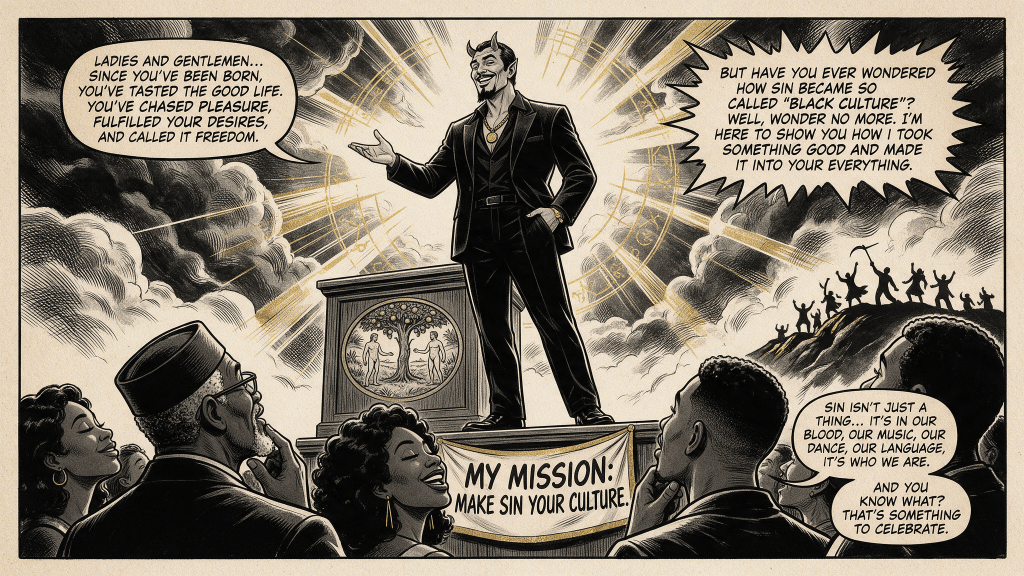
At the same time, he has extended public honor to Louis Farrakhan and the Nation of Islam. Introducing Farrakhan, Bryant said, “We welcome to the Word Network and the entire world, the honorable Minister Louis Farrakhan! We’re honored to have you, sir. I’m so appreciative to be able to mark in history that I lived in the same chasm of time as one of the greatest leaders of our people.”
He has repeated versions of the claim that “the success of the Nation of Islam is built on the failure of the black church,” framing the NOI as a corrective for the church’s shortcomings with men. The Nation of Islam teaches that God is a Black man, that the White race was engineered by a scientist named Yakub, and that Christianity is the religion of the oppressor. These are not cultural footnotes. They are explicit denials that Jesus Christ is the eternal Son of God come in the flesh (1 John 2:22; 4:1–3; 2 John 7). “Whosoever transgresseth, and abideth not in the doctrine of Christ, hath not God” (2 John 9). To call the leader of such a system “one of the greatest leaders of our people” while claiming to preach Christ is not bridge-building. It is the platforming of a false gospel.
The pattern is consistent. Bryant presents a Jesus who was largely “wrong,” then racializes that Jesus so that his significance depends on the hearer’s ethnicity, then uses racial categories to attack other Christians, and then honors a movement that denies the deity of the very Christ he claims to preach. Each step contradicts the plain text. The perfection of Christ is denied (Hebrews 4:15; 1 Peter 2:22). The unity of the body is denied (Galatians 3:28). Partiality is practiced (James 2:1–9). Fellowship is extended to those who do not abide in the doctrine of Christ (2 John 9–11). And the works of the flesh—hatred and variance—are not only present but celebrated as prophetic.

Scripture is clear about the destination of another gospel. “But though we, or an angel from heaven, preach any other gospel unto you than that which we have preached unto you, let him be accursed. As we said before, so say I now again, If any man preach any other gospel unto you than that ye have received, let him be accursed” (Galatians 1:8–9). The warning in 2 Timothy 4:3–4 describes the people who will not endure sound doctrine but will “heap to themselves teachers, having itching ears,” and will be “turned unto fables.”
New Birth has remained a large congregation under Bryant’s leadership, with an emphasis on social justice, economic empowerment, and culturally relevant worship. These elements from a progressive lens cannot exist without error. When they are joined to a Christ who was substantially “wrong,” a racially differentiated gospel, and honor for systems that deny Christ’s person, the result is the accumulation of teachers who scratch the desire for identity affirmation rather than the demand for repentance and faith in the sinless Savior.
The members who continue under this teaching are not exempt from the test of spirits (1 John 4:1). The consistent choice to remain is itself evidence of the condition the apostle described.

None of this requires denying historical injustices or the pastoral needs of any community. It does require recognizing that the remedy is not a racially particular Jesus. The remedy is the Christ who is fully God and fully man, without sin in any part of his life, the exclusive mediator for every tribe and tongue (1 Timothy 2:5; Acts 4:12).
When that Christ is replaced by one who was “wrong” for most of his life and whose primary relevance is racial, the church is no longer offering salvation. It is offering a culturally tailored idol. The New Testament’s language for such a substitution is not gentle. It is anathema. It is exclusion from the kingdom. It is the warning that false teachers and those who follow them are on a path that does not lead to life.
Bryant’s public record shows a sustained pattern of undermining the perfection of Christ, racializing the gospel, practicing partiality, and platforming systems that deny the doctrine of Christ. That pattern matches the biblical description of false teaching that leads people away from the only Savior who can deliver them. The people who sit under it deserve better than a false Jesus constructed from racial grievance and doctrinal compromise.

They deserve the Christ who knew no sin, who died for sinners of every nation, and who requires no ethnic filter to be known and received. Anything less is not pastoral care. It is, by the Bible’s own terms, a path that leads to destruction.





Leave a Reply