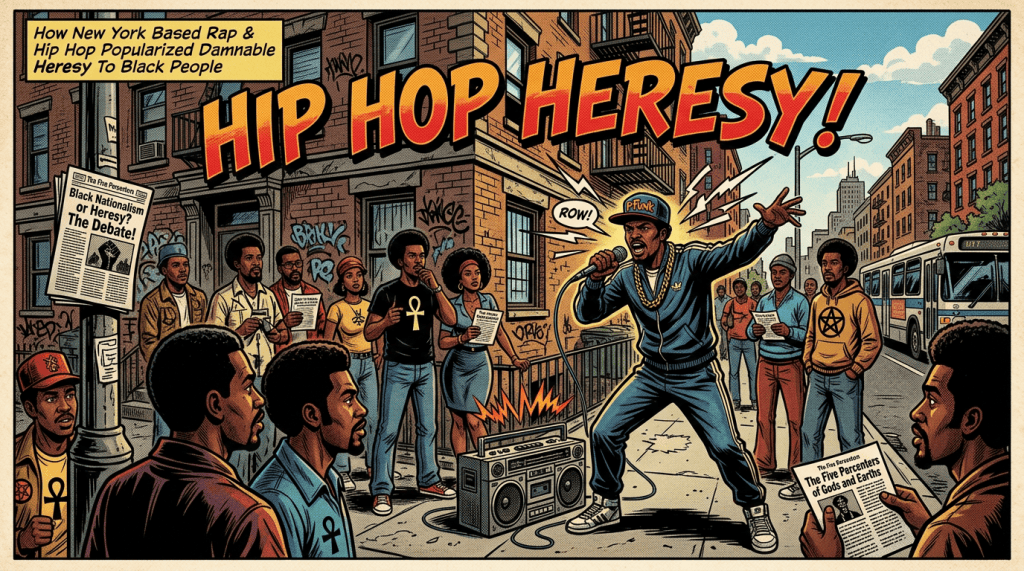
The Nation of Islam’s assault on the historic Black church began in Detroit storefronts and Chicago temples in the 1930s. It reached its widest audience decades later through the recording studios and street corners of New York City.

What had been a fringe racial mythology—whites as engineered devils, the Black man as God, Christianity as a slave religion, and the biblical Jesus as a failed prophet—became, by the late 1980s, the soundtrack of a generation. New York rap did not merely echo the Nation of Islam. It translated its core heresies into slang, samples, and self-understanding that millions of young Black Americans absorbed before they ever heard a contrary word from Scripture.
Hip-hop itself was born in the Bronx and Harlem. From its earliest years it overlapped with the Nation of Islam and its more street-oriented offshoot, the Five Percent Nation. Clarence 13X, a former member of Harlem’s Temple No. 7, left the Nation of Islam and took its Supreme Wisdom Lessons into the parks and housing projects. He taught that the Black man is God, that the white race is the devil, and that “knowledge of self” is the key to liberation. Those lessons circulated among the same young men who were building the sound systems and writing the rhymes that would become commercial hip-hop. The phrase “word is bond,” now ubiquitous in rap, derives from the catechism of Master W. Fard Muhammad. “Knowledge of self” moved from mosque study sessions to album credits.
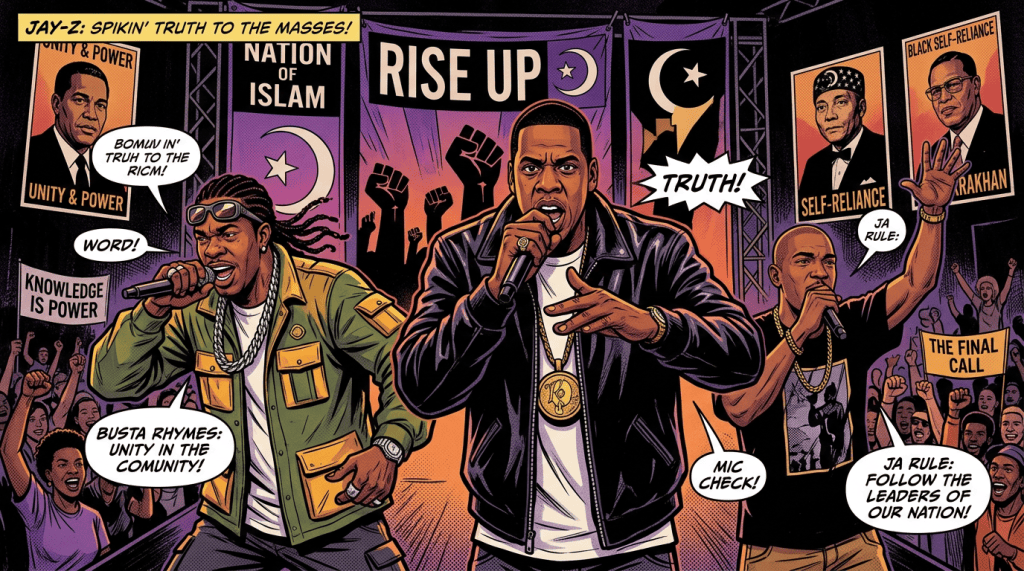
By the mid-to-late 1980s the connection was overt. Public Enemy, formed on Long Island, placed Louis Farrakhan at the center of its political message. On “Bring the Noise” Chuck D rapped, “Farrakhan’s a prophet and I think you ought to listen to.” The group’s security force adopted the visual discipline of the Fruit of Islam. Rakim, the “God MC” from Long Island, closed tracks with peace to the Nation of Islam and referenced the “actual facts” of the Lost-Found Muslim Lessons.
Big Daddy Kane opened records with Farrakhan samples. Brand Nubian, Poor Righteous Teachers, and later the Wu-Tang Clan from Staten Island wove Five Percent and Nation of Islam language into their work. Ice Cube, though from Los Angeles, has described his introduction to these ideas through New York groups. Jay Electronica and others continued the pattern into later decades, filling projects with Farrakhan’s voice and Fruit of Islam imagery.
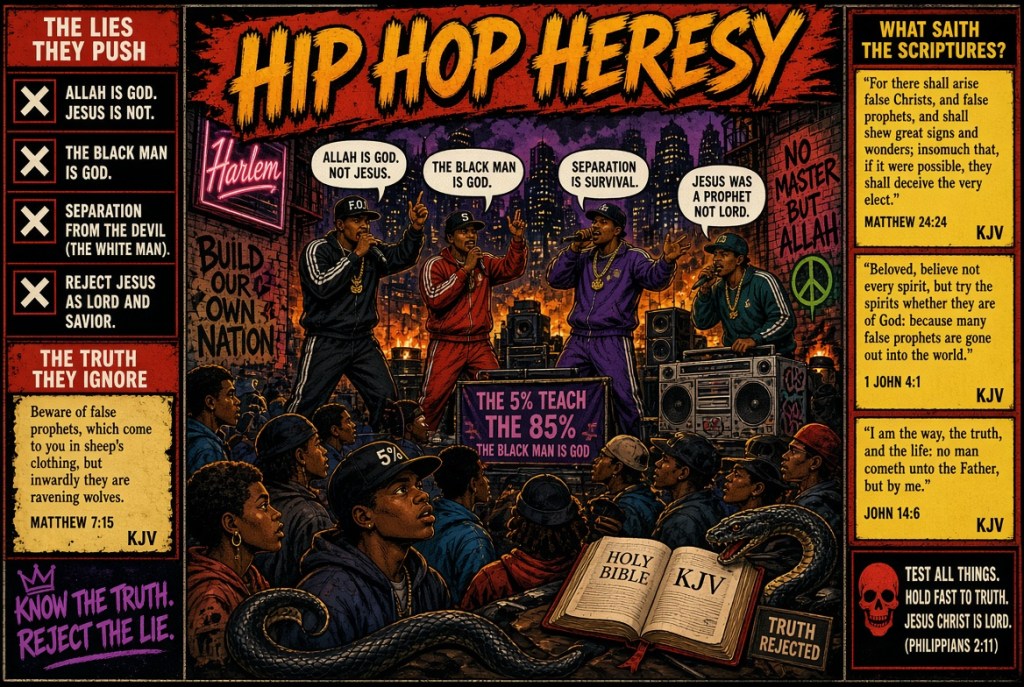
The doctrines that traveled on these records were not vague affirmations of Black pride. They were specific denials of the gospel. Elijah Muhammad had written that Christianity is “one of the most perfect black-slave-making religions on our planet” and that “there will be no Christian religion or churches” after the judgment. He taught that God is a man—specifically a Black man—and that “we just cannot make Him other than a man.”
The white race, created by the Black scientist Yakub through centuries of selective breeding, was “not made by nature to accept righteousness.” Jesus was reclassified as a Muslim prophet who never died for the sins of the world. Farrakhan has repeated the claim: “God never sent Jesus to die for this world… He never was on no cross. There was no Calvary for that Jesus.” When New York rappers treated these ideas as wisdom, or simply as the language of consciousness, they popularized a system that the Bible flatly rejects.
Scripture states the opposite. “God is not a man, that he should lie” (Numbers 23:19). “God is a Spirit: and they that worship him must worship him in spirit and in truth” (John 4:24). God “hath made of one blood all nations of men” (Acts 17:26). Christ is the Word made flesh who knew no sin and who was made sin for us (John 1:1, 14; 2 Corinthians 5:21). “Who is a liar but he that denieth that Jesus is the Christ? He is antichrist, that denieth the Father and the Son” (1 John 2:22). In Christ there is neither Jew nor Greek, bond nor free (Galatians 3:28).
The cross is not a symbol of racial enslavement; it is the place where the one true God deals with the sin of every man.
New York hip-hop did not invent this theology. It nationalized it. For many Black listeners in the 1980s and 1990s, the first coherent account of God, history, and the church arrived not from the Baptist or Methodist pulpit that had carried their grandparents through Jim Crow, but from a cassette or radio station playing records made in New York.
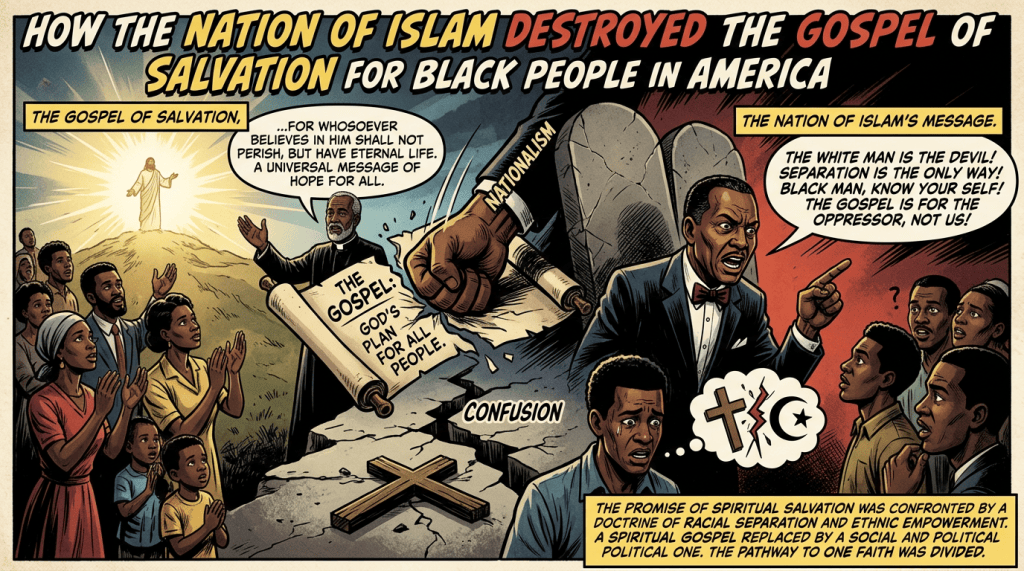
The historic Black church had preserved the message that sinners of every color need the same Savior. The Nation of Islam and its New York amplifiers replaced that message with a racial creation myth in which an entire people group is inherently incapable of righteousness and in which the finished work of Christ is irrelevant.

The practical consequences followed the doctrine. When the gospel is recast as a white man’s trick, the church that preaches it becomes an obstacle rather than a refuge. When identity is defined by a 20th-century racial myth rather than by union with Christ, the call to repentance and faith is displaced by a call to racial consciousness.
The economic self-help and personal discipline associated with the Nation of Islam were real. They do not cancel the fact that the movement’s foundational claims about God, man, and the cross contradict Scripture and lead away from the only name under heaven given among men whereby we must be saved (Acts 4:12).
None of this is a defense of every failure of American Christianity. Segregation in churches was sinful. Some white Christians twisted Scripture to justify oppression. Partiality is condemned by the same Bible the Nation of Islam rejected (James 2:1–9). The answer to a corrupted presentation of the gospel is not a counter-gospel that makes race the decisive category of salvation and damnation. The answer is the actual gospel.
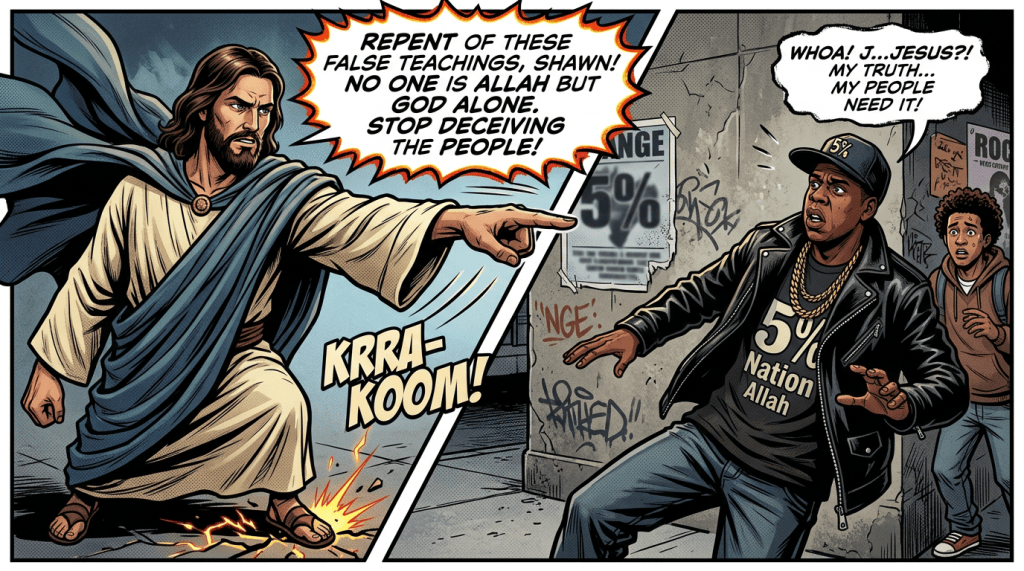
New York City rap took a heresy that once competed with the Black church from small temples and put it on platinum albums. It popularized the idea that the Black man is God, that the white race is a race of devils, and that the Jesus of the Bible is not the Savior of the world. That is not consciousness. It is the substitution of a false origin story and a false christ for the one blood of humanity and the finished work of the cross.
The record of how New York hip-hop carried the Nation of Islam’s racial assault on the gospel into the mainstream should be clear.


Leave a Reply