In the early years of the twentieth century, Pyongyang was known among Protestant missionaries as the Jerusalem of the East.
Churches dotted its skyline. A Presbyterian seminary trained indigenous leaders. Hospitals and schools founded by missionaries stood alongside growing congregations. The city was the center of a movement that had taken root faster in the north than in the south. By the time of the 1907 revival, northern Korea already held a disproportionate share of the peninsula’s Christians. That history is now largely erased from public view in the city that once hosted it.
The 1907 Pyongyang Revival, often called the Korean Pentecost, marked the high point of this early growth. It built on smaller local awakenings, including a 1903 movement in Wonsan linked to Canadian Methodist medical missionary Robert A. Hardie, who had publicly confessed personal shortcomings and led meetings focused on prayer for the Holy Spirit. Reports of the Welsh Revival and of similar movements in India had reached Korean Christians and missionaries in 1906, prompting intensified prayer.
In January 1907 a winter Bible conference drew roughly 1,500 Korean men to Jangdaehyun (Central) Presbyterian Church. Women met separately because of limited space. The decisive spark came when Gil Seon-ju, one of the first Koreans ordained as a Presbyterian minister that year, publicly confessed. Accounts record him describing himself as “a sinner like Achan” and admitting to having misused funds entrusted to him. The confession triggered a cascade of others. Men rose one after another, wept, and threw themselves on the floor.
Simultaneous audible prayer—hundreds of voices at once—filled the building. Presbyterian missionary William Newton Blair, who was present, later compared the sound to “the falling of many waters, an ocean of prayer beating against God’s throne.” Meetings stretched late into the night. Blair also preached on the need for love that extended even to Japanese people amid rising colonial pressure. The intensity spread to other churches and nearby cities through the spring.
Immediate results included thousands of new converts—reports of roughly 2,000 by March and figures near 30,000 by July—and a near-doubling of Protestant numbers by the end of the year. The first Korean Presbyterian ministers were ordained in 1907. More lasting were the practices that took root: early-morning prayer meetings associated with Gil Seon-ju’s leadership, all-night prayer, simultaneous corporate prayer, and a strong emphasis on personal conversion and Bible study. These became hallmarks of Korean Protestantism.
Christian leaders, including Gil, later played visible roles in nationalist resistance under Japanese rule; he signed the 1919 March First Declaration of Independence and was imprisoned. The revival occurred under the shadow of Japanese encroachment, yet it produced indigenous leadership and numerical growth rather than mere dependence on foreign missionaries.
Japanese colonial rule from 1910 to 1945 brought further pressure—demands for participation in Shinto ceremonies, restrictions on schools, and surveillance of nationalist activity—but Christianity continued to expand. Many Christians associated the faith with both personal salvation and resistance to foreign domination. When the peninsula was divided after 1945, the north held the larger share of believers.
Soviet occupation authorities and their Korean clients moved quickly against potential rivals. Christian political figures such as Cho Man-sik were arrested. A state-controlled church federation was imposed; leaders who refused compliance were imprisoned or killed; church properties were confiscated. Open churches largely closed by the late 1940s. Large numbers of Christians fled south. Kim Il Sung, raised in a Christian household and familiar with church structures, returned with Soviet backing and built a personality cult that appropriated certain religious forms—rituals of devotion, sacred texts, a messianic narrative—while outlawing independent Christianity.
Juche ideology and later the “Ten Principles” required total loyalty to the Kim family.The Korean War intensified the assault. As North Korean forces retreated after the Inchon landing, they massacred Christians and other civilians they regarded as enemies to prevent their liberation. After the war the remaining open expression of the faith was eliminated. The regime classified Christians in the “hostile class” under the songbun system. Possession of a Bible, private prayer, or unauthorized meetings became grounds for arrest, torture, and imprisonment in political camps. Collective punishment of families for up to three generations became standard.
Public executions were reported in some cases. Official churches in Pyongyang function primarily as showpieces for foreign visitors. Monitoring organizations have ranked North Korea at or near the top of global persecution lists for decades. Estimates of remaining Christians range from the low hundreds of thousands, nearly all underground, with tens of thousands believed to be in camps.
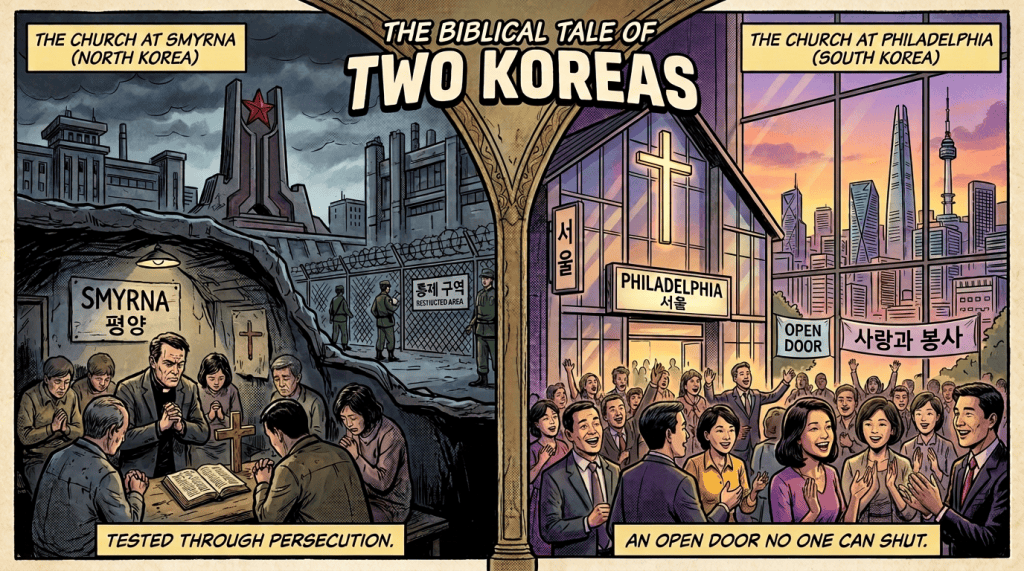
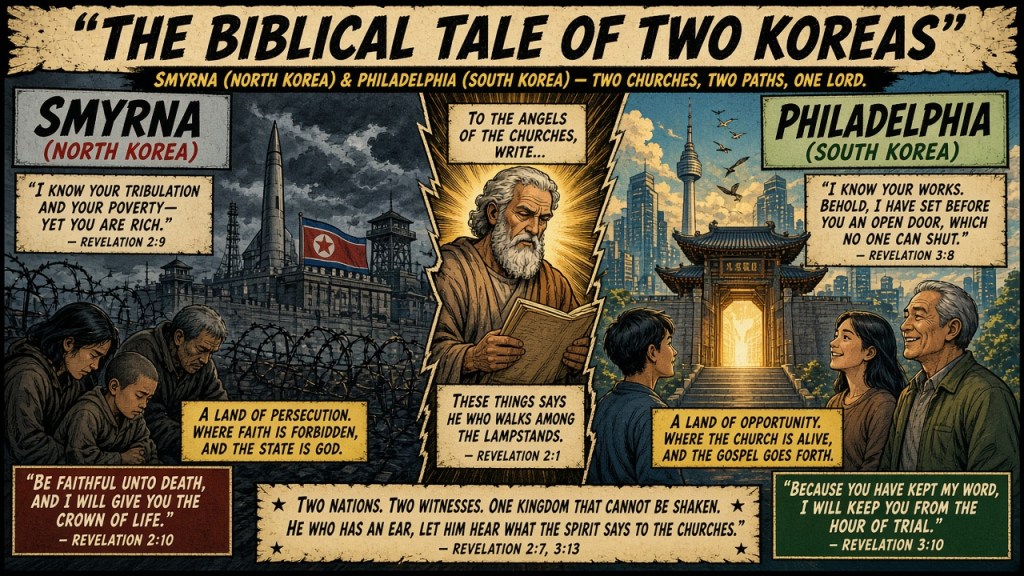
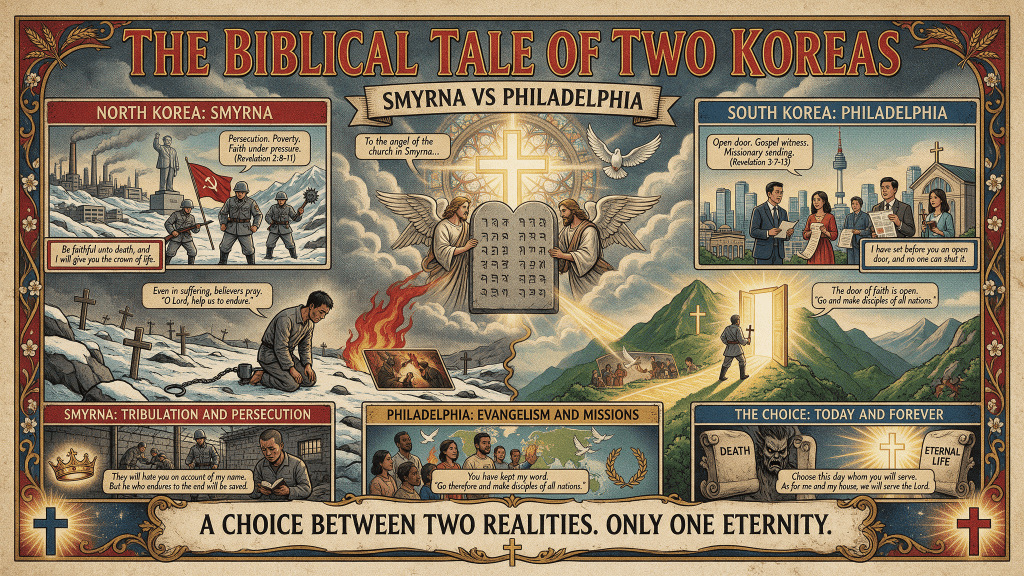
A literal reading of the letters to the churches in Smyrna and Philadelphia supplies one long-standing interpretive lens for these divergent outcomes. The letter to Smyrna (Revelation 2:8–11) addresses a body known for its works, tribulation, and poverty—yet described as rich. It records the blasphemy of those who claim a privileged status while opposing the churches, warns of imprisonment by the devil for testing, and calls for faithfulness unto death with the promise of a crown of life. There is no rebuke. The letter to Philadelphia (Revelation 3:7–13) commends a church of little strength that has kept the word and has not denied the name. An open door is set before it that no one can shut. It is promised protection from the broader hour of trial that comes upon the earth. Again, there is no rebuke.
The northern trajectory aligns with the Smyrna description. Material scarcity under the regime coexists with documented endurance under extreme pressure—the “poverty, but thou art rich” of the text. Imprisonment and testing match the letter’s warning. The regime’s claims of religious freedom and its personality cult that demands ultimate allegiance function, in the language of the letters, as the blasphemy of those who say they are Jews and are not, but are a synagogue of Satan.
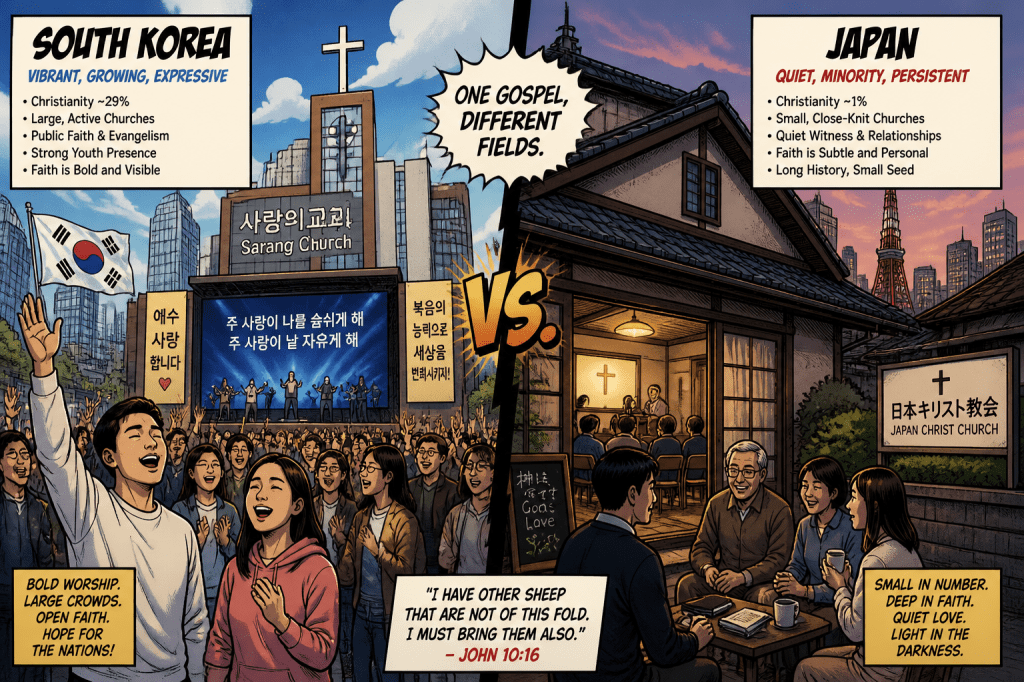
The southern trajectory aligns with the Philadelphia description. Northern refugees carried the practices of the earlier revivals southward. From a small postwar base, Protestant and Catholic communities expanded rapidly amid urbanization and relative political openness. Churches retained a strong emphasis on Scripture. South Korea became one of the world’s leading missionary-sending nations, with more than twenty thousand long-term workers abroad in recent counts. The open door has not been shut. The South has not faced the systematic imprisonment imposed in the North; the relative freedom corresponds to the promise of being kept from the hour of temptation that tries those who dwell on the earth.
China’s role has been decisive in sustaining the northern condition and in modeling an alternative form of ideological control. Mao Zedong’s decision to intervene in the Korean War in late 1950 prevented the collapse of the North Korean regime when United Nations forces approached the Yalu River. The accompanying domestic campaign in China intensified pressure on foreign-linked Christian institutions and accelerated the consolidation of state-supervised religious bodies.
In subsequent decades China has remained the DPRK’s primary external backer. In practice this has included the forcible repatriation of North Korean escapees. Chinese authorities interrogate returnees about contact with South Koreans, missionaries, or churches. Those found to have had such contact face especially severe punishment upon return, including political prison camps. Surveillance tools have been used to map support networks that include Christian groups.
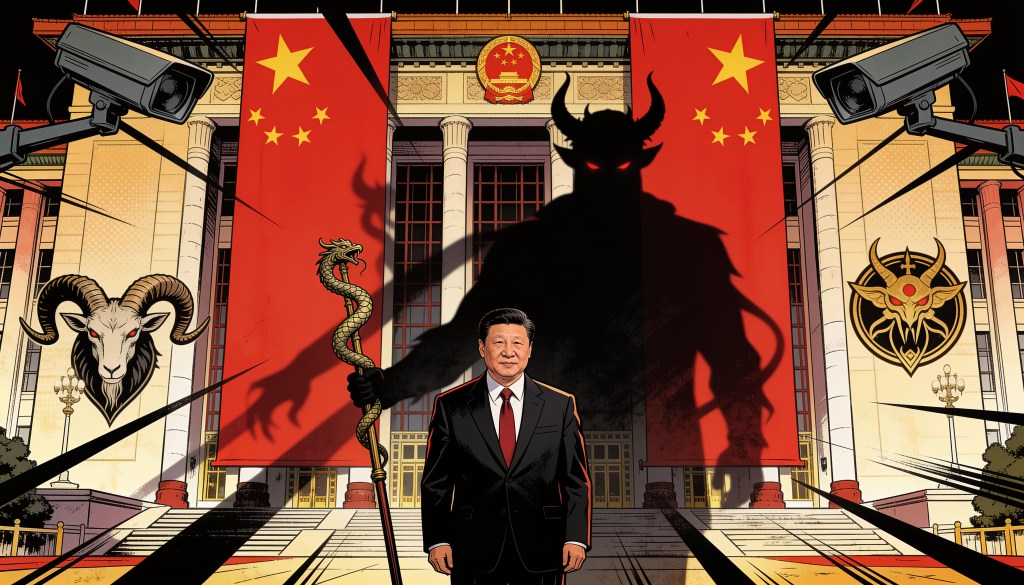
USCIRF reporting and human-rights monitors in 2025–2026 document the continuation of these returns—hundreds since 2020, with the pattern holding into the present year—and the explicit questioning about religious contact. China’s own “sinicization” policy, which requires religious groups to subordinate doctrine and practice to Communist Party ideology, supplies both a template and a shared rationale for treating unauthorized Christianity as a threat to political monopoly. House-church crackdowns inside China continued in 2026, with raids, detentions of pastors and leaders, and restrictions on Bible distribution.
In 2026 the pattern persists with incremental intensification of Chinese influence on the peninsula. Cultural-exchange programs originating in China’s northeastern provinces aim to shape a more favorable ideological environment inside the North. Diplomatic engagement with Seoul seeks stability and economic ties. Available reporting shows no equivalent campaign of direct suppression against mainstream South Korean churches. Internal South Korean controversies involving groups often labeled as cults by other Christians have drawn some parallel activism, but these remain primarily domestic matters. The open door in the South has not closed; the tribulation in the North has not lifted. China’s sustained assistance to the northern regime and its own domestic policy of ideological subordination have prolonged the former condition.
The two letters contain no rebuke of the churches they address. They record what is known of their works under differing conditions of pressure and opportunity. The Korean case illustrates both. One people received the word under successive oppositions—Confucian hostility, Japanese colonial demands, war, and then a communist system that co-opted religious forms while eradicating independent faith. Under the harsher measure the response has been the tested faithfulness described for Smyrna. Under the open door the response has been the retention of the word and missionary outflow described for Philadelphia. Whether Chinese assistance continues to shape outcomes on the peninsula will depend on decisions made in Beijing, Pyongyang, and Seoul, and on the endurance of those who continue to keep the word under whatever conditions are set before them.
The historical record shows that the word has been kept under both tribulation and open doors; the letters indicate that the outcome is measured by faithfulness in the conditions that are given.


Leave a Reply