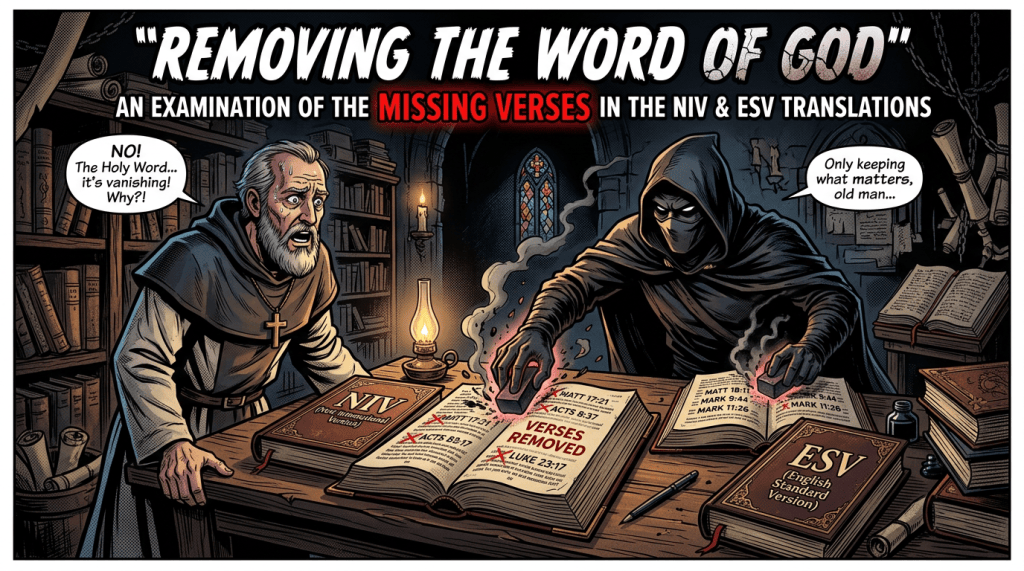
Among the many devices employed to diminish the authority of the Word of God, none is more subtle, and none more dangerous, than the quiet excision of whole verses from the sacred page under the pretext of superior scholarship.
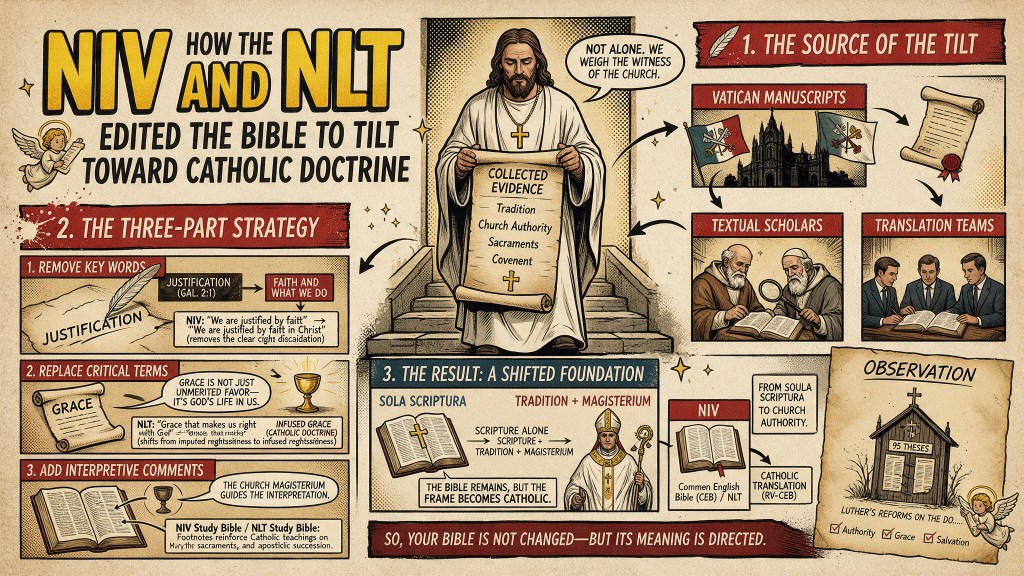
The Authorized Version, commonly called the King James Bible, has for centuries stood as the received English text of Holy Scripture. It was rendered from the Textus Receptus, that Greek New Testament which had been the standard of the churches of the Reformation. Modern translations such as the New International Version and the English Standard Version, by contrast, rest upon a critical text assembled in the nineteenth century and thereafter.
From that critical text the translators have removed, or relegated to footnotes, numerous verses that appear in the Authorized Version. These omissions are not neutral; they strike at doctrines plainly taught by the literal sense of Scripture and thereby undermine the standard of truth by which all teaching must be judged.
The principle which must govern this inquiry is simple and absolute. The Bible, in its literal and grammatical sense, is the sole and sufficient rule of faith and practice. No catechism, no confession framed centuries after the apostles, and no theory of textual criticism may be permitted to overrule the plain words of the text that the churches have received.
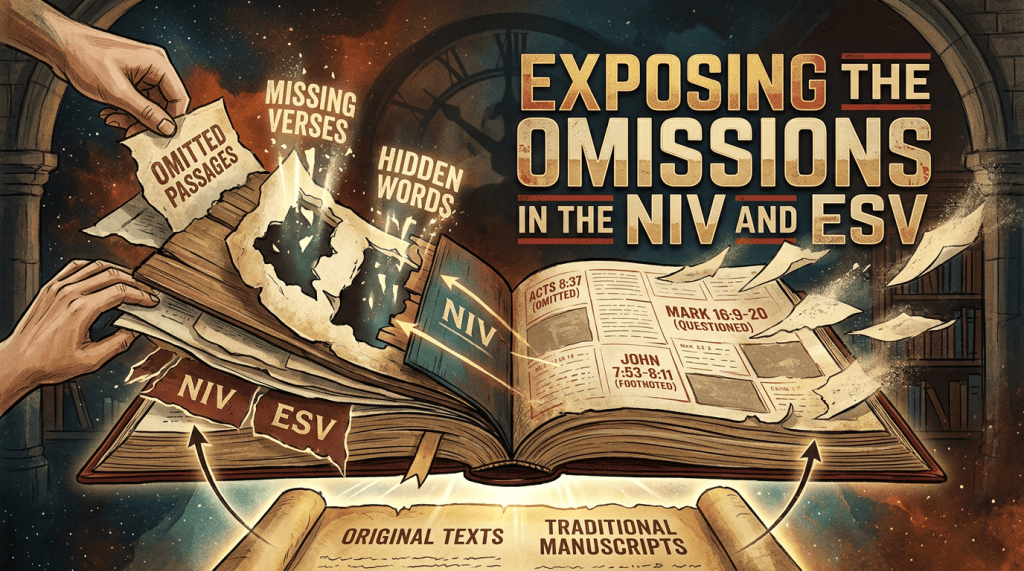
Where a verse appears in the Authorized Version and is absent from the NIV or ESV, the burden rests upon those who omit it to demonstrate that the verse is not the Word of God. That burden has not been met. The verses in question are attested by the great majority of Greek manuscripts, by the early versions used throughout the Christian world, and by the continuous testimony of the churches. Their removal therefore constitutes an attack upon biblical truth.
Consider first the explicit witness to the Trinity in 1 John 5:7–8. The Authorized Version reads: “For there are three that bear record in heaven, the Father, the Word, and the Holy Ghost: and these three are one. And there are three that bear witness in earth, the Spirit, and the water, and the blood: and these three agree in one.” The NIV and ESV omit the heavenly witnesses entirely, leaving only the earthly triad. The result is the removal of the sole verse in the New Testament that directly and grammatically declares the three persons of the Godhead to be one.
Other passages name the Father, Son, and Spirit together, yet none states so clearly that they are one. To erase this declaration is to deprive the believer of the most compact and unambiguous scriptural statement of the doctrine. The claim that the clause is a late addition cannot override the fact that it stands in the received text and has been confessed by the churches as Scripture. Its absence from modern versions is an assault upon the clear testimony of the Word concerning the nature of God.
A second omission touches the necessity of personal faith before baptism. Acts 8:37 in the Authorized Version records the eunuch’s confession: “And Philip said, If thou believest with all thine heart, thou mayest. And he answered and said, I believe that Jesus Christ is the Son of God.” Neither the NIV nor the ESV retains the verse in the text. The surrounding narrative is thereby left without any explicit profession of faith in the deity of Christ as the condition of baptism.
The literal sense of the passage, as preserved in the Authorized Version, establishes that saving faith must precede the ordinance. Its removal weakens the scriptural order of salvation and leaves the reader without the clear example of a public confession of the Son of God. No appeal to the supposed priority of certain early manuscripts can justify the suppression of a verse that has stood as the church’s witness to the content of saving faith.
The purpose of the Son of Man is likewise diminished. Matthew 18:11 declares, “For the Son of man is come to save that which was lost.” The parallel statement in Luke 19:10 remains in modern versions, yet the removal of the Matthean text is not harmless. In its context the verse supplies the reason for the preceding parable of the lost sheep and underscores the salvific mission of Christ. By omitting it the NIV and ESV leave the reader without this concise summary of why the Son of Man entered the world.
The same pattern appears in other places where the Authorized Version retains language that modern versions drop: the call of sinners “to repentance” (Matthew 9:13), the necessity of prayer and fasting for the expulsion of certain demons (Matthew 17:21), and the warning that failure to forgive will result in the Father’s refusal to forgive (Mark 11:26). Each excision removes a concrete statement of divine purpose, of spiritual discipline, or of conditional promise.
The doctrine of eternal punishment is likewise attenuated. In Mark 9:44 and 9:46 the Authorized Version repeats the solemn refrain, “Where their worm dieth not, and the fire is not quenched.” These clauses are absent from the text of the NIV and ESV, though the identical language of verse 48 is retained. The repetition in the received text intensifies the warning; its removal softens the force of the Lord’s teaching on the unending character of the fire prepared for the unrepentant.
Hell is not thereby denied, yet the emphatic, thrice-repeated declaration is weakened. The believer is left with a less insistent witness to the reality of eternal judgment.
Further examples may be briefly noted. Matthew 23:14, the woe against those who devour widows’ houses and for a pretense make long prayer, is omitted. Mark 15:28, which records the fulfillment of Isaiah’s prophecy that the Messiah would be numbered with the transgressors, disappears from the text. Luke 23:17, noting the custom of releasing a prisoner at the feast, is absent. John 5:4, describing the angel’s stirring of the waters at Bethesda, is relegated to a footnote or omitted. Romans 16:24, the apostolic benediction, is dropped.
In each case the Authorized Version preserves a statement that either records historical fulfillment, clarifies narrative detail, or seals a section with apostolic authority. Their collective absence is not a matter of indifference; it represents the progressive thinning of the text that the churches have long received as complete.
The longer passages of Mark 16:9–20 and John 7:53–8:11 are customarily bracketed or footnoted in the NIV and ESV. The Authorized Version includes them without reservation. Mark’s longer ending supplies the Great Commission in its fullest form, the promise of accompanying signs, and the ascension. John’s account of the woman taken in adultery presents the Lord as the one who neither condemns nor condones, but commands, “Go, and sin no more.” To treat these passages as doubtful is to cast suspicion upon texts that have been read as Scripture by the great majority of believers for centuries. The literal sense of the received text does not permit such doubt.
The defense commonly offered is that the omitted verses are absent from certain early manuscripts and are therefore later additions. This argument rests upon a theory of textual criticism that privileges a handful of witnesses over the continuous testimony of the church. It is a theory, not a divine revelation. The Authorized Version, by contrast, rests upon the text that God has preserved and that the churches of the Reformation received. Deuteronomy 4:2 and Revelation 22:18–19 forbid both addition to and subtraction from the words of the book.
When whole verses are removed from the text that has been the standard of the English-speaking churches, the prohibition against taking away is violated in practice, whatever the intention of the translators. The footnotes that sometimes retain the omitted material do not restore the authority of the text; they reduce it to a secondary status and invite the reader to regard the verse as optional.
No core doctrine of the Christian faith is wholly absent from the NIV or ESV. That fact does not exonerate the omissions. The Word of God is not a collection of bare doctrines that may be stated in summary form; it is the particular words, phrases, and verses that the Holy Spirit has given. To remove even one verse is to diminish the fullness of that revelation.
The believer who takes the Authorized Version as the literal standard of truth finds in these missing verses clear statements concerning the Trinity, the necessity of faith, the mission of Christ, the reality of hell, the duty of forgiveness, and the power of prayer and fasting. Their absence from modern translations is therefore an attack upon the completeness and the clarity of biblical truth.

The remedy is not complicated. Let the churches return to the text that has been received. Let the Authorized Version be read, studied, and proclaimed without apology. Let every argument and every question be judged by its plain words. In that return lies the preservation of the faith once delivered to the saints and the rejection of every device that would subtract from the sacred page.


Leave a Reply