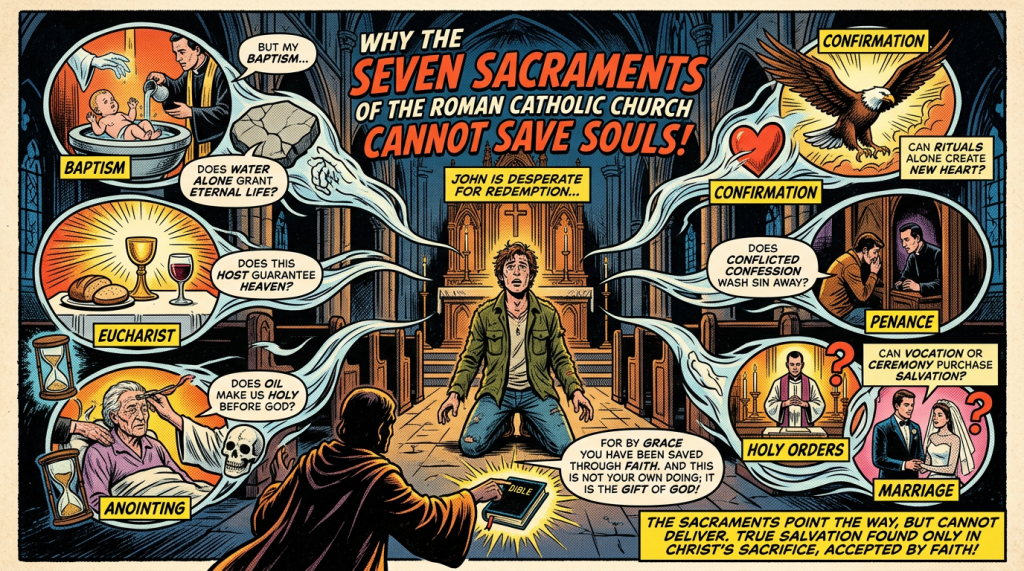
The Roman Catholic Church teaches that the seven sacraments—Baptism, Confirmation, the Eucharist, Penance, Anointing of the Sick, Holy Orders, and Matrimony—are effective means of grace that confer or increase sanctifying grace and are necessary for salvation.
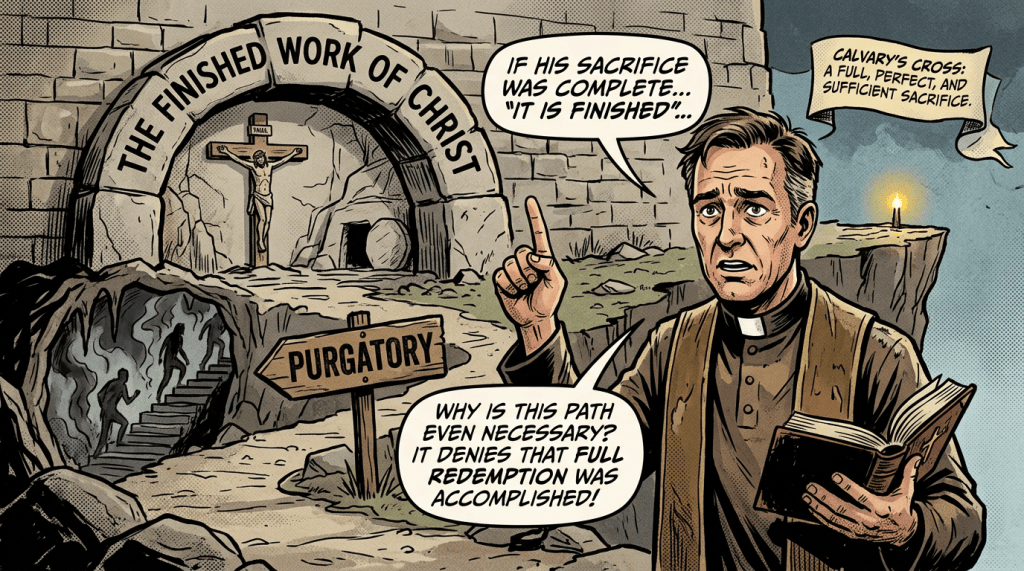
According to this system, these rites, properly administered, actually accomplish what they signify and place the recipient in a state of grace or restore that state after sin. A literal reading of Scripture yields a different conclusion. Salvation is the present possession of the one who hears the word of Christ and believes on the Father who sent him (John 5:24). It is by grace through faith, not of works, lest any man should boast (Ephesians 2:8–9). No ritual, however ancient or solemn, supplies what the finished work of Christ has already accomplished or what faith alone receives.
Baptism is the sacrament most often presented as the ordinary means of regeneration and the remission of original sin. Scripture, however, consistently places faith before baptism and treats the latter as the public confession of an already-received salvation. The Ethiopian eunuch asked, “What doth hinder me to be baptized?” and Philip answered, “If thou believest with all thine heart, thou mayest” (Acts 8:36–37). The Philippian jailer was told, “Believe on the Lord Jesus Christ, and thou shalt be saved,” and he and his household were baptized afterward (Acts 16:31–33). Paul thanked God that he had baptized few of the Corinthians, declaring that Christ sent him not to baptize but to preach the gospel (1 Corinthians 1:14–17). If baptism were the instrument that confers saving grace, the apostle’s gratitude for having performed it rarely would be inexplicable. The New Testament knows baptism as the ordinance that follows belief, not the cause of it.

Confirmation, or chrismation, is said to complete baptism by the impartation of the Holy Spirit through the laying on of hands and anointing. The apostolic record shows the Spirit given upon faith, not upon a later episcopal rite. In Acts 10 the Holy Ghost fell on Cornelius and his household while Peter was still speaking the word, before any baptism or confirmation occurred. Ephesians 1:13 states that after hearing the word of truth and believing, believers were sealed with the Holy Spirit of promise. No text requires a distinct sacramental confirmation to receive or complete the Spirit’s work. The claim that an additional rite is necessary adds a condition the apostles did not impose.
The Eucharist is presented as the sacrifice of the Mass in which Christ is offered anew and his body and blood are received under the appearances of bread and wine, thereby conveying grace. Scripture describes the Lord’s Supper as a remembrance. Jesus said, “This do in remembrance of me” (Luke 22:19; 1 Corinthians 11:24–25). Paul explains that as often as the bread is eaten and the cup is drunk, the Lord’s death is proclaimed until he comes (1 Corinthians 11:26). Hebrews 10:10–14 declares that by one offering Christ has perfected forever those who are sanctified and that there is no more offering for sin. A repeated sacrifice that conveys grace contradicts the once-for-all character of the cross. The Supper is a memorial ordinance for those who have already believed, not a means by which the unregenerate or the lapsed obtain life.
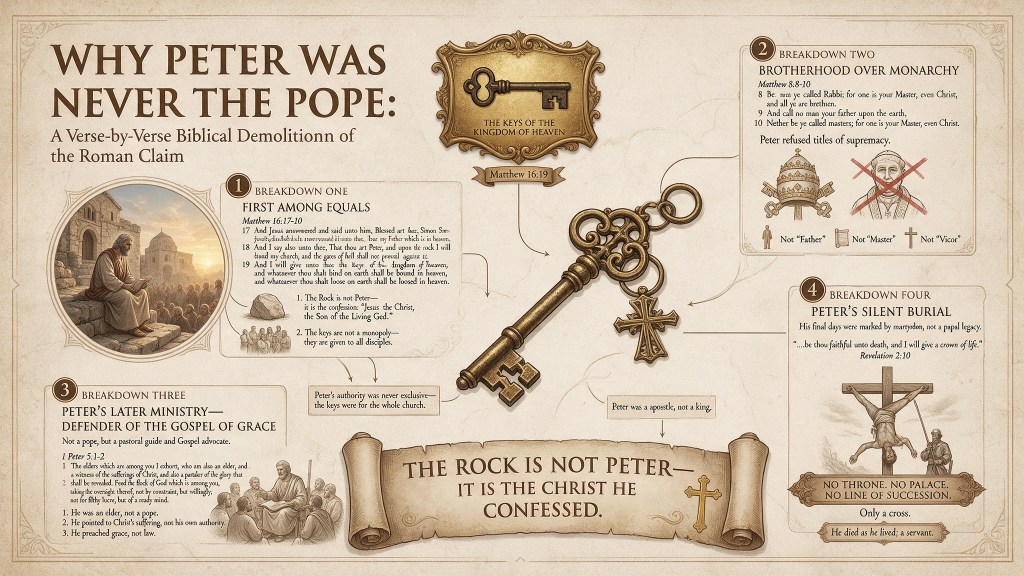
Penance is taught as the sacrament by which post-baptismal sins are forgiven through contrition, confession to a priest, and satisfaction. The New Testament directs confession to God. “If we confess our sins, he is faithful and just to forgive us our sins, and to cleanse us from all unrighteousness” (1 John 1:9). The blood of Jesus Christ cleanses from all sin (1 John 1:7). No apostle instructs believers to seek absolution from a priest as a condition of forgiveness or of restored grace. The publican in the temple went down to his house justified after praying, “God be merciful to me a sinner,” without priestly mediation (Luke 18:13–14). Penance as a saving rite replaces the direct access secured by Christ with an ecclesiastical process the Scriptures do not require.
Anointing of the Sick is said to confer grace, forgive sins, and sometimes restore health when administered to the seriously ill. James 5:14–15 does instruct the sick to call for the elders of the church, who are to pray and anoint with oil in the name of the Lord, and it adds that the prayer of faith shall save the sick and that if he have committed sins they shall be forgiven him. The passage describes a pastoral ministry of prayer within the local church, not a sacrament that conveys saving grace by the act itself. Forgiveness remains tied to the confession of sin and the prayer of faith, not to the rite as an automatic instrument. The text supplies no warrant for treating the anointing as a necessary means of salvation or of the remission of sins for the dying.

Holy Orders is presented as the sacrament that confers the indelible character of the priesthood and the power to offer the sacrifice of the Mass and to forgive sins. The New Testament knows no separate sacerdotal class that stands between God and the believer. All believers are a royal priesthood (1 Peter 2:9). Elders and deacons are recognized for service and teaching, yet nowhere are they said to receive, by ordination, the power to re-offer Christ or to dispense saving grace. The claim that holy orders confers such power elevates an office beyond anything the apostles established and places the mediation of salvation in human hands rather than in the finished work of the one Mediator (1 Timothy 2:5).
Matrimony is called a sacrament that confers grace upon the spouses for the fulfillment of their duties. Marriage is an ordinance instituted by God in creation and regulated in the New Testament for believers, yet it is never presented as a means of obtaining or increasing saving grace. Paul treats marriage as honorable and as a remedy against fornication (1 Corinthians 7), but he nowhere suggests that the marriage rite itself saves or sanctifies in the sense of conferring eternal life. Salvation remains the possession of those who believe, whether married or unmarried.

Across all seven rites the same pattern appears. Each is said to convey grace by the performance of the act. Scripture locates grace in the finished work of Christ received by faith. John 5:24 promises everlasting life to the one who hears Christ’s word and believes on him who sent him; the believer has already passed from death unto life and shall not come into condemnation. Romans 4:5 justifies the ungodly by faith without works. Titus 3:5 states that we are saved not by works of righteousness which we have done, but according to God’s mercy.
The sacraments, whatever their proper place as ordinances or pastoral practices for those who have already believed, cannot supply the righteousness that Christ’s obedience and blood alone provide. To treat them as necessary instruments of salvation is to add conditions the gospel does not contain and to shift the ground of assurance from the cross to the correct administration of rites.
The strongest biblical argument is therefore the simplest. Salvation is by grace through faith in the Son, not by the reception of sacraments. The blood of Christ cleanses from all sin. The offering of Christ perfects forever those who are sanctified.

Any system that requires seven rites to obtain or maintain that cleansing has substituted an ecclesiastical process for the once-for-all work the apostles proclaimed. The written Word leaves no room for the claim that the sacraments save.


Leave a Reply