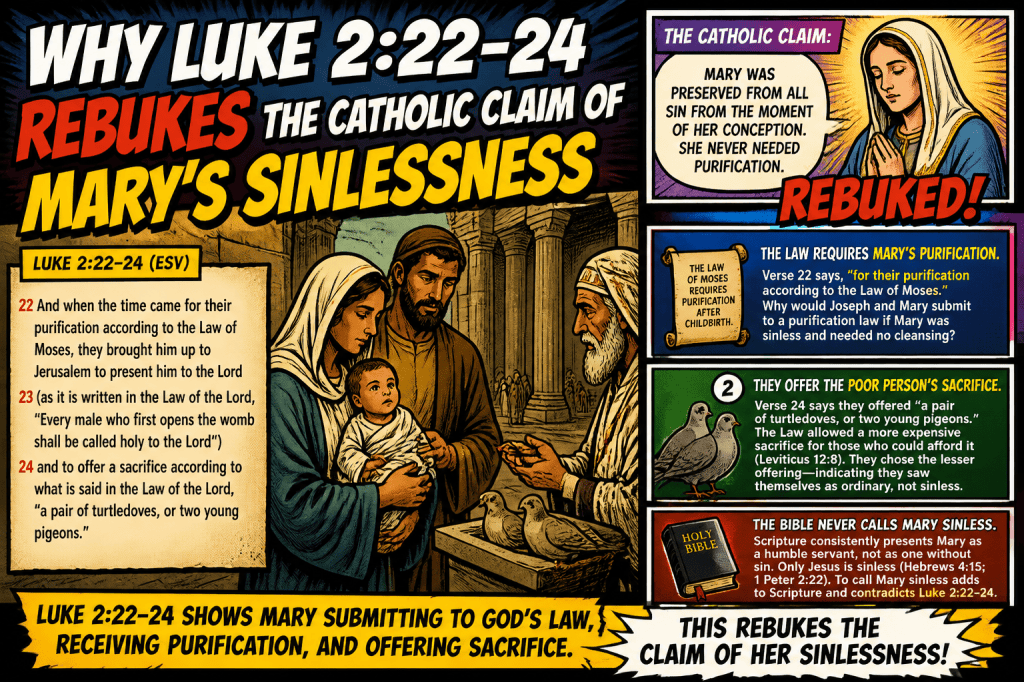
Roman Catholic teaching asserts that Mary was preserved from all stain of original sin and from personal sin throughout her life. This doctrine, formally defined in 1854 as the Immaculate Conception, is treated as essential to the Church’s understanding of Mary’s unique role.
Yet the New Testament record of Mary’s own actions after the birth of Jesus directly contradicts the claim. Luke 2:22–24 states that when the days of her purification according to the Law of Moses were accomplished, Mary and Joseph brought the child to Jerusalem “to present him to the Lord” and “to offer a sacrifice according to that which is said in the law of the Lord, A pair of turtledoves, or two young pigeons.” The law in view is Leviticus 12:1–8, which requires a woman who has given birth to bring a sin offering for her own purification.
Leviticus 12 is explicit about the purpose of the offering. After childbirth, the mother is unclean for a set period. At the conclusion of that period she must bring “a lamb of the first year for a burnt offering, and a young pigeon, or a turtledove, for a sin offering” (Leviticus 12:6). If she cannot afford a lamb, she brings two turtledoves or two young pigeons, “the one for the burnt offering, and the other for a sin offering: and the priest shall make an atonement for her, and she shall be clean” (Leviticus 12:8). The text does not treat the offering as optional, symbolic, or directed solely toward the child. It is the means by which the mother is cleansed. The priest makes atonement for her. The language of sin offering and atonement is the ordinary language of the Mosaic system for dealing with uncleanness that required purification.
Luke records that Mary fulfilled this requirement. She waited the prescribed days, traveled to the temple, and offered the sacrifice the law demanded for her purification. The passage does not describe the offering as a mere ceremonial gesture unrelated to her own condition. It identifies the act as the completion of “the days of her purification according to the law of Moses.” If Mary had been free from all sin and from every form of impurity that required atonement, the law’s provision would have been unnecessary for her. Scripture presents her as subject to the same requirement that applied to other Israelite mothers.
This account is consistent with Mary’s own words earlier in Luke. In the Magnificat she declares, “My spirit hath rejoiced in God my Saviour” (Luke 1:47). The language of needing a Savior is the language of one who stands in need of deliverance, not the language of one who has been preserved from all sin. The New Testament nowhere exempts Mary from the universal statements that apply to humanity. Romans 3:23 declares that “all have sinned, and come short of the glory of God.” Ecclesiastes 7:20 states that “there is not a just man upon earth, that doeth good, and sinneth not.” The only person Scripture presents as without sin is Jesus Christ (Hebrews 4:15; 1 Peter 2:22; 2 Corinthians 5:21). No parallel claim is made for Mary.
Catholic explanations typically argue that the Levitical offering addressed only ritual uncleanness and not moral sin, or that Mary offered the sacrifice out of humility rather than necessity. These distinctions do not remove the difficulty. Leviticus 12 repeatedly uses the terminology of sin offering and atonement for the mother. The law does not carve out an exception for a woman who might later be declared free from original sin.
Luke’s narrative simply records that Mary did what the law required of mothers. The suggestion that she complied with a purification rite she did not need introduces a category of voluntary ritual compliance that the text itself does not supply. The more direct reading is that the law applied to her because she, like other women, required the purification it provided.

The doctrine of Mary’s sinlessness is not taught in the apostolic writings. It emerged in later centuries and was defined as dogma only in the nineteenth century. The New Testament presents Mary as a faithful Israelite woman who bore the Messiah, submitted to the requirements of the Mosaic law after childbirth, and rejoiced in God as her Savior. It does not present her as uniquely exempt from the condition that Scripture attributes to all humanity apart from Christ. The claim that she was free from all sin requires setting aside the plain implication of her purification offering and the universal statements of Scripture concerning sin.
Luke 2:22–24 and Leviticus 12:1–8 therefore stand as a clear biblical obstacle to the doctrine of Mary’s sinlessness. Mary fulfilled the law’s requirement for her own purification by bringing the prescribed sin offering. That act is recorded without qualification or special exemption.
Combined with her confession that God is her Savior and the New Testament’s consistent teaching that all have sinned, the passage leaves no scriptural foundation for the claim that Mary was without sin. Where later ecclesiastical definitions conflict with the written Word, the written Word must prevail.


Leave a Reply