On November 15, 2026, in a four-and-a-half-hour production at Transformation Church in Tulsa, Oklahoma; Michael “Mike” Todd was publicly anointed, affirmed, and installed as an “apostle.” Oil was poured over his head. Fellow ministers consented to his elevation.
Prophetic declarations announced that he would one day advise presidents and gather world leaders. Todd, turning forty the next day, declared he had dodged the title for years out of concern for what people would say, but now “could care less what man thinks.” The service celebrated both his birthday and his new office.
The Bible already named this scene two thousand years ago.
“For such are false apostles, deceitful workers, transforming themselves into the apostles of Christ. And no marvel; for Satan himself is transformed into an angel of light. Therefore it is no great thing if his ministers also be transformed as the ministers of righteousness; whose end shall be according to their works.” (2 Corinthians 11:13–15)
The verb is precise. The Greek metaschēmatizō means to change one’s outward form or fashion, to disguise oneself by assuming a different appearance. False apostles do not arrive waving a banner that says “servant of Satan.” They transform their presentation until they are received as apostles of Christ and ministers of righteousness. The transformation is the method.

Todd’s church is named Transformation Church. The institution that elevated him operates under the exact concept Scripture uses to describe the self-fashioning of false apostles. What Paul identifies as the characteristic activity of deceivers—“transforming themselves into the apostles of Christ”—has been adopted as the brand. The name is not incidental. It is the public confession of the method.
Scripture does not leave the office of apostle undefined. An apostle had to have accompanied Jesus from the baptism of John until the day He was taken up, and had to be a witness of the resurrection (Acts 1:21–22). Paul defended his own apostleship by the fact that he had seen the Lord (1 Corinthians 9:1). He insisted his commission was “not of men, neither by man, but by Jesus Christ, and God the Father” (Galatians 1:1). The church is built on the foundation of the apostles and prophets, with Christ Himself the chief cornerstone (Ephesians 2:20). The New Jerusalem’s twelve foundations bear the names of the twelve apostles of the Lamb (Revelation 21:14).
Todd meets none of these requirements. He was not an eyewitness of the risen Christ. He was not appointed by Christ Himself. He was installed by men in a church ceremony involving oil and public consent. He and his church appeal to Ephesians 4:11, where Christ “gave some, apostles; and some, prophets; and some, evangelists; and some, pastors and teachers.”

That list describes gifts given for the equipping of the saints. It does not erase the specific qualifications given elsewhere, nor does it authorize modern men to confer the office upon one another. The foundation has already been laid. The twelve are already named. A forty-year-old man in Tulsa does not become an apostle because other ministers pour oil on his head and the congregation cheers.
The surrounding context in 2 Corinthians 11 makes the pattern unmistakable. Paul describes men who glory after the flesh, who bring the people into bondage, who devour them, who take of them, who exalt themselves (2 Corinthians 11:18–20). True apostles pointed to their labors, stripes, imprisonments, and near-death experiences. The false ones displayed a different fruit.
During the same service that conferred the title, Todd changed outfits and was photographed wearing multiple luxury watches. Observers widely identified one as a diamond-set Rolex Daytona model with a reported retail value around $244,000. Even if the precise model and price remain unverified by independent appraisal, the visible display of high-value timepieces is documented.
This fits a longer public record of expensive designer clothing—Louis Vuitton jackets, high-end pants, flashy accessories—and a stage presence that repeatedly centers his personal appearance and prosperity. The resources that sustain such a lifestyle come from the offerings of the people who gather under his ministry.
This is what “devour” and “take of you” look like in practice. The congregation supplies the means; the leader transforms the appearance of apostleship while living in visible luxury. Jesus warned of the same pattern: false prophets who come in sheep’s clothing but inwardly are ravening wolves (Matthew 7:15). The outer transformation—the title, the oil, the production, the clothing—conceals the inward reality that Scripture measures by works.
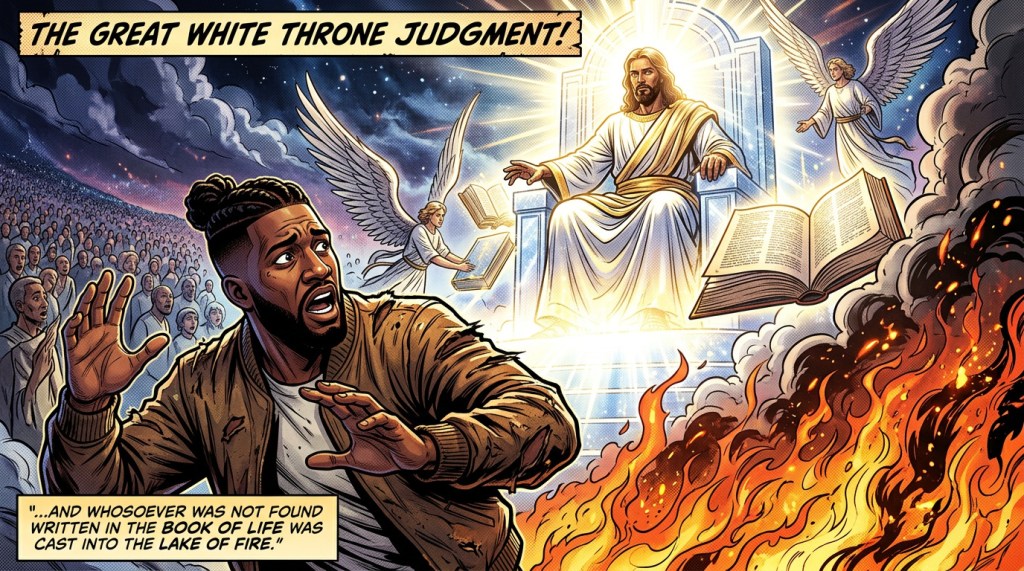
During the same installation, Todd stated, “I will be judged higher at the great white throne.” Revelation 20:11–15 describes that throne in unambiguous terms: “And I saw a great white throne, and him that sat on it, from whose face the earth and the heaven fled away; and there was found no place for them. And I saw the dead, small and great, stand before God; and the books were opened: and another book was opened, which is the book of life: and the dead were judged out of those things which were written in the books, according to their works… And whosoever was not found written in the book of life was cast into the lake of fire.” Believers appear at the judgment seat of Christ (2 Corinthians 5:10), not the great white throne. Todd’s own words place him at the judgment reserved for the condemned, where works—not titles or stagecraft—determine the outcome, and the absence of one’s name in the book of life ends in the lake of fire.
Todd’s response to criticism has been consistent with the text. He dismissed concern over public perception and told his people he follows what God says. The biblical standard, however, is not private conviction or prophetic endorsement. It is the plain qualifications of the office and the observable pattern of self-exaltation and material advantage. When a man who fails every scriptural test for apostleship accepts the title in an elaborate ceremony while displaying luxury sustained by the flock, the description in 2 Corinthians 11:13–15 is not a stretch. It is a direct match.
The end is according to their works. Size of platform, quality of production, and bold declarations about future influence do not alter the criteria. The church that calls itself Transformation and then transforms its pastor into an apostle by human hands has enacted the very thing the apostle warned against. The ministers who pour the oil and the man who receives it present themselves as ministers of righteousness. Scripture says it is no great thing if they are instead ministers of the one who transforms himself into an angel of light.
The warning is not subtle, and the application is not difficult. False apostles transform themselves. They do it in the open, under a name that announces the method, while the people supply the means. Their end is according to their works.




Leave a Reply