Roman Catholic teaching holds that Mary remained a virgin throughout her life—before, during, and after the birth of Jesus. This claim, elevated to dogma centuries after the New Testament was written, is presented as settled truth that faithful Catholics must accept.
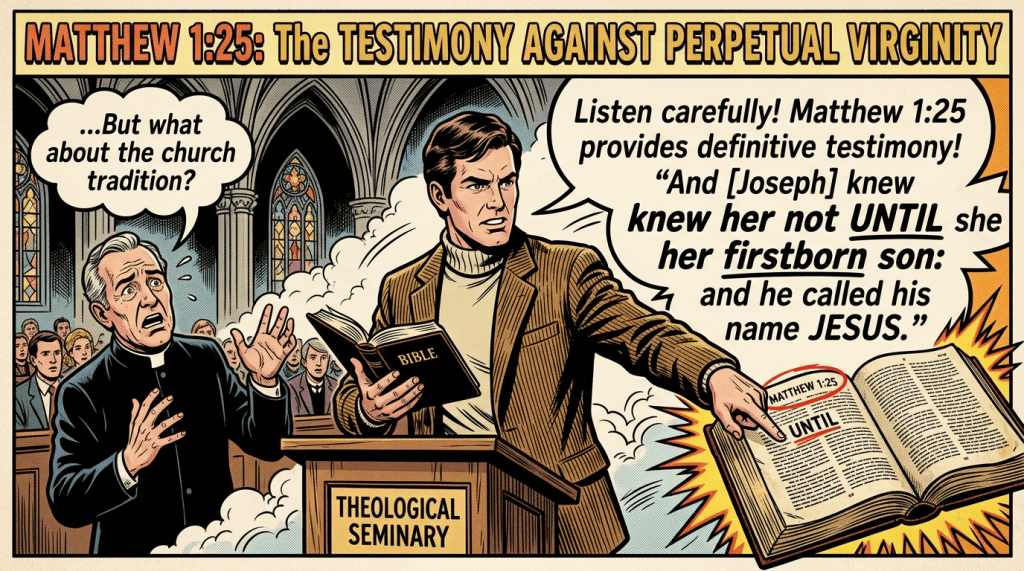
Yet the plain language of Scripture offers no support for it and, in fact, directly contradicts it. The strongest and most concise biblical rebuke is found in Matthew 1:24–25: “Then Joseph being raised from sleep did as the angel of the Lord had bidden him, and took unto him his wife: And knew her not till she had brought forth her firstborn son: and he called his name JESUS.”
The force of the passage is straightforward. Joseph, having been instructed by the angel, took Mary as his wife. The text then states that he “knew her not till she had brought forth her firstborn son.” In biblical usage, the phrase “knew her not” is the standard euphemism for sexual relations (see Genesis 4:1, 4:17, 4:25; 1 Samuel 1:19). The word “till” (Greek heos hou) indicates a point up to which a condition holds and after which it does not. Joseph did not have marital relations with Mary until after the birth of Jesus. The natural reading is that the restriction ended once the child was born. To claim that the couple never consummated the marriage requires imposing a meaning on the text that the words themselves do not bear.
This reading is reinforced by the description of Jesus as Mary’s “firstborn son.” The term “firstborn” (Luke 2:7; Matthew 1:25) distinguishes the first child from those who follow. While the word can occasionally be used in a technical sense of preeminence, its ordinary meaning in the context of a mother’s children is chronological. If Scripture intended to communicate that Jesus was Mary’s only child, it had clearer language available. Instead, it consistently speaks of him as the firstborn among siblings.

Those siblings are named and described in multiple independent passages. Matthew 13:55–56 records the reaction of Jesus’ hometown: “Is not this the carpenter’s son? is not his mother called Mary? and his brethren, James, and Joses, and Simon, and Judas? And his sisters, are they not all with us?” Mark 6:3 lists the same brothers and refers to his sisters. John 7:3–5 shows these brothers urging Jesus to go to the feast in Judea, and the text notes that they did not yet believe in him.
Later, after the resurrection, the brothers are found among the disciples (Acts 1:14). Paul refers to James as “the Lord’s brother” (Galatians 1:19) and mentions that “the brethren of the Lord” took wives (1 Corinthians 9:5). These are not isolated or ambiguous references. They appear across the Gospels, Acts, and the epistles.
Catholic responses typically claim that the Greek words for “brothers” and “sisters” could refer to cousins or other relatives, and that “till” does not necessarily imply a subsequent change. Both arguments fail under scrutiny. The New Testament writers had a distinct word for cousin (anepsios, used in Colossians 4:10 of Mark, the cousin of Barnabas). They did not use it for the brothers of Jesus.
The consistent use of adelphos in these contexts, combined with the specific naming of individuals and the contrast drawn between Jesus’ family and his disciples, indicates ordinary siblings. The argument that “till” never implies a change of state is equally unsustainable. When Scripture says that a condition continues “until” a certain point, the normal expectation is that the condition ends. The angel’s instruction and Joseph’s obedience are presented as a temporary restraint for the purpose of protecting the virgin birth, not as the establishment of a lifelong vow.
The perpetual virginity doctrine also sits uneasily with the biblical teaching on marriage. Genesis 2:24 establishes that a man and his wife become one flesh. First Corinthians 7:3–5 treats the mutual sexual obligation of husband and wife as the ordinary expectation within marriage. Nothing in the account of Joseph and Mary suggests they were exempt from this pattern after the birth of Jesus. The text simply records that Joseph took Mary as his wife and refrained from relations until after the birth.
Historically, the idea of Mary’s perpetual virginity developed in the second and third centuries and was later formalized in church councils and papal statements. It is not taught in the apostolic writings. The New Testament presents Mary as a faithful Jewish woman who bore the Messiah, offered the purification offering required by the Law (Luke 2:22–24), and later appears among the disciples. It does not present her as a lifelong virgin whose body was uniquely preserved from the normal relations of marriage. The elevation of that later tradition to the level of dogma requires accepting ecclesiastical authority over the plain sense of Scripture.
Matthew 1:24–25 remains the clearest single text on the question. Joseph took Mary as his wife. He did not know her until after she had brought forth her firstborn son. The brothers and sisters named throughout the Gospels are most naturally understood as the subsequent children of that marriage. Attempts to reinterpret these statements in service of a doctrine that arose later do not withstand the weight of the language itself. Scripture’s testimony is sufficient. The claim of perpetual virginity is not required by the text, is not supported by the text, and is contradicted by the most natural reading of the text. Where tradition and Scripture conflict, the written Word must govern.


Leave a Reply