
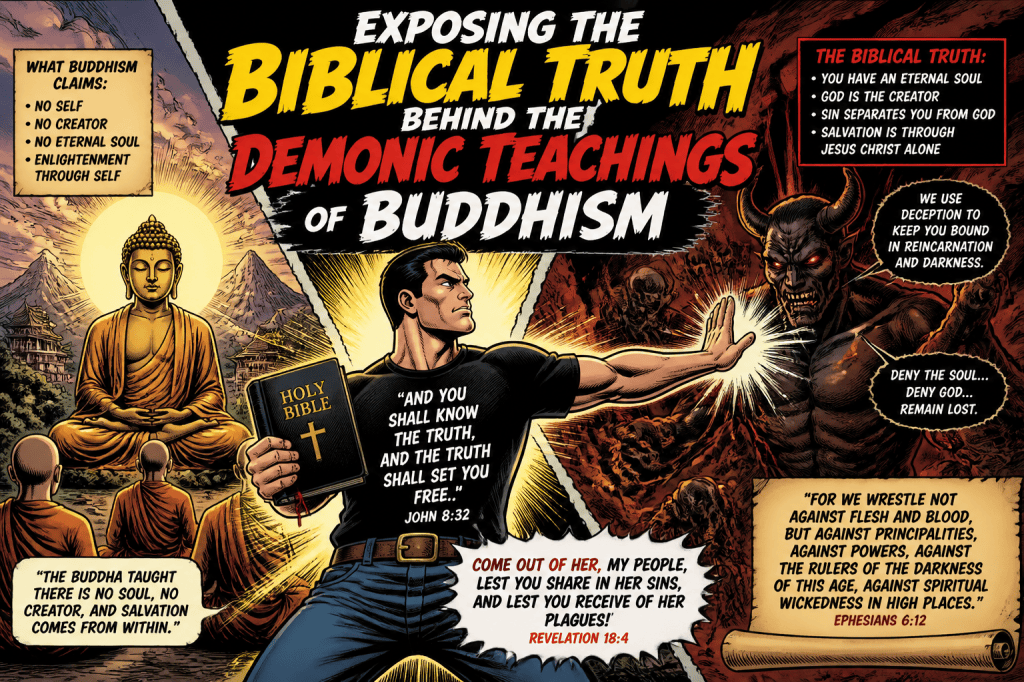
Buddhism presents itself as a gentle path of compassion, mindfulness, and liberation from suffering, a tradition that has shaped the civilizations of East Asia for two millennia.

Temples draw pilgrims, meditation apps promise peace, and cultural exports from Japan, Korea, and China continue to lend the religion an aura of ancient wisdom. Yet when measured against the literal standard of the Bible, Buddhism stands exposed as a system of human invention that offers no true God, substitutes self-effort for divine grace, and advances doctrines that directly oppose the gospel of Christ.
The historical Buddha, Siddhartha Gautama, lived in northern India sometime between the sixth and fourth centuries before Christ. A prince who renounced luxury after confronting old age, sickness, and death, he claimed enlightenment beneath a tree and taught the Four Noble Truths: that life is suffering, that craving causes suffering, that suffering can cease, and that the Eightfold Path of ethical and meditative practice leads to that cessation.
From these roots grew the denial of any permanent self, the doctrine of karma governing rebirth across multiple realms, and the goal of nirvana—the extinguishing of desire and the end of the cycle of existence. These teachings traveled north along trade routes into China by the first and second centuries after Christ, then into Korea in the fourth century and Japan in the sixth. Royal patronage, monastic networks, and the absorption of local spirits and deities secured their place.

None of this transmission, however, supplies divine authority. Scripture traces the origin of such systems to the post-Babel turning of the nations away from the Creator: “Because that, when they knew God, they glorified him not as God, neither were thankful; but became vain in their imaginations, and their foolish heart was darkened” (Romans 1:21).
The false teachings begin with the diagnosis of the human condition. Buddhism locates the problem in craving and ignorance, not in rebellion against a holy God. The remedy is therefore personal discipline along the Eightfold Path—right view, intention, speech, action, livelihood, effort, mindfulness, and concentration—aimed at the extinction of the fires of greed, hatred, and delusion. There is no atoning sacrifice, no substitute who bears the penalty of sin, and no resurrection of the body. Nirvana is not eternal life in the presence of God but the cessation of individual existence as ordinarily understood.
Scripture, by contrast, declares that “all have sinned, and come short of the glory of God” (Romans 3:23) and that “the wages of sin is death; but the gift of God is eternal life through Jesus Christ our Lord” (Romans 6:23). The appointed path is not self-effort but the gospel: “Christ died for our sins according to the scriptures; And that he was buried, and that he rose again the third day according to the scriptures” (1 Corinthians 15:3-4). Salvation is “by grace… through faith; and that not of yourselves: it is the gift of God: Not of works, lest any man should boast” (Ephesians 2:8-9). Buddhism’s insistence on multiple lifetimes until enlightenment is likewise rejected by the plain statement that “it is appointed unto men once to die, but after this the judgment” (Hebrews 9:27).
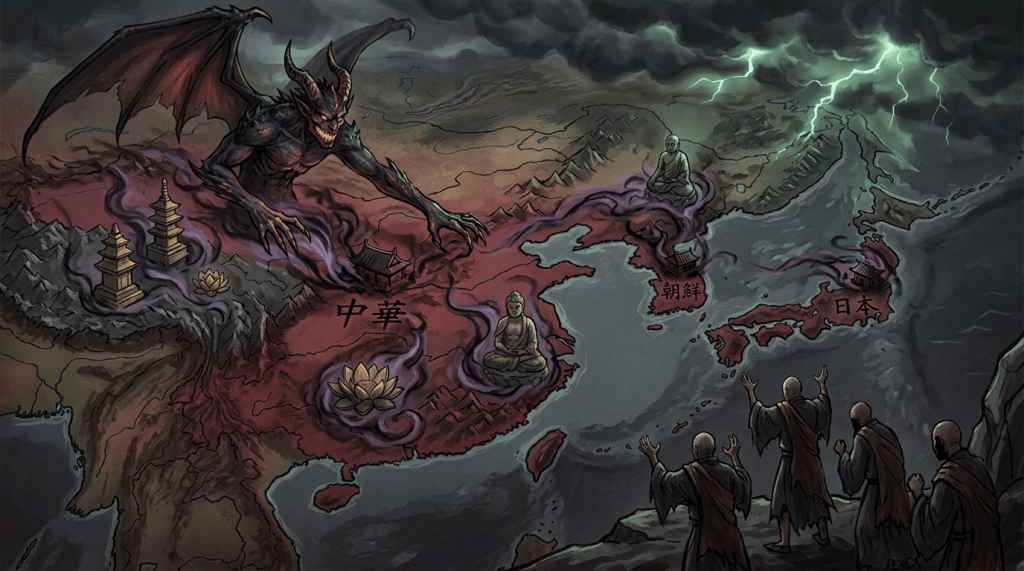
The religion’s account of ultimate reality is equally incompatible with Scripture. Classical formulations do not affirm a personal, eternal Creator who speaks, judges, and redeems. Deities that appear in later or popular forms—devas, bodhisattvas, or local spirits incorporated as protectors—are subordinate or temporary beings still subject to the cycle of rebirth.
Worship directed toward images of the Buddha or other figures, accompanied by offerings of incense, flowers, and food, falls under the prohibition of Exodus 20:4-5: “Thou shalt not make unto thee any graven image… Thou shalt not bow down thyself to them, nor serve them.” Where such offerings are made to spirits or subordinate beings, the apostle’s assessment applies: “the things which the Gentiles sacrifice, they sacrifice to devils, and not to God” (1 Corinthians 10:20).
The Bible knows only one true God, who declares, “I am the Lord: that is my name: and my glory will I not give to another, neither my praise to graven images” (Isaiah 42:8). Any system that withholds worship from this God or redirects it elsewhere is, by definition, the service of a false god.
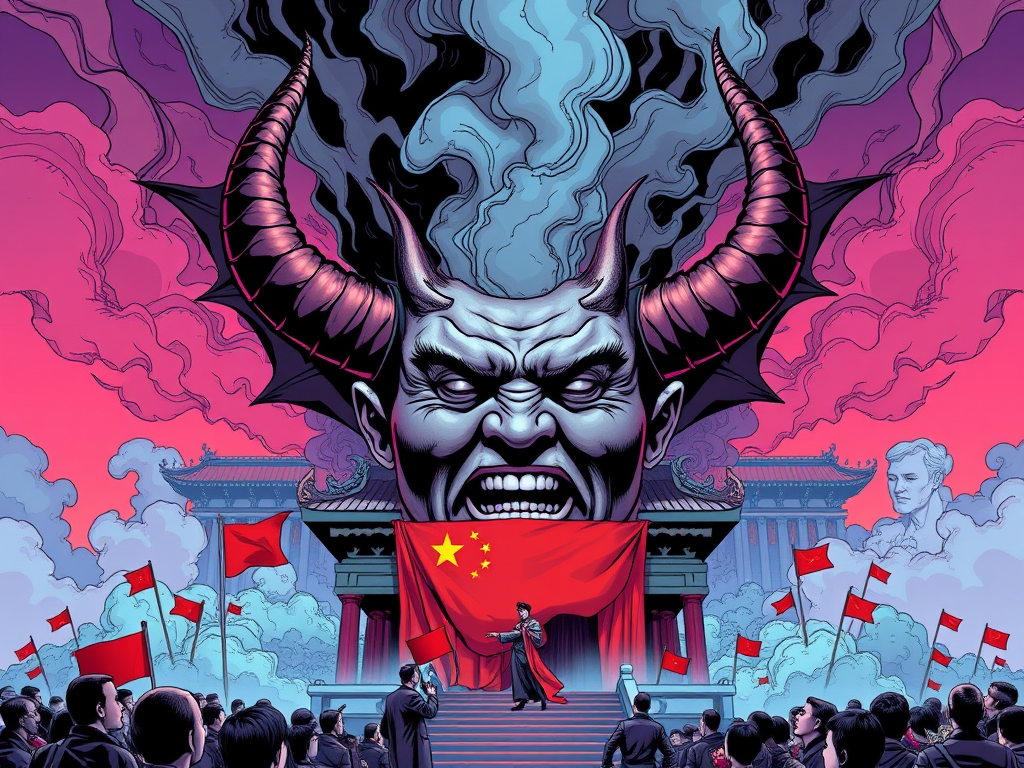
This opposition to the gospel is not incidental; it bears the marks of the spirit of antichrist. The apostle John writes that “every spirit that confesseth not that Jesus Christ is come in the flesh is not of God: and this is that spirit of antichrist” (1 John 4:3). Buddhism has no place for the incarnation of the eternal Son who took on human nature to die for sins and rise again. It offers neither the historical cross nor the empty tomb as the ground of salvation.
Where the gospel proclaims that “there is none other name under heaven given among men, whereby we must be saved” (Acts 4:12), Buddhism presents an alternative path of self-liberation that renders the atoning work of Christ unnecessary. Such a system does not merely differ on secondary matters; it attacks the central message by which sinners are reconciled to God. The warning of 1 Timothy 4:1 is therefore pertinent: in the latter times some shall “give heed to seducing spirits, and doctrines of devils.”
The incorporation of local spirits, the use of images as foci of devotion, and the denial of the unique person and work of Christ fit the pattern.The regional dominance of this system in China, Korea, and Japan illustrates how thoroughly a false religion can embed itself when royal patronage and cultural adaptability meet the absence of the gospel. In China, Buddhism entered via the Silk Road and, by the Tang dynasty, had produced major schools such as Chan and Pure Land while absorbing elements of Daoist and popular religious practice. Temples, cave complexes, and literature reshaped Chinese aesthetics and thought even as periodic persecutions occurred.
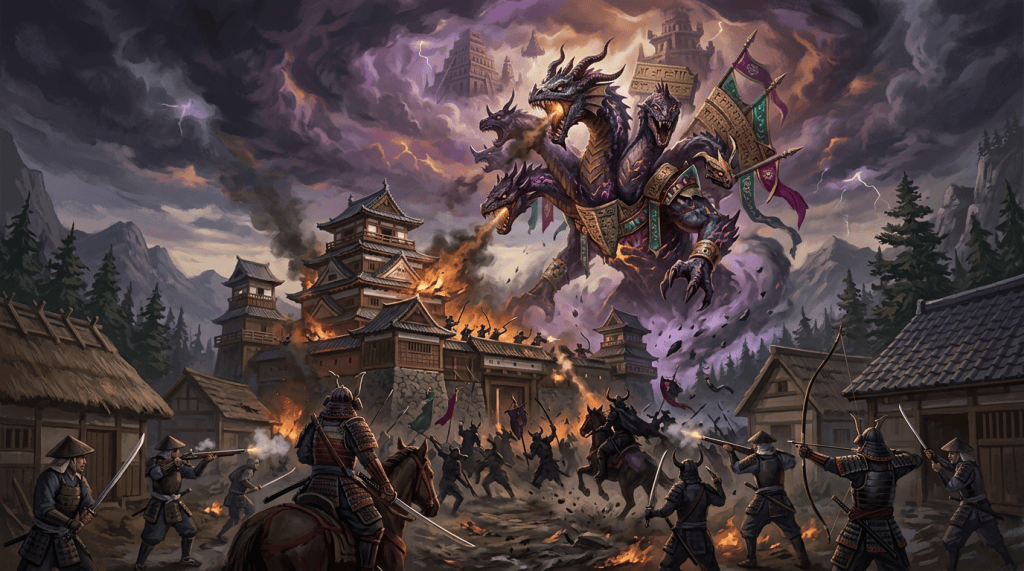
From China the tradition reached the Korean peninsula in the fourth century, becoming a state-supported religion in the Three Kingdoms period and flourishing under the Goryeo dynasty before facing Neo-Confucian pressure under the Joseon. In Japan the official introduction from Korea in the sixth century led to state endorsement under Prince Shōtoku; for centuries Buddhism and indigenous Shinto coexisted in a syncretic arrangement in which local kami were often treated as manifestations or subordinates of Buddhist figures.
Zen, Pure Land, and other schools deeply influenced Japanese art, tea ceremony, martial culture, and funerary practice.Modern surveys show declining formal identification amid secularization, yet the cultural infrastructure remains vast. Estimates of those who identify as Buddhist or regularly engage Buddhist practices run into the tens of millions in each of these societies, with temples continuing to serve as centers of ritual life. The numerical and institutional weight of the religion in these lands does not validate its claims; it demonstrates the capacity of human tradition and demonic deception to occupy the vacuum left when nations do not glorify the Creator as God.
Romans 1 describes precisely this trajectory: the exchange of the truth of God for a lie and the worship of the creature rather than the Creator. The Bible supplies the sole criterion by which these matters are to be judged. Buddhism’s origins are human, its teachings contradict the doctrines of sin, grace, and resurrection, its objects of devotion are idols or subordinate spirits, and its alternative path of salvation stands in opposition to the gospel of Christ’s death, burial, and resurrection.

Dominance in East Asia changes none of these facts. The only remedy remains the message Paul declared: the gospel by which men are saved when they receive and stand in the testimony that Christ died for our sins, was buried, and rose again the third day according to the scriptures. All other paths, however ancient or culturally entrenched, are judged by that standard and found wanting.



Leave a Reply