

The Jewish people have endured centuries of exile, persecution, and attempted annihilation, yet they returned to their ancestral land and built a free, prosperous democracy that stands as a beacon of resilience in a hostile region.

Israel’s right to exist and defend itself is not a partisan slogan but a moral and historical necessity. Most American Jews, particularly those who remain attached to tradition, understand this. The Orthodox community, with its higher birth rates and deeper commitment to the Torah, has grown more supportive of Israel’s security and more skeptical of progressive orthodoxies.
Ordinary Jews—shopkeepers, teachers, engineers, and small-business owners—continue to contribute to American life while maintaining a connection to their people and their God.
A different pattern has emerged among a narrow but highly visible class of secular Jewish elites in media, technology, finance, and philanthropy. These are not the Jewish people as a whole. They are a self-selected subset who have traded the faith of their fathers for the approval of contemporary institutions. They occupy positions of cultural and financial influence disproportionate to their numbers, and they have used that influence to advance causes that would have been unrecognizable—and often abhorrent—to the biblical tradition they nominally inherit.
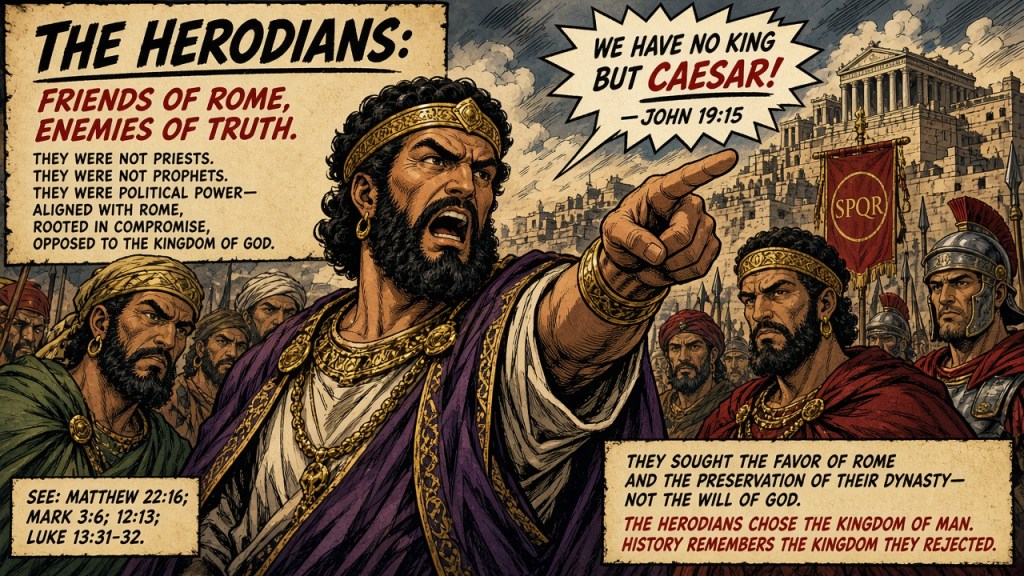
In doing so, they have become the functional equivalent of the Herodians: political realists who collaborate with the dominant power of their age for the sake of status and stability, even when that collaboration requires compromising the core of their heritage.
The Herodians of the first century supported the Roman-appointed dynasty of Herod, client kings whose legitimacy came from imperial favor rather than Davidic succession. They allied with the Pharisees to neutralize Jesus because his claims threatened the arrangement that secured their position. Their defining trait was pragmatism. Jesus warned against their leaven.
Today’s secular Jewish elites practice a similar pragmatism toward the progressive institutions that now set the terms of elite status. Hollywood studios, technology platforms, and major foundations reward conformity to prevailing views on gender, sexuality, immigration, and the relative moral claims of Israel and its adversaries. Figures who navigate these incentives successfully gain wealth and access. Those who resist them risk professional marginalization.
The results are visible. Entertainment products that mock traditional sexual ethics or treat biblical narratives with contempt reach wide audiences. Philanthropic dollars flow to organizations that frame Israel as a colonial project while remaining silent on the explicit eliminationist aims of groups like Hamas. Technology executives and investors who publicly affirm progressive priorities on domestic social issues have, at times, treated criticism of Israel’s self-defense as a career risk for others while insulating themselves through selective statements.
Seth Rogen illustrates the problem.
A successful Hollywood comedian whose films and shows have repeatedly treated biblical themes with crude mockery especially of Jesus Christ—from ‘This Is the End’ to drug-fueled church scenes and comments that Christians are fair game for ridicule—he has built a career and fortune by aligning with the prevailing cultural incentives of progressive entertainment.
At the same time, he has publicly questioned the founding of Israel and described the idea of a Jewish state as antiquated. A Jewish man, who doesn’t believe in the God of his father, who is both an enemy of Christians and the nation of Israel.

This is not the posture of a people faithful to the God of Abraham, Isaac, and Jacob, nor of the many traditional and Orthodox Jews who maintain observance and support Israel’s right to exist and defend itself. Rogen’s choices reflect a narrower elite bargain: worldly status and commercial success purchased at the expense of the distinctive claims of Jewish faith and peoplehood. Unlike Rogen, who has a net worth of roughly 80 million dollars and elite Hollywood status, the Jewish people as a whole have not made that deal.
This is not the behavior of a people faithful to the God who commanded Israel to possess the land and to distinguish itself from the surrounding nations. It is the behavior of a class that has accepted the moral framework of the institutions that confer prestige.
The distinction matters. The Jewish people are not defined by the most secular and institutionally successful among them any more than the American people are defined by Hollywood or Wall Street. Orthodox and traditional Jews have largely rejected the progressive consensus on family, sex, and national identity. They have higher rates of religious observance and, in recent years, stronger identification with conservative politics and with Israel’s right to exist as a Jewish state.

Secular elites who reject the God of their fathers do not speak for them. When critics fail to make this distinction, they slide into the older error of collective indictment. The proper target is the specific pattern of elite collaboration with worldly power, not Jewish peoplehood itself.
Scripture is unambiguous about the danger of serving two masters. “No man can serve two masters,” Jesus taught, “for either he will hate the one, and love the other; or else he will hold to the one, and despise the other. Ye cannot serve God and mammon.” The ancient Herodians chose the arrangement that preserved their influence under Rome. A portion of today’s secular Jewish elites have chosen the arrangement that preserves their influence under progressive cultural hegemony.
In both cases the cost is the same: a willingness to treat the distinctive claims of the God of Israel as negotiable when they conflict with the requirements of status. The Jewish people as a whole have not made that bargain. Israel has not made that bargain.

The elites who have made it should be judged by the bargain they struck, not shielded by the history of a people they have largely set aside.




Leave a Reply