
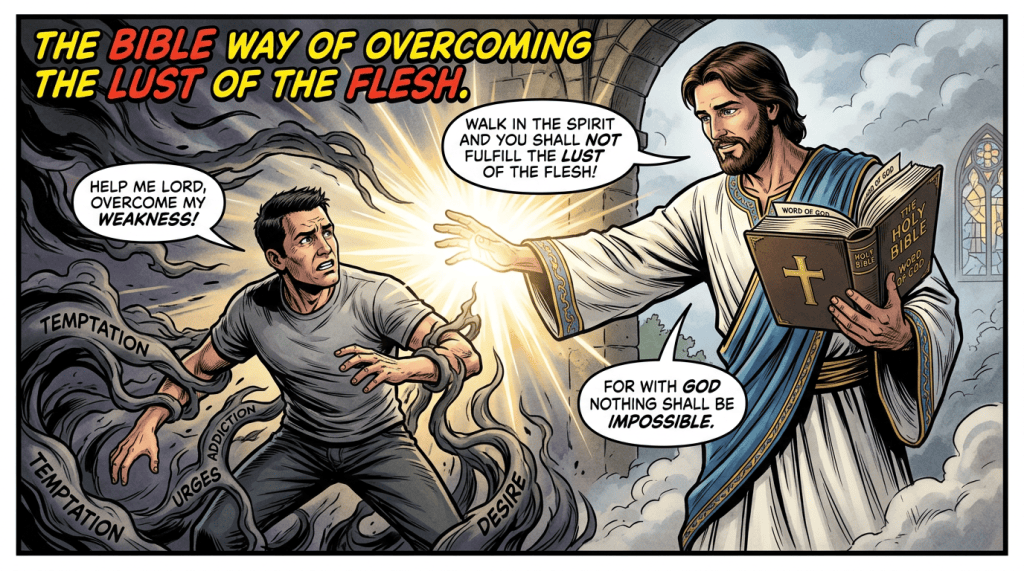
The ancient diagnosis is blunt. In the first letter of John, the writer names “the lust of the flesh” as one of three forces that constitute the world set against God. The letter to the Galatians then itemizes what that lust produces when it is allowed to govern: adultery, fornication, uncleanness, lasciviousness, drunkenness, revellings, and “such like.” These are not obscure theological categories. They are the ordinary failures of appetite—sexual, chemical, and social—that men still recognize in private browsers, late-night texts, and the quiet calculations that keep a marriage or a conscience intact only on the surface.

What the same texts refuse to offer is a technique for managing desire while leaving the desire itself unopposed. Instead they describe a conflict already under way inside anyone who has been joined to Christ. “The flesh lusteth against the Spirit, and the Spirit against the flesh: and these are contrary the one to the other: so that ye cannot do the things that ye would.”
The inability is not total paralysis; it is the daily discovery that wanting rightly and wanting wrongly occupy the same body. Romans 7 records the experience without euphemism: delight in the law of God coexists with another law in the members that wages war and takes captive. The cry for deliverance is answered not by the disappearance of the war but by the presence of a stronger principle—“the law of the Spirit of life in Christ Jesus.”
The practical instruction that follows is therefore neither sentimental nor optional. “Walk in the Spirit, and ye shall not fulfil the lust of the flesh.” Walking here is not a mood. It is the sustained refusal to hand the members of the body over as instruments of the very desires just named. Romans 8 makes the agency explicit: “if ye through the Spirit do mortify the deeds of the body, ye shall live.” Mortification is active.

It includes the command to flee fornication rather than negotiate with it, to make no provision for the flesh, and to set affection on things above because the life in question is already hid with Christ. The same passages treat marriage, where it is given, as the appointed containment for sexual desire—“to avoid fornication, let every man have his own wife”—while insisting that marriage itself does not cancel the need to possess one’s vessel in sanctification and honor.
Sanctification, in these letters, is both a status already conferred and a work still required. Those who once practiced the listed sins “are washed, but ye are sanctified, but ye are justified in the name of the Lord Jesus, and by the Spirit of our God.” Yet the will of God remains “your sanctification, that ye should abstain from fornication.”
The word is the instrument of the ongoing separation: “Sanctify them through thy truth: thy word is truth.” Beholding the glory of the Lord produces change “from glory to glory, even as by the Spirit of the Lord.” The believer is told both that God works in him to will and to do, and that he must work out his own salvation with fear and trembling—cleansing himself from filthiness of the flesh and spirit, perfecting holiness in the fear of God.

None of this language softens the modern setting in which the lust appears. Pornography is simply uncleanness and lasciviousness rendered frictionless; serial non-marital sex is fornication under updated manners; intoxication pursued as relief is the revelling the text already forbade. The remedy the letters prescribe does not depend on the particular technology.
It depends on reckoning the old man crucified, yielding the body to righteousness rather than to iniquity, and continuing to walk by the Spirit who wars against the contrary desire. Confession restores when the flesh wins a particular hour—“If we confess our sins, he is faithful and just to forgive us our sins, and to cleanse us from all unrighteousness”—but continued practice without forsaking is treated as evidence that one remains after the flesh.
The end named in the texts is not managed coexistence with appetite but presentation “holy and without blemish.” Until then the opposition inside the mortal body continues, and the commands remain the same: abstain, flee, mortify, walk. The letters offer no assurance that the desire will feel weaker tomorrow.

They offer the assurance that the man who walks in the Spirit will not fulfill it.


Leave a Reply