
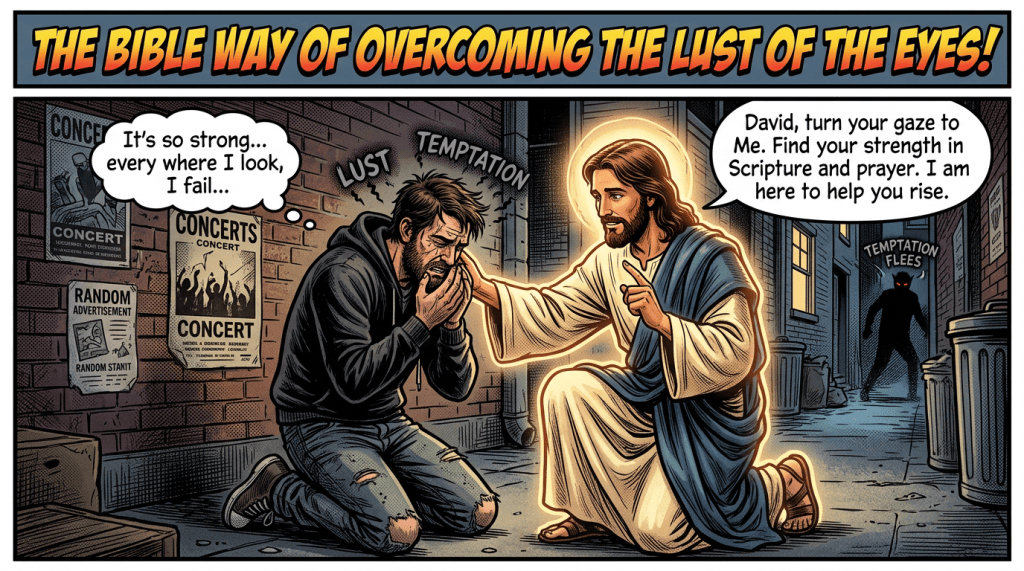
The screen does not invent a new sin. It only multiplies an old one. A man opens his phone in the ordinary course of a day and is met by bodies arranged to be desired, advertisements that treat attention as a purchase, and feeds that learn what his eye lingers on and then supply more of it. The pattern is older than the device. In the account of the first transgression, the woman saw that the tree was pleasant to the eyes and a tree to be desired, and she took. The sequence has not been revised: sight, desire, taking.

The New Testament names the middle term. “All that is in the world,” one letter says, “the lust of the flesh, and the lust of the eyes, and the pride of life, is not of the Father, but is of the world.” The lust of the eyes is desire awakened and steered by what is seen. It is distinguished from bodily appetite and from the vanity of status. Another sentence makes the moral weight plain: whoever looks on a woman to lust after her has already committed adultery in his heart. The prohibition is not limited to a person standing in the room. It attaches to the look that produces the desire. Images made and sought for that purpose fall under the same sentence.
Modern conditions change the supply, not the category. Pornography is the concentrated form. Public dress, algorithmic video, and storefront display are the diffuse form. Both train the eye to take what is offered and to want the next frame. The world, the same letter continues, passes away, and the lust of it. The man who does the will of God abides. The practical question is what that will requires when the occasion sits in a pocket.
Scripture’s answer is prior and severe, not managerial. One man records that he made a covenant with his eyes, so that he would not think upon a maid. The covenant is made before the second look, not negotiated after it. A psalm prays that the eyes be turned from beholding vanity. Another resolves to set no wicked thing before the eyes. These are not moods. They are refusals of the inlet.

Where the inlet has already become a habit, the language grows surgical. If the right eye offends, pluck it out and cast it from you; it is better that one member perish than that the whole body be cast into hell. The image is hyperbolic for the body and literal for the occasion. The account, the private hour, the unrestricted device, the feed ordered around display—these are the doors. An older proverb tells the hearer to remove his way far from the forbidden house and not to come near the door. Distance is the method. A boundary the man can lift alone, at the moment of wanting, is not yet distance.
Flight is commanded in the same key. Flee youthful lusts, and then follow righteousness with those who call on the Lord out of a pure heart. Flee fornication. Abstain from every appearance of evil. The alternative is not a cleaner willpower inside the same room. It is a different room, a different company, and a mind already occupied. Set your affection on things above, not on things on the earth, and mortify what belongs to the earth—including uncleanness and covetousness. Whatever is true, honest, just, pure, and of good report, think on these things. Walk in the Spirit, and the lust of the flesh is not fulfilled. Put on the Lord Jesus Christ, and make no provision for the flesh. Provision is the kept access. Removing it is part of the obedience, not a preliminary to obedience.
Rising after a fall belongs inside those limits, not outside them. A proverb observes that a just man falls seven times and rises again, while the wicked fall into mischief. The contrast is the rising, not the absence of the fall. Another proverb attaches mercy to a double act: he who confesses and forsakes finds mercy; he who covers his sins does not prosper. Confession that leaves the door open is still a covering. The advocate with the Father, and the hand that upholds the good man so that he is not utterly cast down, meet the man who arises. Arising includes the cast-away occasion. Seven is not a quota that excuses the unblocked screen. It is the number of times the fall is refused as a dwelling.

None of this cleanses the public square. The landscape will continue to present the lust, because the world is still the world. The plan does not wait on a reformed culture. It binds the eyes in advance, casts away the instruments that repeat the offense, flees the company that treats the look as normal, fills the vacant minute with the word, and treats each return to the same vanity as a reason to tighten the severance rather than to reinterpret the fall. The lust passes with the world. The man who does the will of God is told that he abides.




Leave a Reply