
On a November morning in 2009, Major Nidal Hasan walked into a processing center at Fort Hood, bowed his head, shouted “Allahu Akbar,” and opened fire on unarmed soldiers preparing to deploy.
Thirteen people died. Thirty-two were wounded. Private Francheska Velez was pregnant; her unborn child died with her. Hasan had told colleagues that infidels should be beheaded and would burn in hell. He carried cards marked “Soldier of Allah.” He had written to the cleric Anwar al-Awlaki asking when jihad was lawful. A court-martial convicted him of premeditated murder and sentenced him to death. This week the Army set an execution date of December 3, by firing squad, the first military execution in 65 years.
The sentence has reopened a quarrel that modern Christianity prefers to treat as settled. Lila Rose, the Catholic founder of Live Action, answered the defenders of that sentence directly. Capital punishment, she wrote, “can be just in extreme circumstances if necessary to protect the common good, but not in modern America.” The Bible “does not mandate capital punishment in America.” In a nation with maximum-security prisons, she has argued, execution is unnecessary and inhumane, a relic of an age that could not lock a killer away for life. Vengeance belongs to the Lord. A horrific crime does not erase the criminal’s humanity.
The argument is serious, and it is widespread. It is also not what the texts say.
The oldest warrant is not an Israelite statute. After the flood, speaking to Noah and his sons — that is, to the human race — the King James Version records: “Whoso sheddeth man’s blood, by man shall his blood be shed: for in the image of God made he man” (Genesis 9:6). The ground is the image, not the technology of confinement. The instrument is man. “Whoso” does not expire when a nation learns to pour concrete. Hasan shed the blood of thirteen image-bearers and of the child one of them carried. The sentence the verse states is that his blood be shed by man.
Numbers 35 then closes the door on substitutes. The killer who strikes with iron, or lies in wait, or strikes in hatred, “shall surely be put to death.” One witness is not enough. And then: “ye shall take no satisfaction for the life of a murderer, which is guilty of death: but he shall be surely put to death… for blood it defileth the land: and the land cannot be cleansed of the blood that is shed therein, but by the blood of him that shed it.” Satisfaction means a ransom, a fine, a penalty that leaves the murderer alive. Life imprisonment is satisfaction. The chapter distinguishes manslaughter, which has a city of refuge, from murder, which does not. Hasan armed himself, entered a room of people who could not fight back, and fired. That is the case assigned to death.
Romans 13 does not withdraw the rule under the gospel or under a pagan magistrate. The ruler “beareth not the sword in vain: for he is the minister of God, a revenger to execute wrath upon him that doeth evil.” A sword is not a metaphor for a cell key. Paul wrote to Christians in Rome, not to elders in a theocracy that lacked jails. The claim that prisons repeal the text requires a sentence the text does not contain.
Ms. Rose’s stronger point is prudential: modern states can err, and an execution cannot be undone. That caution belongs to procedure — two or three witnesses, a record, appeals — not to a blanket exemption for a nation that owns prisons. Hasan’s guilt is not a close case. He announced the act in the religious vocabulary of the system that sent him, and he was convicted of it. Certainty of guilt was the condition Numbers already required. It is met here.
The same revision that exempts the murderer also edits the judge. The pacifist Christ of the seminar and the op-ed page is not the Christ of the book. “Jesus Christ the same yesterday, and to day, and for ever” (Hebrews 13:8). The Word by whom all things were made is the one who required the murderer’s blood and who will return, John writes, judging and making war, a sword proceeding out of his mouth. “Think not that I am come to send peace on earth: I came not to send peace, but a sword” (Matthew 10:34). The command to turn the other cheek concerns a personal insult, not the magistrate and not a mass killing. He drove the merchants from the temple with a scourge. He told the disciples, at the end, that the man without a sword should sell his cloak and buy one. A Christ who forbids the sword in the hand of the minister of God is a Christ the New Testament does not contain.
Apply the same sentences without a special pleading for the age, and the class of offenders is not a handful of barracks shooters.
The World Health Organization and the Guttmacher Institute put induced abortions at about 73 million a year in the most recent global estimates, up from roughly 50 million a year in the later twentieth century and about 56 million in the decades after 1995. Stack those annual rates from 1980 forward and the cumulative total lands between 2.5 and 2.7 billion by the middle of this decade.
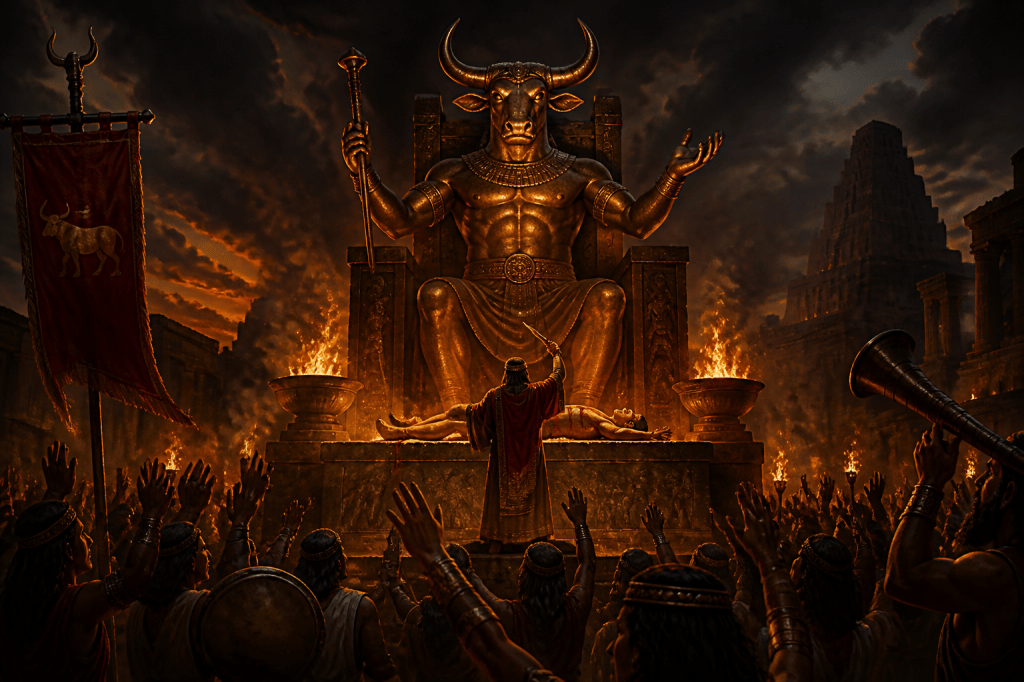
It is an extrapolation from published annual estimates, not a single census, and stricter tallies come in lower. It is still the scale implied by the figures the public-health authorities themselves use. Unique women are fewer than procedures, because many women abort more than once, and physicians perform most of the acts. The biblical category does not care about that distinction in the way a modern statute might.
Genesis 9 speaks of whoso sheds man’s blood. Numbers 35 forbids satisfaction for the life of the murderer and says the land is cleansed by the blood of the one who shed it. If the unborn child is the neighbor made in the image of God — the claim on which the case against abortion has always rested — then the woman who procures the killing and the practitioner who performs it are shedders of that blood.
That implication is why the modern exception is so fiercely guarded. A rule that binds Hasan and then stops at the clinic door is not a reading of Genesis 9. It is a truce with the age. Ms. Rose has spent her public life insisting that the child in the womb is a human being whose blood may not be shed. The texts she sets aside to spare the modern state are the same texts that make that insistence a demand for justice rather than a sentiment.
They do not say the demand lapses when the killers are numerous, or female, or convinced they have done no wrong. They say the blood is required, by man, because the victim was made in the image of God.


Leave a Reply