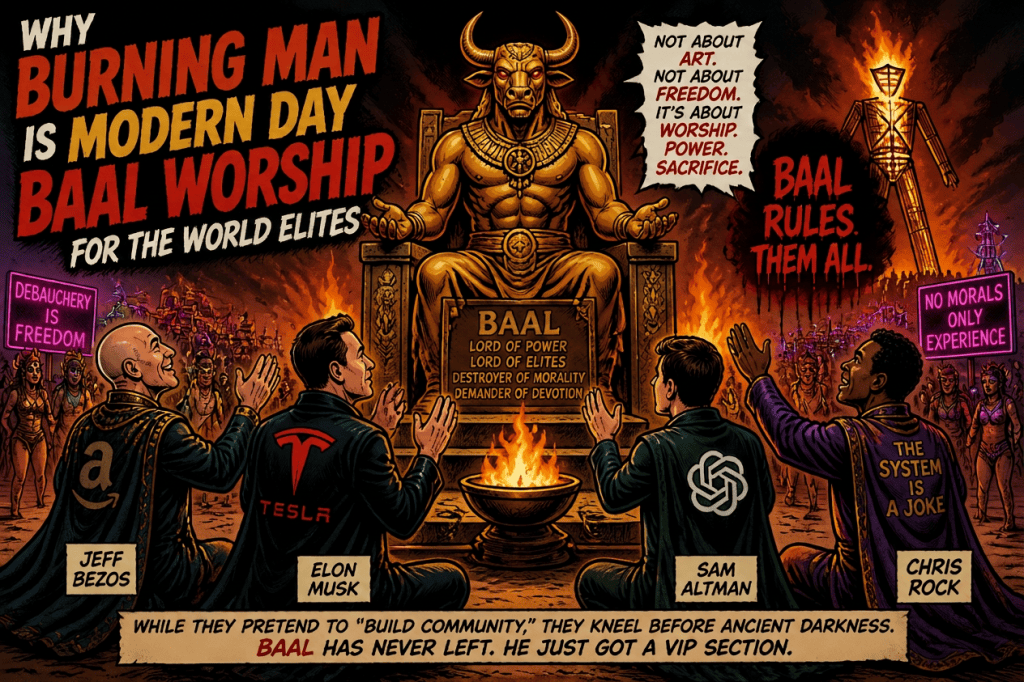
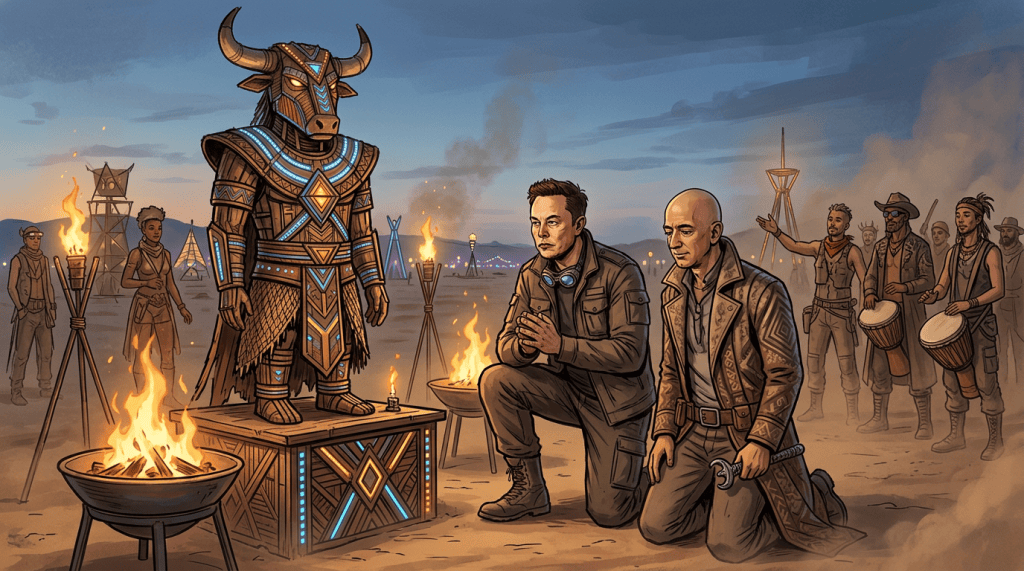
The wooden man still burns. Every late summer, in the alkaline dust of Nevada’s Black Rock Desert, tens of thousands of people gather to raise a human-shaped effigy, circle it for a week, and set it alight. The organizers insist the figure means nothing in particular. That claim deserves scrutiny. A rite does not become innocent because its priests decline to name the god.
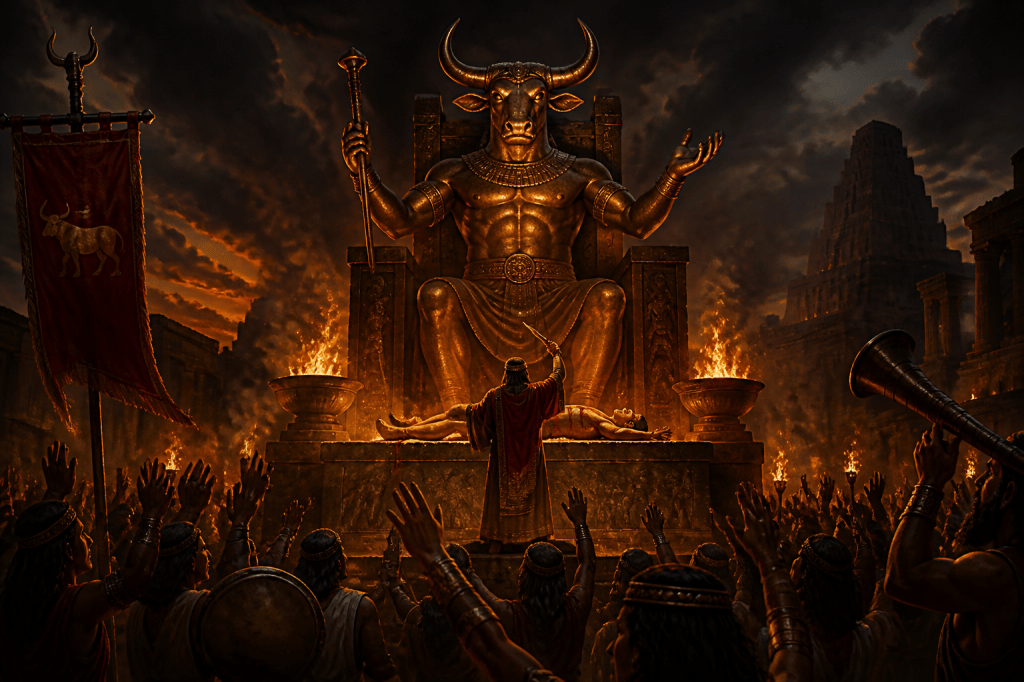
Scripture’s record of Baal worship is not vague. The King James text describes a recurring pattern: a people forsake the Lord’s commands, build high places, bow to images, join themselves to other lords through sacrificial feasts and sexual license, and are often led there by kings and elites. “They have built also the high places of Baal, to burn their sons with fire for burnt offerings unto Baal, which I commanded not,” Jeremiah 19:5 records. At Baal-peor the mechanism was simpler and more familiar: Israel “began to commit whoredom with the daughters of Moab (Numbers 25:1)” ate their sacrifices, bowed, and “joined himself unto Baalpeor.” The title Baal means lord or master. The offense was not a trademark. It was the transfer of allegiance.
Burning Man began in 1986, when Larry Harvey and Jerry James burned an eight-foot wooden man on a San Francisco beach at the summer solstice. The event later moved to the desert and acquired, in 2004, ten principles that now govern the temporary city. Read without sentiment, those principles are a creed of autonomy. Radical self-reliance tells the participant to “discover, exercise and rely on their inner resources.” Radical self-expression holds that “no one other than the individual or a collaborating group can determine its content.”
Immediacy declares immediate experience “the most important touchstone of value,” and warns that “no idea can substitute for this experience.” This is the old “I will” in modern prose: the creature as the measure, the moment as the judge, no external word permitted to interrupt.
The same impulse appears, without biblical vocabulary, in the Nine Satanic Statements of Anton LaVey: indulgence instead of abstinence, vital existence instead of spiritual pipe dreams, the so-called sins as routes to gratification. LaVeyan Satanism is largely symbolic; it does not require a personal devil. It does require the rejection of any moral claim that originates outside the self. Burning Man does not distribute The Satanic Bible at the gate. It does not need to. Its operating rules already enact the rejection.
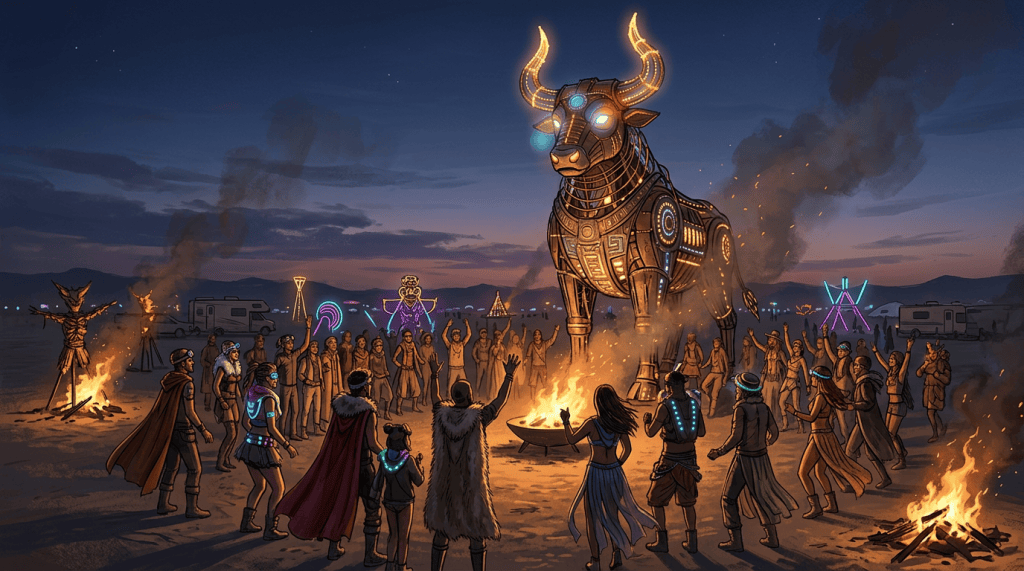
The central act remains the burn. Official language calls it release and renewal. Participants are invited to supply their own meaning. That is precisely how image-and-fire rites survive scrutiny. Deuteronomy does not ask whether the worshipper has a sophisticated theory of the pillar or the grove. It forbids the practice of making and serving images, and of doing “whatsoever is right in his own eyes.”
Organizers have at times bristled at comparisons to the wicker man, the old European effigy linked in antiquarian literature to sacrifice. One early collaborator later said they had seen the film before the first burn. The denial of a source does not erase the form: a human figure, built at the center of a wilderness assembly, consumed by fire before a crowd.
Around that fire the culture has long included what Numbers 25 would recognize. Public reporting and participant accounts describe widespread nudity, psychedelic use, and organized sexual spaces, including the much-discussed Orgy Dome. This is not secret temple prostitution of the Canaanite kind. It is the same joining by another name: sexual license treated as communal experience rather than as a boundary. The biblical writers did not require a fertility theology before they called the pattern whoredom. They required the act and the assembly.
The elite attendance fits the older record as well. Ahab and Jezebel sponsored the prophets of Baal; Manasseh rebuilt the altars. In our century the sponsors arrive by private aviation. Elon Musk has attended for years and posted about the event as recently as 2022. Sam Altman has said he went five or six times. Sergey Brin was reported there as recently as 2023. Josh Kushner was photographed on the playa in 2022. Ray Dalio appeared in 2019. Jeffrey Katzenberg was present for a 2022 drone display he later cited as an investment prompt.
Among entertainers, Paris Hilton returned repeatedly in the 2010s and again in 2022; Karlie Kloss, Cindy Crawford, and Kaia Gerber have posted from the desert; Diplo and Chris Rock were among those stranded by the 2023 mud. In the narrower window of the last two years the public celebrity list thins, but it does not vanish: Scott Eastwood posted from the 2024 burn, and Bethenny Frankel documented her first attendance, RV and all, in 2026.

None of this is child sacrifice. Jeremiah’s specific horror is not on the program, and it would be dishonest to pretend otherwise. The event is not a clandestine cult of a deity named Baal. Its founders described solstice catharsis, Dada, and later a secular ethos of gifting and leave-no-trace. Some principles—cleanup, civil cooperation—are ordinary prudence. The indictment does not require every ancient atrocity to be restaged. It requires the governing pattern: an image raised and burned, a temporary high place in the wilderness, sexual license as a feature of the gathering, and a public creed that locates authority in the inner self and the immediate moment. Cultural and economic leaders normalize it by showing up.
A society that cannot name this pattern will keep funding it. Tickets, art grants, luxury camps, and breathless profiles treat the burn as creativity with dust. The older books used a plainer word. They called it service to another lord. The man is built. The man is burned. The crowd calls the emptiness meaning. That is not a rebuttal. It is the rite.



Leave a comment