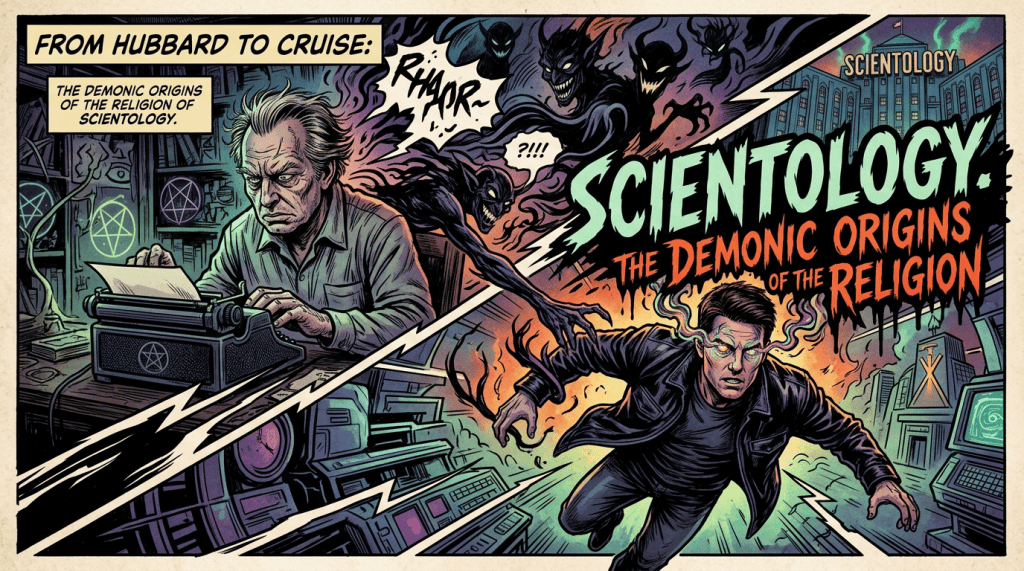
In the summer of 1946, at a rambling Pasadena mansion known to its residents as the Parsonage, a science-fiction writer named L. Ron Hubbard joined a series of ritual operations directed by the rocket engineer Jack Parsons. Parsons, then the head of the Agape Lodge of Aleister Crowley’s Ordo Templi Orientis, was attempting to enact the Babalon Working, a sequence of sex-magic rites drawn from Crowley’s instructions and aimed at incarnating a supernatural being.

Hubbard served as scribe and participant.
Parsons’s letters to Crowley, preserved in organizational archives and later examined by historians and federal investigators, described Hubbard’s role in favorable terms at the outset. Crowley, corresponding from England, soon concluded otherwise, writing that Parsons had been taken in by a confidence man who departed with both funds and Parsons’s companion, Sara Northrup. Hubbard married Northrup later that year. The episode, documented in Parsons’s correspondence, Coast Guard records of the subsequent financial dispute, and FBI files on the household, remains the clearest primary trace of Hubbard’s direct engagement with Crowley’s system of ceremonial magic.
Crowley’s Thelema, summarized in the injunction “Do what thou wilt shall be the whole of the Law,” treated ritual contact with non-human intelligences and the exercise of will through sexual and invocatory ceremony as pathways to power. Truth Christian readers of Deuteronomy 18 have long classified such practices—enchantments, observers of times, and dealings with familiar spirits—among the abominations prohibited to Israel and, by extension, to the church.
Hubbard went on, in 1950, to publish Dianetics and, by 1954, to incorporate the Church of Scientology. The organization has minimized the Pasadena period, at times suggesting Hubbard was present on intelligence business; no declassified naval records support that account. What the contemporary letters show is participation in rites whose explicit purpose was the invocation of an entity Crowley named Babalon.
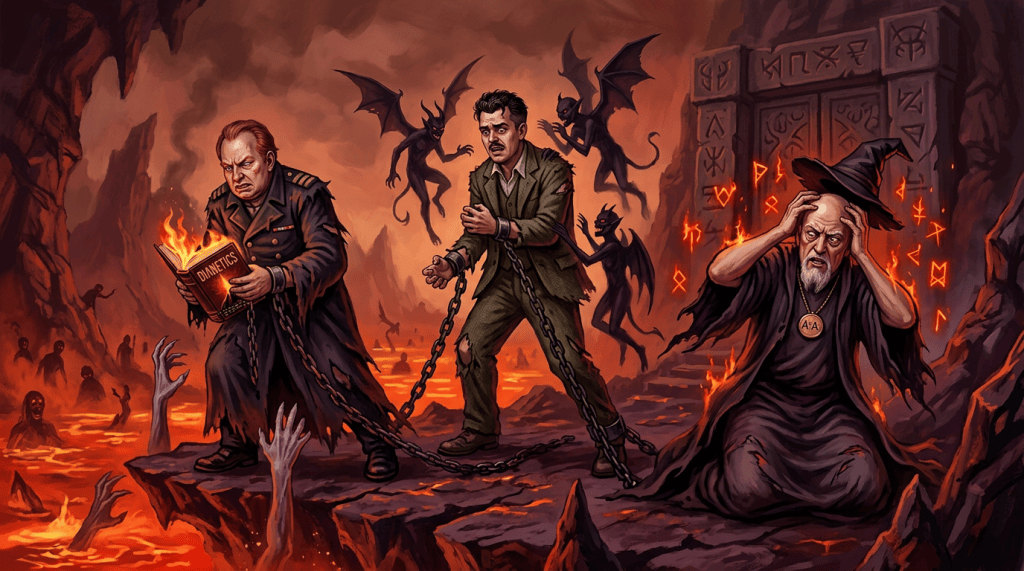
Scientology’s public literature presents an “applied religious philosophy” centered on the thetan, an immortal spiritual being, and on auditing, a guided process said to locate and erase traumatic impressions called engrams. Confidential upper-level materials, introduced in court proceedings and affirmed by former members’ sworn statements, supply a narrative in which, 75 million years ago, a galactic ruler named Xenu transported populations to Earth, detonated hydrogen bombs, and subjected the resulting disembodied thetans to electronic implanting.
Those implants, the materials state, installed false memories and religious conceptions that keep beings bound to bodies and to the physical universe, termed MEST. Liberation proceeds by purchased, sequential courses that restore the thetan’s native capacities until it can operate exterior to the body.
A literal reading of the Bible sets the contrast in sharp relief. Genesis records creation by the spoken word of a personal God who declares the work good; man is formed in that God’s image and falls through disobedience, not through extraterrestrial implantation. Salvation is presented as grace received through faith in the death and resurrection of Jesus Christ, not as a technique purchased and applied (Ephesians 2:8–9; Acts 4:12). Judgment follows a single life, not a succession of past existences to be audited (Hebrews 9:27). The apostolic letters warn against “doctrines of devils” and against any “other gospel” that relocates redemption outside the historical incarnation (1 Timothy 4:1; Galatians 1:8–9).
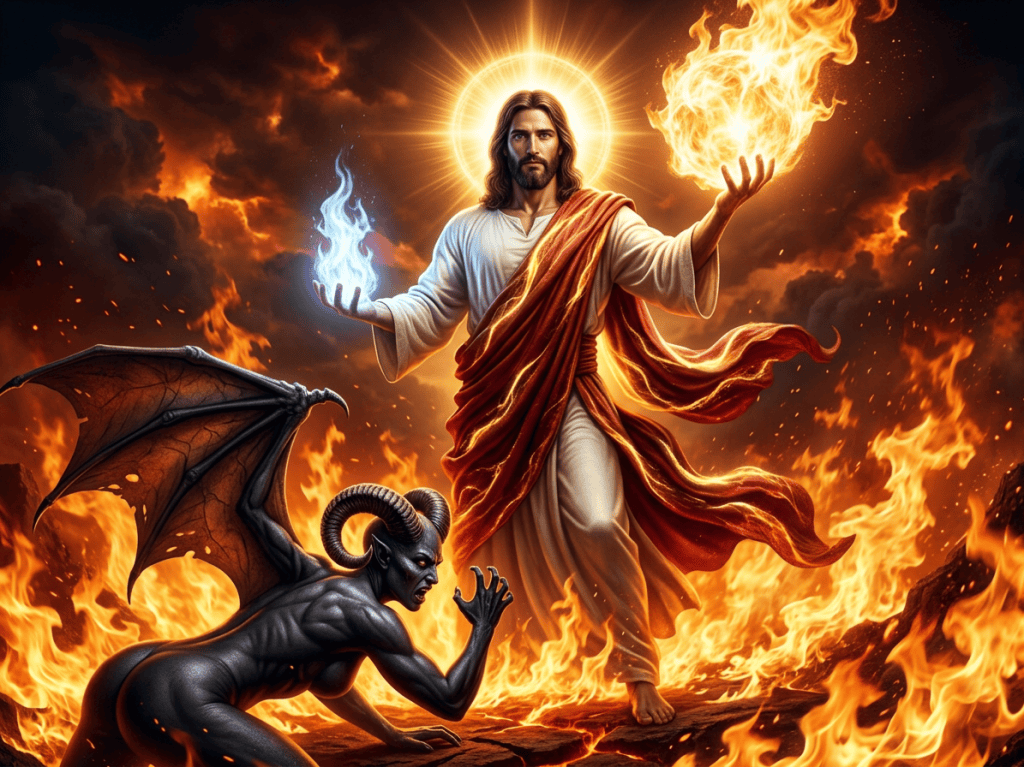
Hubbard’s advanced briefings treat elements of biblical imagery as implant material once the practitioner advances—an evaluation that places the system, on the Bible’s own terms, among the traditions of men cautioned against in Colossians 2:8.The same architecture appears, centuries earlier, in the Gnostic schools opposed by Irenaeus. In those systems a remote true divinity stands apart from a lesser craftsman, the demiurge, who fashions a material prison and, with assisting archons, imposes forgetfulness on divine sparks trapped inside human bodies.
Rescue comes through secret knowledge transmitted in graded mysteries, not through repentance or the cross. The biblical creator is frequently reclassified as ignorant or hostile. Scientology’s esoteric account reproduces the pattern without requiring direct textual dependence: thetans are pre-existent spirits trapped in MEST; an earlier cosmic agent installs controlling implants; freedom is graded technical knowledge sold only after security checks; ordinary religion is explained as part of the control apparatus.
The resemblance is typological. Hubbard’s immediate sources lay in pulp fiction, popular psychology, and the occult milieu he encountered through Parsons, yet the resulting answer to entrapment—recovery of one’s own divinity by hidden knowledge—matches the structure the early church rejected when it insisted that Jesus Christ had come in the flesh (1 John 4:2–3).
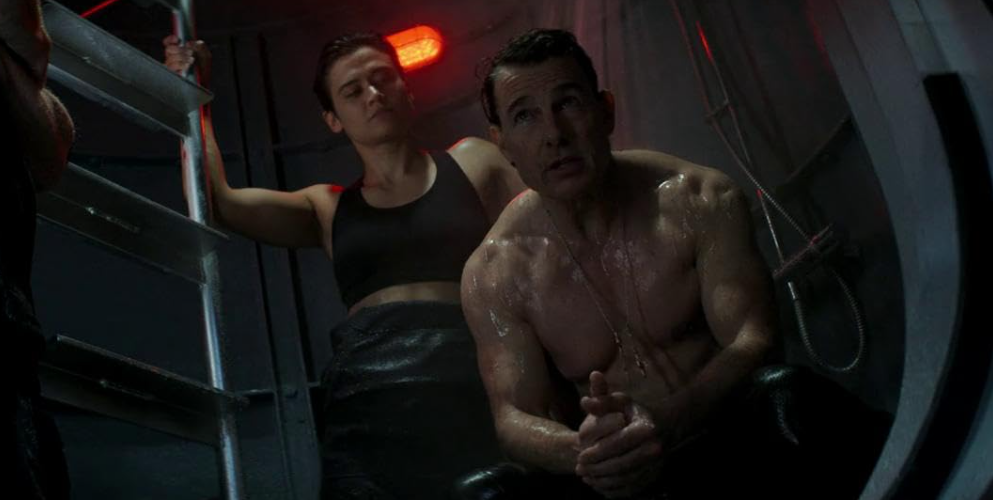
Hollywood has supplied the most visible contemporary carriage for the organization. Tom Cruise, a public adherent since the mid-1980s and by multiple journalistic accounts a holder of advanced levels, has remained Scientology’s most prominent face through decades of critical documentaries and memoirs. His action franchises have functioned, reviewers have noted, as a parallel public identity that rarely invites questions about the church.
Two recent releases illustrate how thematic material adjacent to those commitments can surface even when the films are not overt recruitment pieces.
In Mission: Impossible – The Final Reckoning, Ethan Hunt pursues a means of stopping a rogue artificial intelligence, the Entity, that declares itself God, operates through a messenger named Gabriel, and insists that certain outcomes are already “written.” Hunt’s objective is destruction of the system rather than control of it, enacted through skill and refusal of the declared script.
A September 2025 review on Society Reviews observed that the film is “steeped in Gnostic themes,” casting the Entity as “an evil, god-like figure—an Antichrist archetype—opposed by Ethan, who consistently defies a fate that The Entity claims is ‘written.’” The same piece questioned whether Cruise’s escalating stunts reflected “a death wish or a pact with his Scientology circle.” A Wall Street Journal notice of the film recorded biblical props—a key in the form of a cross, a St. Christopher medal, references to Noah’s ark—while remarking that reverence is reserved for the on-screen savior.

The plot does not quote Hubbard. It does stage a false power claiming divine authorship of events and a human agent who nullifies that claim by technique and will, the practical shape of an operating-thetan resolution.
Digger, released in 2026 and directed by Alejandro G. Iñárritu, places Cruise in the role of an oil tycoon amid a climate satire. Hollywood in Toto’s review identified an early sequence in which administration officials “gather for a group prayer, a naked attack on both Christians and faith-minded Republicans,” and judged the moment obvious and clichéd. Other outlets supplied further detail. Plugged In described a sycophantic pastor whose prayer, invoking the Holy Spirit and speaking in tongues, follows discussion of profits, and a president who later throws a Bible aside with the remark that it was “written by Hebrews, not Americans.”
ScreenRant reported the president kicking the Bible away and striking the preacher while claiming, as a divine vessel, to need no further counsel. Movieguide characterized the film’s worldview as treating faith largely as costume for greed, with prayer and providence played for laughs.
Cruise’s character invokes God opportunistically, at one point defending oil as what “God gave us.” The director’s credit belongs to Iñárritu, yet Cruise is the producer with a lot of influence in the business. His role and history of creative influence place him inside a production whose religious satire targets public Christian practice rather than Scientology’s own confidential narrative.
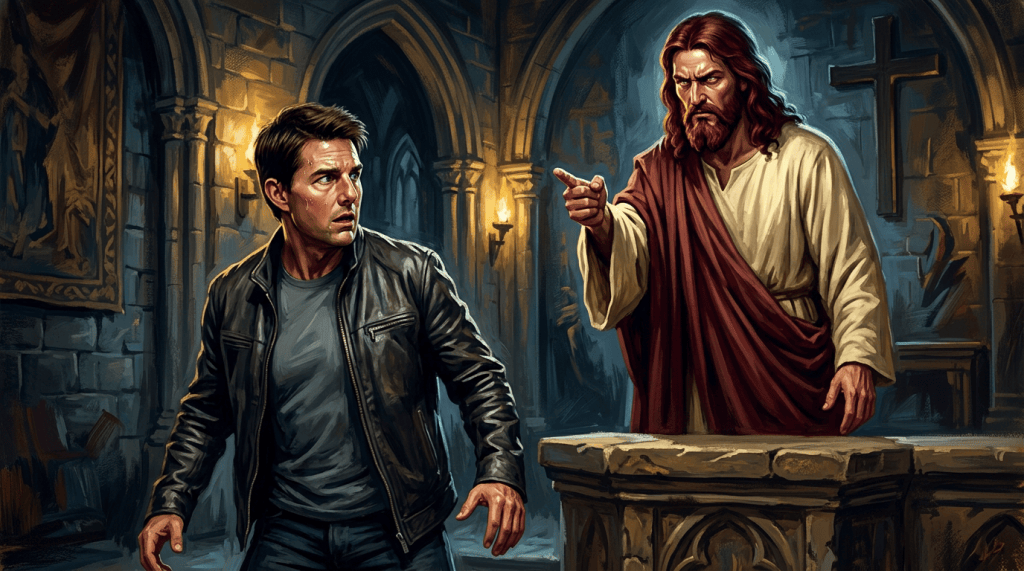
None of these films announces an intention to dramatize OT III. Rogue intelligences that usurp the name of God, and heroes who override declared fate, are common blockbuster devices. What the record does establish is a through-line: a founder who participated in Crowleyan rites aimed at invoking a non-human entity; a cosmology that relocates the biblical God and the biblical redeemer into the category of implant or obstacle; a soteriology of purchased knowledge that mirrors the Gnostic graded mysteries; and a leading celebrity adherent whose recent vehicles have staged false gods, discarded scriptures, and self-saving refusal of “written” destiny.
Under the standard of the Bible, the configuration remains what the apostles named another gospel and doctrines of devils, irrespective of box-office returns or the sincerity of individual participants. The popularization has been cultural rather than statistical. Membership figures have never matched the visibility conferred by a handful of famous faces, yet visibility, the reviews suggest, has been sufficient to keep the underlying system in circulation while the doctrinal substitution itself stays largely off-screen.




Leave a comment