
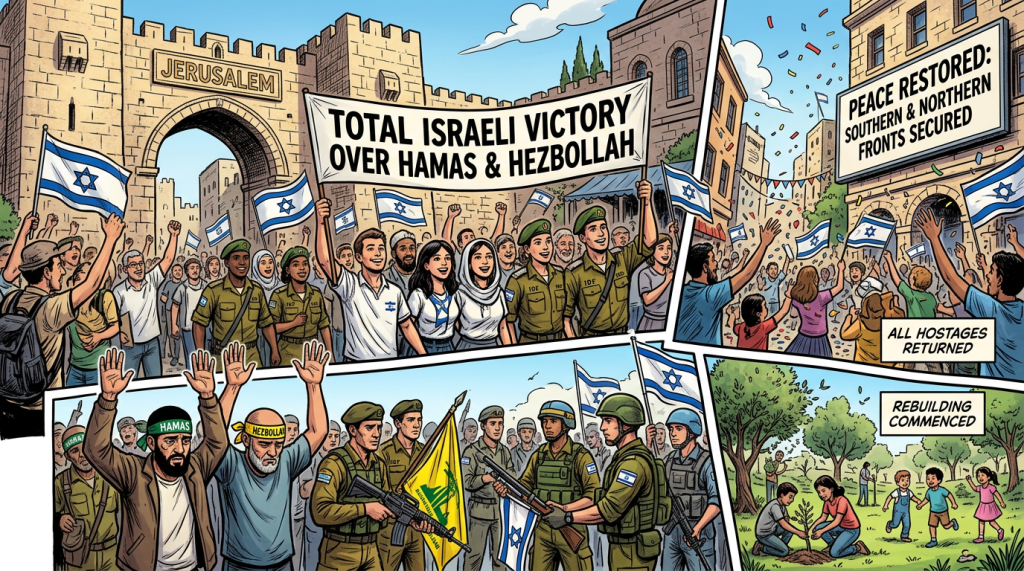
If Israel finishes Hamas and Hezbollah, the world will not applaud. Zechariah said it would not.
There is a sentence in the Hebrew prophets that modern diplomacy keeps trying not to read. “And in that day,” Zechariah writes, “will I make Jerusalem a burdensome stone for all people: all that burden themselves with it shall be cut in pieces, though all the people of the earth be gathered together against it.” It is not a metaphor for a peace process. It is a description of a city that has become too heavy to lift and too dangerous to drop.
Apply that sentence to the war that has defined this decade and the picture clarifies. Hamas in Gaza and the West Bank, and Hezbollah in Lebanon, have been the instruments by which much of the world managed Jerusalem. They were the reason a ceasefire could always be demanded, the reason a “day after” could always be postponed, the reason Israel could be told that security was a negotiation rather than a fact. A total defeat of those forces would not settle the argument over the land. It would remove the intermediaries. The stone would then sit in the open, and every capital that has leaned on it would have to decide whether to carry it or to let it fall on their own feet.
That is the meaning of a burdensome stone. It is not that Jerusalem becomes popular. It is that Jerusalem becomes unavoidable.
For two years and more, the fighting in Gaza and on the northern border has been discussed as if the problem were intensity. Intensity is not the problem Zechariah names. The problem is outcome. So long as Hamas still governs a strip of the coast and Hezbollah still holds a parallel army on the Litani, the international system has a familiar script: restrain Israel, preserve a Palestinian address, keep Lebanon’s south in a state of armed ambiguity, and call the arrangement stability. The script fails the moment those two armies are gone. There is then no address left that can be invited to a conference as the other party to the land. There is only the state that won, and the city at its center.
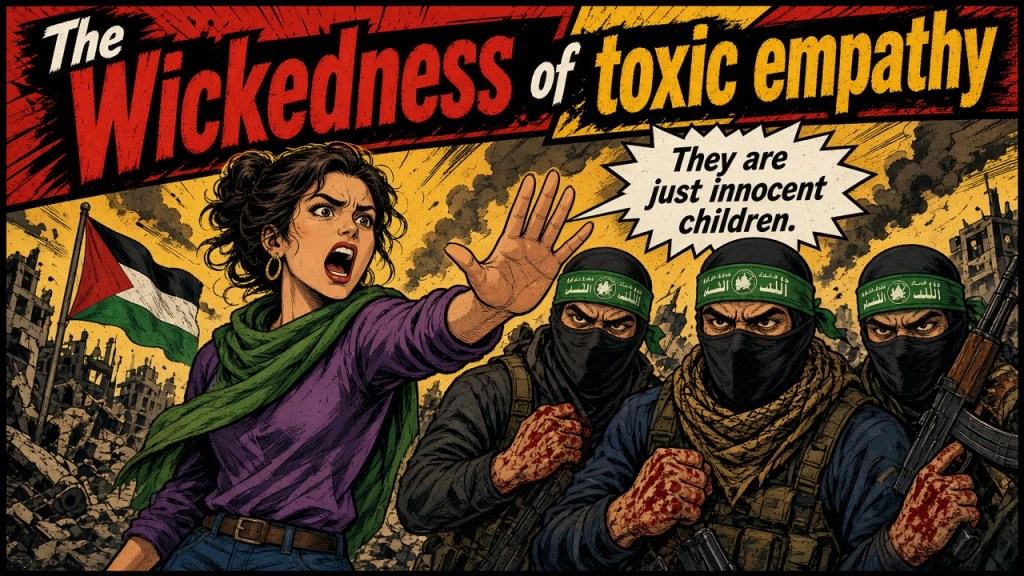
The world has already shown what it does when that possibility comes into view. It does not ask whether the defeated organizations murdered civilians, built tunnels under hospitals, or turned villages into launch pads. It asks whether the victor will now be permitted to keep what victory produced. Sanctions talk, recognition races, campus encampments, and the sudden discovery of international law in capitals that ignored charters for a generation are not random weather. They are the reflex of people who have burdened themselves with Jerusalem and discovered the weight.
Zechariah’s pairing matters. Jerusalem is first “a cup of trembling unto all the people round about,” then a stone “for all people.” The neighborhood shakes first. The earth gathers after. A finished war against Hamas and Hezbollah would follow that order with grim precision. Egypt, Jordan, and the Gulf would face publics that call any Israeli quiet a theft. Iran would face the corpse of its forward strategy. Turkey and the wider Sunni street would face a map on which “resistance” no longer has a border to stand on. Then the farther nations, which never had to live under the rockets, would discover that they too had made Jerusalem their test of virtue. All that burden themselves with it, the prophet says, shall be cut in pieces. He does not say they will be persuaded.

None of this requires a mystical calendar. It requires only the ordinary observation that the present order in the Levant is built on the survival of Israel’s near enemies. Remove those enemies and the order has to be rebuilt in public. That rebuilding is what the phrase “two-state solution” has meant in practice: a demand that Israel reconstitute a rival on the land it has just cleared, so that the stone can be shared again and therefore feel lighter. A government in Jerusalem that refused would not be accused of failing to win. It would be accused of winning too completely.
Lebanon makes the point sharper than Gaza. Hezbollah was never merely a militia. It was Iran’s border, Syria’s leftover file, and Beirut’s excuse for not being a state. Its destruction would leave a republic that cannot pretend the south is someone else’s problem and an international community that cannot pretend UN resolutions were a substitute for an army. Israel remaining in a security zone after such a victory would be called occupation. Israel leaving would be called preparation for the next war. Either choice would be Jerusalem as stone: too heavy to hold by the old rules, too dangerous to set down.
The West Bank belongs in the same frame. Hamas there is not the Palestinian Authority, and a military end to Hamas does not by itself dissolve Ramallah. But the world’s panic is not fine-grained. The moment the last organized force that openly seeks Israel’s removal is broken in both theaters, the argument will not be about factions. It will be about whether Israel is allowed to be the only government between the river and the sea that can enforce a border. That question is the stone. Every foreign ministry that answers it will be picking it up.
Zechariah is not a press release for a cabinet. He is describing what happens when the city at the center of the claim is no longer balanced by a nearby gun. The trembling and the gathering are the cost, not the prize. A nation that finished these wars would inherit isolation as surely as it inherited quiet. That is not a reason to keep Hamas and Hezbollah alive. It is a reason to stop pretending that their defeat would be received as justice.
The prophet’s last movement in the chapter is not the United Nations. It is the Lord seeking to destroy the nations that come against Jerusalem, and a spirit of grace poured on the house of David. Readers may take or leave that ending. They should not take or leave the middle. The middle is already visible. The more complete Israel’s victory over the armies that have defined the conflict, the more completely Jerusalem becomes the object that cannot be managed. All people will try. That is what “gathered together against it” means.
A burdensome stone is not lifted by a better communiqué. It is lifted by people who think they are strong enough to move a city that was never theirs to carry. If Hamas is finished in Gaza and the West Bank, and Hezbollah is finished in Lebanon, the world will discover how much of its politics was only the attempt to keep from having to touch Jerusalem with bare hands. Then it will touch it anyway. Zechariah’s warning is that the stone does not become lighter when everyone reaches for it at once.



Leave a Reply