
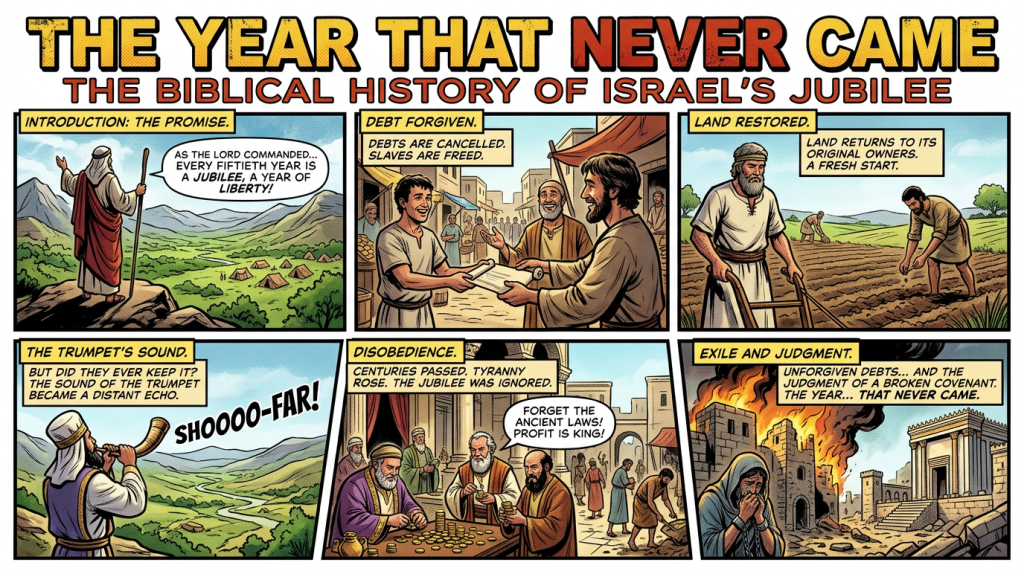
Every fifty years, according to the oldest land law in the Hebrew Bible, Israel was supposed to stop. Not for a weekend. For a year. Fields were to lie fallow. Debts were to dissolve. A man who had sold himself into service was to walk free. A family that had lost its field was to receive it back. A ram’s horn was to be blown on the tenth day of the seventh month—the Day of Atonement—and liberty was to be proclaimed “throughout all the land unto all the inhabitants thereof.” The name for that year is Jubilee. In Hebrew it is yovel. In Leviticus 25 it is not a metaphor. It is a statute.
The statute has not been kept, in any form the chapter would recognize, for more than two thousand years. That is not a scandal of forgetfulness. It is a scandal of conditions. The year requires a people, a land, a single authority over that land, and a legal memory of who owned what when the lots were first drawn. Modern Israel has a people and a state. It does not have the rest. The wars of this decade have made the missing pieces visible again: Gaza, the West Bank, the northern border, the Golan. They have also made a temptation visible—the temptation to treat a military quiet as if it were the trumpet Moses described. It is not.
Leviticus 25 is precise. Israel is to count seven sabbaths of years, forty-nine years, and then hallow the fiftieth. The sabbatical year already commanded rest for the soil every seventh year. Jubilee stacks a second rest on top of the seventh sabbatical, so the land is idle two years running. God promises, in the same chapter, that the harvest of the forty-eighth year will be enough. The point is not agronomy. The point is that the land is not finally owned by the man who holds the deed in year forty-seven. “The land shall not be sold for ever,” the text says, “for the land is mine.” Jubilee is the mechanism that keeps that sentence from becoming poetry. Without the fiftieth year, sale becomes permanence. With it, sale is only a lease that expires when the horn sounds.
The horn does not sound on the civil new year. It sounds on Yom Kippur. Leviticus 23 already set the tenth of the seventh month as the day the nation afflicted itself and atoned. Leviticus 25 puts the Jubilee blast on that same day. Liberty and atonement are timed together. A people that has just named its sin is then told to unmake the economic consequences of sin: the field taken in desperation, the brother sold to eat. Isaiah 61 later borrowed the same vocabulary—liberty to the captives, the acceptable year of the Lord—and Jesus read those lines in a Nazareth synagogue and said they were fulfilled in the hearers’ ears. He stopped before “the day of vengeance.” The first coming, in that reading, opened the acceptable year. It did not empty Leviticus 25 of a future claim on the land itself.
Why, then, did the year never arrive as a working institution after the biblical period? The honest answer is that the conditions named in the verse failed. “All the inhabitants thereof” was read, early and often, as all the tribes that had received an inheritance living on that inheritance. Reuben, Gad, and half of Manasseh were planted east of the Jordan. When the eastern tribes went into exile, the rabbis concluded that the full command no longer applied. Maimonides and the Talmudic discussions in Arakhin treat Yovel as bound to a complete Israel in a complete land. After the Babylonian destruction, even the Second Temple community, which counted sabbatical cycles so the seventh years would fall correctly, did not carry out the return of fields and the release of servants as a national act. After 70 A.D. the count itself stopped. Sabbatical years continued, in some form, as a religious discipline. Jubilee did not. There is no serious historical record of a fiftieth year observed with land reversion and a public trumpet after the First Temple world ended.
That is why “never happened” is slightly too clean and still basically true. Something like Jubilee may have been kept while Joshua’s map was intact. It has not been kept since the map tore. The tear is not only exile. It is the loss of title. Jubilee assumes that a court can say: this ridge belonged to that clan in the original allotment, therefore it returns. No modern registry contains those lines. A government can annex. It cannot, by annexing, recover the lots of Numbers and Joshua.
Which brings the question down to the present tense. What would have to happen before Israel could keep Leviticus 25 rather than merely quote it?

First, there cannot be a second government on the land being proclaimed. The verse is not written for a condominium. Hamas in Gaza was a government with weapons. The Palestinian Authority in parts of the West Bank is a government with ministries. Hezbollah in Lebanon was an army on the approach to the northern tribes. As long as those structures administer people and ground inside the old inheritance, a trumpet “throughout all the land” is a speech, not a statute. A total military end to Hamas and Hezbollah would remove two of those structures. It would not, by itself, dissolve the Authority in Ramallah, and it would not give Israel the east bank that Reuben and Gad received. Jordan is a treaty state sitting on Gilead. The Lebanese republic, even without Hezbollah, is still the sovereign of Tyre’s hinterland. Syria, even as a security partner, still holds what remains of Bashan beyond the Golan Israel already occupies. Those are not insults. They are borders. Leviticus 25 does not negotiate them.
Second, the inhabitants named in the verse have to be the inhabitants the verse means. The lost tribes are not a Sunday-school phrase. They are the reason the classical sources said Yovel lapsed. A state of Jews, most of them from Judah and associated communities, is not “all Israel” in the sense the land law used. Ingathering of the kind Jeremiah and Ezekiel describe—one nation on the mountains of Israel, no longer two kingdoms—is a restoration text, not an immigration statistic.
Third, the land must be able to rest and revert. That requires peace enough for fields to lie idle and courts enough to assign them. A country that has just finished three wars and is becoming, in Zechariah’s image, a burdensome stone to the nations is not in a sabbatical mood. Zechariah 12 says Jerusalem will be a cup of trembling and a stone that injures those who try to lift it. A victory that erased Hamas and Hezbollah would, in that register, increase the trembling, not the rest. The world would not greet a Jubilee. It would greet a winner it intended to isolate. Isolation is not the legal environment in which ancestral fields change hands.

Fourth, someone has to blow the horn with authority. Leviticus assumes a people that can “cause the trumpet of the jubile to sound” across the land on a known Day of Atonement after a known count of forty-nine years. There is no agreed count. The cycles were broken. Starting them again by cabinet decision would be a beginning, not a continuation. The rabbis who stopped the count were not being precious. They were refusing to pretend.
What must not be smuggled into this list is a Third Temple. Leviticus 25 does not require one. The Day of Atonement in the wilderness and in the land is older than Herod’s platform. A sanctuary would matter for other prophecies—Daniel’s interrupted sacrifice, Paul’s man who sits in the temple of God—but it is a different file. Conflating the files is how Jubilee becomes an end-times poster instead of a land law.
The meaning of the year, if it is allowed to stay a land law, is almost embarrassing in its clarity. Wealth is not to harden into caste. Kinship is not to be lost because a famine year was cruel. The soil is not a commodity that outlasts the family. Every fiftieth year the society is forced to remember that it is a tenant. Modern readers who want the Bible to underwrite either unfettered markets or unfettered conquest will both be disappointed. Jubilee is a limit on both. It limits the buyer and it limits the king. The land is the Lord’s. The people are returned to their portions because they do not, in the end, own the portions.
That is why the year never came after the map broke, and why it cannot be declared by a press conference after a successful campaign. Israel can win wars. It has. It may yet end the organizations that have made the southern and northern borders unlivable. If it does, it will stand closer to a single authority over more of the western allotment than at any time since antiquity. That would be historically enormous. It would still leave Jordan on Gilead, Beirut on Asher’s edge, Damascus on the rest of the northeast, the tribes unreturned, and the titles unknown. Those are not “things Israel has not gotten around to.” Some of them are foreign sovereigns. Some of them are the difference between a state and a restoration.
An op-ed is not a midrash, and a newspaper is not the place to time the horn. The useful sentence is smaller. Jubilee is the Bible’s name for a year in which the land and the poor are released together, on the day the nation atones, after a count that assumes the whole people is home. It lapsed because the whole people was not home and the land was not whole. It will not resume because a border went quiet. If it resumes at all, it will resume when the conditions the chapter itself wrote—inhabitants, inheritances, one land, one horn—are not a metaphor. Until then, the fiftieth year remains what it has been since the last kings of Judah: a law waiting on a map that does not yet exist.



Leave a Reply