
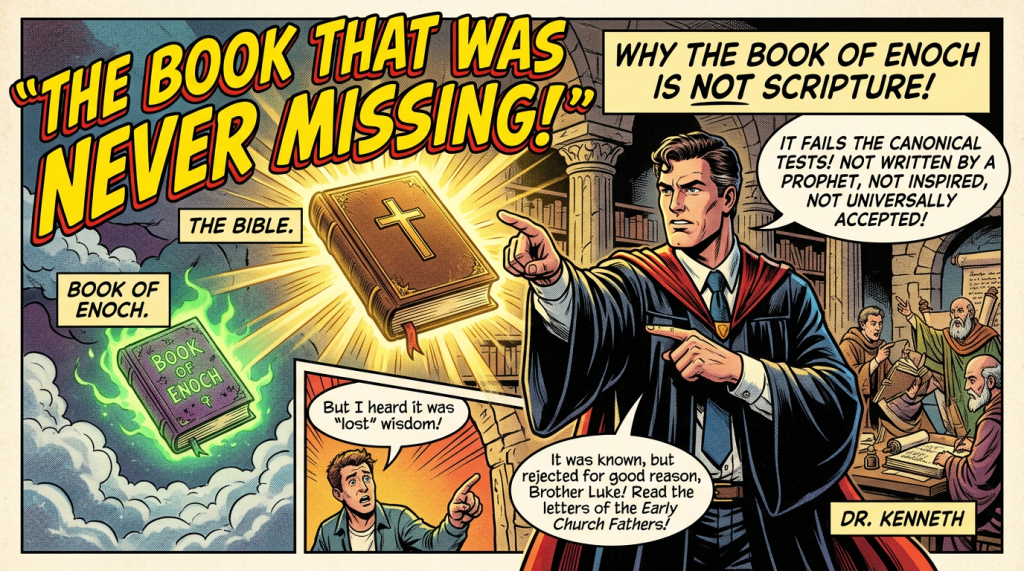
Every few years the Book of Enoch returns like a recovered relic. It is praised as the suppressed prequel to Genesis, the secret key to the Flood, the text “they” removed from the Bible. The claim is dramatic. It is also false. A book can be ancient, influential, and wrong. Enoch is all three.

The standard is not later church politics or modern appetite for hidden knowledge. The standard is the received Scriptures themselves. By that measure, 1 Enoch is not inspired. It is a later Jewish apocalypse, compiled in stages centuries before Christ, written under a borrowed name, and filled with claims the Bible will not bear.
The usual proof offered for its inspiration is Jude. “Enoch also, the seventh from Adam, prophesied of these,” Jude writes, and then gives the sentence about the Lord coming with ten thousands of his saints to judge the ungodly. The wording is close to 1 Enoch 1:9. That fact is not in dispute. What it means is. Inspired writers may quote a true statement without baptizing the library that later preserved it. Paul cited pagan poets. He did not thereby enroll Aratus among the prophets. Jude attributes a prophecy to the historical Enoch of Genesis 5. He does not say, “It is written in the Book of Enoch.” He does not treat the Watcher mythology, the astronomical tract, or the later parables as the Word of God. A genuine word can survive in a mixed book. The mixture does not become Scripture.
The historical Enoch of Genesis lived 365 years and “was not; for God took him.” On the chronology of the text itself he was taken long before Noah’s birth. The book that now bears his name has him explaining that birth from among the angels and, in other places, speaking from a lifetime he never reached. That is not a small chronological wrinkle. It is the signature of pseudepigraphy: a later writer using a famous name.

None of this requires us to flatten Genesis 6 into a sermon about intermarriage between Seth’s line and Cain’s. The phrase “sons of God” is the same phrase Job uses for the heavenly host. Peter and Jude speak of angels who sinned, who left their own habitation, who are reserved in chains of darkness. Jude sets that rebellion beside Sodom’s pursuit of “strange flesh.” Genesis 6 says those sons of God took wives of the daughters of men; there were giants in the earth in those days, and also afterward; their children became mighty men of old, men of renown. The holy angels, Christ said, neither marry nor are given in marriage. That is their proper estate. The crime in view is precisely the abandonment of that estate. One may hold that reading from Job, Genesis, Peter, and Jude without opening Enoch at all.
That is the point. Enoch does not merely retell Genesis 6. It buries four spare verses under a second bible. Two hundred Watchers descend on Mount Hermon and bind themselves by oath. Chiefs are named—Semjaza, Azazel, and a shifting roster that does not even agree with itself later in the same work. They teach weapons, cosmetics, metallurgy, enchantments, root-cutting, and the reading of the heavens. Their sons are measured at heights that turn the Nephilim into walking geology. The giants devour the labor of men, then men, then beasts, then one another. The earth cries out. Uriel is sent to warn Noah, though Genesis has God speaking to Noah directly. The spirits of the dead giants become the demons that roam the world. The Watchers beg Enoch to intercede. He writes their petition. Heaven refuses them.
Some of that atmosphere has shaped Jewish and Christian imagination. Influence is not inspiration. Scripture locates the entrance of sin in one man (Romans 5:12). It names one mediator between God and men. It gives fallen angels no gospel and no advocate. It does not assign the Flood to a syllabus of forbidden arts. It records giants after the Flood and never explains them as leftovers from a mile-high race the deluge failed to drown. It does not found Israel’s calendar on Enoch’s 364-day solar year, or rename Hermon for an angelic curse.
The Book of the Parables goes further still. It develops a heavenly “Son of Man,” hidden before creation, seated for judgment. Then, in the surviving Ethiopic climax, Enoch is told that he is that Son of Man. Whatever one makes of disputed wording and possible later editing, the claim as the book stands collides with the Scriptures’ identification of the Son of man. The Bible does not need a second candidate.
Why, then, was Enoch rejected? It was not lost in a Vatican vault. Jews who kept the Law, the Prophets, and the Writings did not place it among them. It is absent from the lists that defined the churches’ Old Testament. Athanasius did not include it. Jerome was wary of books outside the Hebrew canon. Augustine called the material fable where it contradicted received Scripture. Tertullian admired it because Jude had used a line; the churches kept Jude and let the apocalypse go. Only the Ethiopian tradition later received it as canonical. Survival in one liturgy is not the mark of inspiration. The marks are consistency with prior revelation, truthful origin, and the recognition of the people who already had the oracles of God.
There is a darker possibility that the book itself invites. It lingers over the secrets it says the Watchers taught. It multiplies names Scripture never gives. It offers condemned spirits a spokesman. The New Testament warns of doctrines of demons and of an angel of light. A text that expands Genesis by supplying the very occult catalogue it condemns, then asks the reader to receive the expansion as antediluvian revelation, is not a safe guide even when it happens to preserve a true sentence.

The hunger for Enoch is understandable. Genesis 6 is abrupt. The world of angels, giants, and judgment feels unfinished. People want the director’s cut. But the Bible’s silences are not defects to be repaired by a third-century-before-Christ anthology. They are limits. God told us that sons of God took the daughters of men, that giants were in the earth, that man’s wickedness filled the world with violence, and that the Flood came. He told us that certain angels left their habitation and wait in darkness for judgment. He did not tell us the rest of Enoch’s story because the rest is not His word.
A culture that distrusts institutions will always be tempted to trust the unofficial scroll. The cure is not a more elaborate myth. It is the narrower, harder book we already have. The Lord who comes with ten thousands of His saints does not need a pseudepigraphon to arrive.




Leave a Reply