
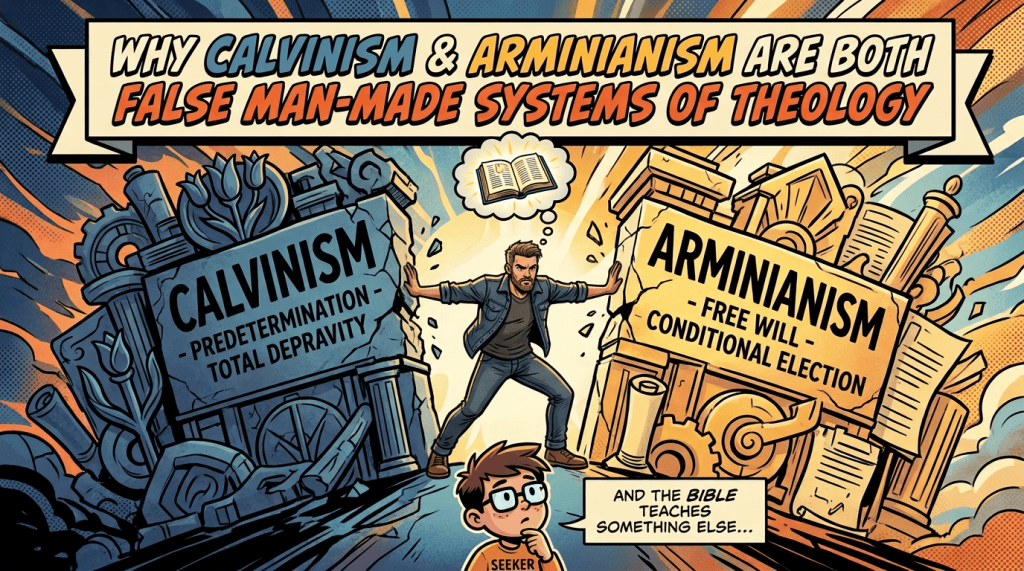
Every few years the old war returns, usually online and always with the same recruiting pitch. You must choose. If you reject the five points associated with John Calvin, you are an Arminian. If you reject the possibility that a believer can fall from saving grace, you are a Calvinist. The debate is presented as a binary as complete as north and south: sovereignty or responsibility, God or man, TULIP or its photographic negative.

That pitch is historically false and theologically lazy. Calvinism and Arminianism are not the two halves of the Bible. They are two post-biblical systems, named for two men, forged in a Dutch controversy more than a millennium and a half after the apostles wrote. Treating them as the only Christian options is like telling a reader of the Constitution that the only available politics are Hamiltonian and Jeffersonian, and that everyone else is confused. The document is older than the parties.
John Calvin died in 1564. Jacobus Arminius died in 1609. In 1610 Arminius’s followers published the Five Articles of Remonstrance. The Synod of Dort answered them in 1618–1619. From that exchange came the famous five-point contrast. The English acronym TULIP arrived later still, a pedagogical flower of the 19th and early 20th centuries, not a verse and not even the original order of Dort’s canons. None of this is Pentecost. None of it is Paul before Agrippa. The New Testament defines the gospel without Calvin, without Arminius, and without a mnemonic: Christ died for our sins according to the scriptures, He was buried, and He rose again the third day according to the scriptures. That message, the apostles said, is the power of God unto salvation to every one that believeth.
To call a later scheme “the gospel” is not zeal. It is substitution. The New Testament warns against being spoiled through philosophy and the tradition of men. It asks whether Christ is divided and whether anyone was baptized in Paul’s name. The same questions apply to Geneva and to the Remonstrants. A man’s name is not the gospel. A synod is not the gospel. A five-point reply to a five-point protest is not the gospel.

Calvinism goes wrong where it stops expounding Scripture and starts policing it. The Bible does teach that man is a sinner, dead in trespasses and sins, and that salvation is of the Lord. It does not teach that the plain words “world,” “all men,” “every man,” and “whosoever will” must be narrowed until they mean the elect only. “God so loved the world” is not a code for a subset. “He is the propitiation for our sins: and not for ours only, but also for the sins of the whole world” does not read like a limited ledger. “Taste death for every man” and “ransom for all” are not awkward metaphors waiting for a systematic theologian to rescue them. When a system must tell the reader that “all” means “all kinds,” the system has begun to edit.
The same is true of the claim that grace, in the saving sense, cannot be resisted by anyone to whom it is given, and that those not given it were never truly offered life. The same Bible that magnifies God’s purpose also records, “ye will not come to me, that ye might have life,” and “ye do always resist the Holy Ghost,” and the lament over Jerusalem: how often the Lord would have gathered the children, and they would not. Commands to repent and believe are not theater. If the invitations of Scripture are sincere only for a pre-selected class and decorative for everyone else, the moral texture of the text has been altered to save a theory.
Election is in the Book. It is not Dort’s property. Believers are chosen in Christ before the foundation of the world, elect according to the foreknowledge of God the Father. The error is not in saying God chooses. The error is in turning that choosing into a scheme that empties responsibility, restricts the atonement against the wording of the epistles, and then congratulates itself for having solved a mystery the apostles were content to preach from both sides at once.

Arminianism is not the cure. It is the rival machine.
It keeps a form of human inability, then inserts a device the Bible never names: a universal, resistible, pre-regenerating enablement—prevenient grace—given to all so that every sinner is repaired enough to accept or reject Christ. The construction is elegant. It is also extra-biblical. Scripture speaks of kindness in providence, of the gospel going out, of the Spirit convicting the world. It does not describe a third spiritual class: the enabled-but-still-unregenerate masses whose wills have been restored and who are now the decisive actors in their own conversion. “Which were born, not of blood, nor of the will of the flesh, nor of the will of man, but of God” is an inconvenient sentence for any theology in which the last determining cause of the new birth is the sinner’s cooperation. “It is not of him that willeth, nor of him that runneth, but of God that sheweth mercy” is another.
Conditional election—God looking down the corridor of time, seeing who will believe, and electing those people because of that foreseen faith—reverses the order of the words it claims to honor. In Acts, as many as were ordained to eternal life believed. The believing is not described as the cause of the ordaining. In Romans the same persons are foreknown, predestinated, called, justified, glorified. That is a chain, not a preview of human merit. If the difference between the saved and the lost finally rests in one person’s superior use of restored will, boasting has been given a crack in the door after the preacher has denied that any crack exists.
The most popular Arminian error is still the most pastoral one: that a person can be truly born again, justified, sealed, and then so fall as to perish everlastingly. Arminius was cautious; later heirs, especially in Wesleyan streams, were not. The Authorized text is not cautious on the point. He that believeth hath everlasting life, is passed from death unto life, shall not come into condemnation. The Lord gives eternal life; they shall never perish; no man can pluck them from His hand or the Father’s. Believers are sealed with the Holy Spirit of promise until the redemption of the purchased possession, kept by the power of God. If “eternal” can expire, the adjective was a mistake. If the new birth can be undone, the New Testament forgot to say so in the only language that would have made it clear.

The warning passages are real. They do not teach an adopted child becoming un-adopted. Some who went out were never of us. Some who tasted and fell away are described in terms that do not fit a regenerate saint who lost life and might later recover it. A believer may be carnal, chastened, and lose reward. That is not the same as being unsealed. Arminianism collapses position into performance and then calls the collapse fidelity.
The deeper problem is the binary itself. It survives because it is useful. Institutions need labels. Debaters need an enemy. Young believers need a team. Once the options are reduced to two, every verse becomes a weapon and every hesitation becomes defection. Refuse limited atonement and you are told you have made man sovereign. Refuse the loss of salvation and you are told you have made holiness optional. The argument never has to face the possibility that both packages overreached.
There is no biblical requirement to enlist. The text can say, without consulting Dort or the Remonstrance, that man cannot save himself; that God must work or no one comes; that Christ gave Himself a ransom for all and the gospel is a true “whosoever”; that those who believe have everlasting life and shall never perish; that election is real and according to foreknowledge, not a camera replay of human virtue; that warnings concern profession, the flesh, fruit, and reward, not the unmaking of the new birth. That cluster is not “Calminianism.” It is what the sentences say when they are not first fed through a 17th-century grid.
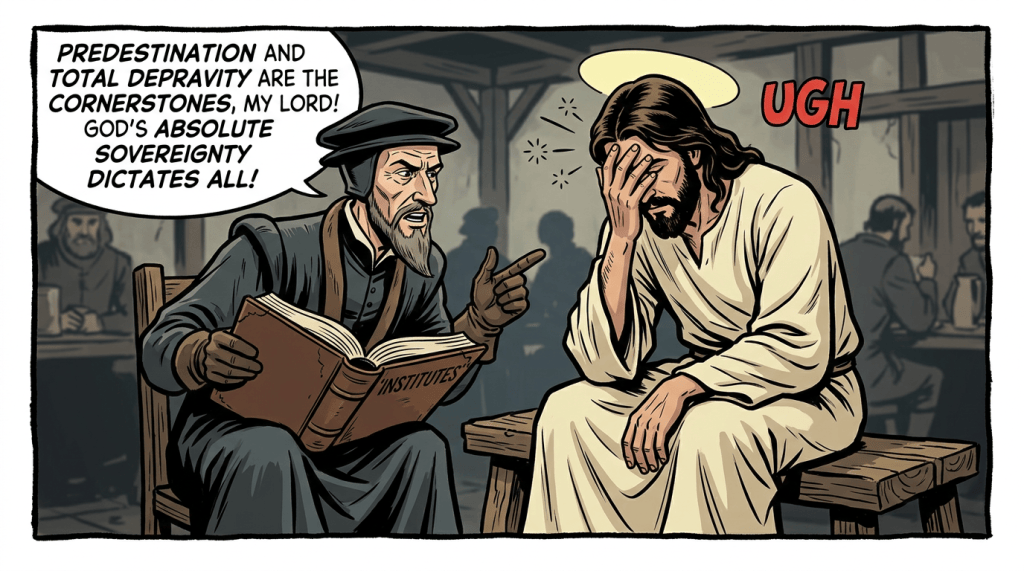
The Reformation recovered truths worth recovering: Scripture over medieval accretion, justification as gift, the sufficiency of Christ’s work. It also left unfinished business and new scholasticisms. Calvinism retained the habit of system-building until the system began to speak for the text. Arminianism retained the habit of reaction until reaction became a second system. Both treat a genuine tension in Scripture—God’s purpose and man’s responsibility—as a problem to be solved by making one pole absorb the other. The Bible does not solve it that way. It commands faith, offers life to the world, and then keeps those who have believed.
Christians are not obligated to choose a flower or a remonstrance. They are obligated not to add to the words and not to preach another gospel. The faith was once delivered to the saints before either camp existed. It will outlast both. The light is still “the light of the knowledge of the glory of God in the face of Jesus Christ,” not in the face of a French Reformer, a Dutch pastor, or the committees that argued about them after they were gone.
If that sounds like a refusal to pick a side, good. The sides were drawn too late, and too tightly, to be mistaken for the whole counsel of God.






Leave a Reply