
The most important fact about Lindsay Clancy is not the diagnosis later attached to her name. It is the deed. In a house in Duxbury, Massachusetts, in January 2023, a mother killed her three children—Cora, five; Dawson, three; Callan, eight months—and then tried to follow them. What the country did next was the sermon. A great deal of public speech, much of it from women, moved the children to the edge of the frame and placed the mother at the center as victim: of postpartum illness, of medicine, of men, of a society that had not supported her enough. A million was raised. “Same, Lindsay” appeared. The husband attracted suspicion. The will that tightened the bands receded behind circumstance.

It ultimately got to a point where 11/12 jury including all 9 female jurors were ready to let her off the hook for triple child murder.
A culture that cannot let a woman own her actions has not become more humane. It has become unable to tell the truth about agency. That inability, in Scripture, is not a mood. It is a mark of judgment.
“The soul that sinneth, it shall die.” “There is no respect of persons with God.” “Every one of us shall give account of himself to God.”
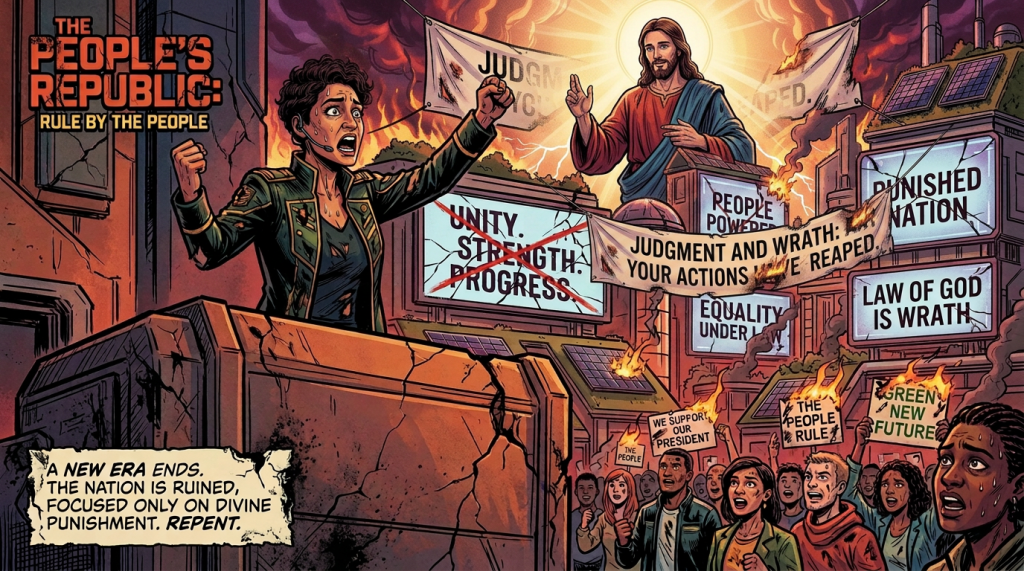
Isaiah 3 does not describe a renaissance. It describes a people from whom God has taken the stay and the staff, the mighty man, the judge, the honourable man, the counsellor. Children become princes. Then the prophet writes the sentence that modern readers are trained to treat as slander: “As for my people, children are their oppressors, and women rule over them. O my people, they which lead thee cause thee to err, and destroy the way of thy paths.” Female rule, in that chapter, is not emancipation. It is what remains when the order that restrained chaos has been withdrawn, and when the people who should have led instead erase the path.
The origin of the order is older than any American party. God formed Adam first and gave him the command concerning the tree. Eve was made a help meet. The serpent addressed the woman. She saw that the tree was good, and pleasant, and desired to make one wise; she took; she ate; she gave also unto her husband with her; and he did eat. The Lord called Adam first because the charge had been Adam’s. He did not stop there. He asked the woman what she had done. She said the serpent beguiled her. He still pronounced a sentence on her for her own deed: sorrow multiplied in conception, pain in bringing forth children, desire to her husband, and “he shall rule over thee.”

Federal headship explains why sin and death entered the race by one man. It does not cancel the woman’s history. “Adam was not deceived, but the woman being deceived was in the transgression.” That is why the apostle will not suffer a woman to teach or to usurp authority over the man, but to be in silence, and why the churches are told that women are to keep silence and to be under obedience, “as also saith the law.” These are not footnotes added by men in powdered wigs. They are the New Testament’s own reading of the garden.
A society that collapses Eve into Adam will collapse every later woman into her circumstances. That is the Duxbury pattern made general. Sermons name male lust, pornography, and abdication with a surgeon’s specificity, then hurry to explain female sin as reaction: his failure, her trauma, the economy, the lack of help. Submission is mentioned only after a long apology. Abortion becomes healthcare. The unborn become the price of a future. The father is told he has no claim. Premarital sex in the women’s ministry is “baggage.” Unbiblical divorce, initiated in the large majority of evangelical cases by the wife, is “finding freedom.” Crystals and horoscopes are “self-care.”
Pastors admit that they have stopped preaching the plain texts because the women will leave and take the giving with them. Revelation warned Thyatira not for inventing Jezebel but for suffering her: a woman who called herself a prophetess, to teach and to seduce. Jezebel wrote letters in Ahab’s name, sealed them with his seal, and shed innocent blood. The text does not treat her as a symptom of a sad husband. It judges her for what she did. Athaliah seized a throne and destroyed the seed royal. The pattern is not that women never suffer. The pattern is that Scripture will not transfer the decisive blame.

Abortion belongs in the same account. The sixth commandment does not contain a sex exemption. The unborn are not a metaphor: “thou hast covered me in my mother’s womb.” Child sacrifice to Molech was an abomination God never commanded. The modern rite is performed for career, convenience, and the self, and then defended as the essence of female dignity. Churches that will not say this to post-abortive women in the pew, for fear of shame, withhold the sorrow that works repentance. They call the silence grace. It is nearer to abandonment.
This is the air in which the country now handles the presidency. As of 2026, Rep. Alexandria Ocasio-Cortez has not announced that she will run in 2028. She has also refused to close the door—“maybe, maybe not”; “I haven’t ruled out the possibility.” Early surveys among Democratic primary voters have sometimes placed her at or near the front of a hypothetical field. She is old enough. She has a mass platform, a movement inheritance, and a public language in which “women’s rights” outrank any particular office. She has discussed freezing her eggs while leaving the White House question open. None of that makes her president. It does reveal what the culture is prepared to treat as a sacrament: a woman in the highest civil seat as proof that the old sequence was cruelty.
The office will not baptize a theology. The hunger around the office already has one. Isaiah did not say women lack mind or courage. Scripture records prophetesses and a judge in a day when men would not lead. It does not record that a nation is blessed when the created sequence is inverted, when the deceived is placed over the one formed first, and when leaders destroy the way of the paths while the people applaud.

“All have sinned, and come short of the glory of God” is not a men’s verse. “Except ye repent, ye shall all likewise perish” is not a courtesy. A people that will not hold women accountable for their own hands is not preparing them for mercy. It is preparing them for a judgment in which every soul answers alone—and it is already walking in the ruin the prophet named, calling the walk compassion.





Leave a Reply