
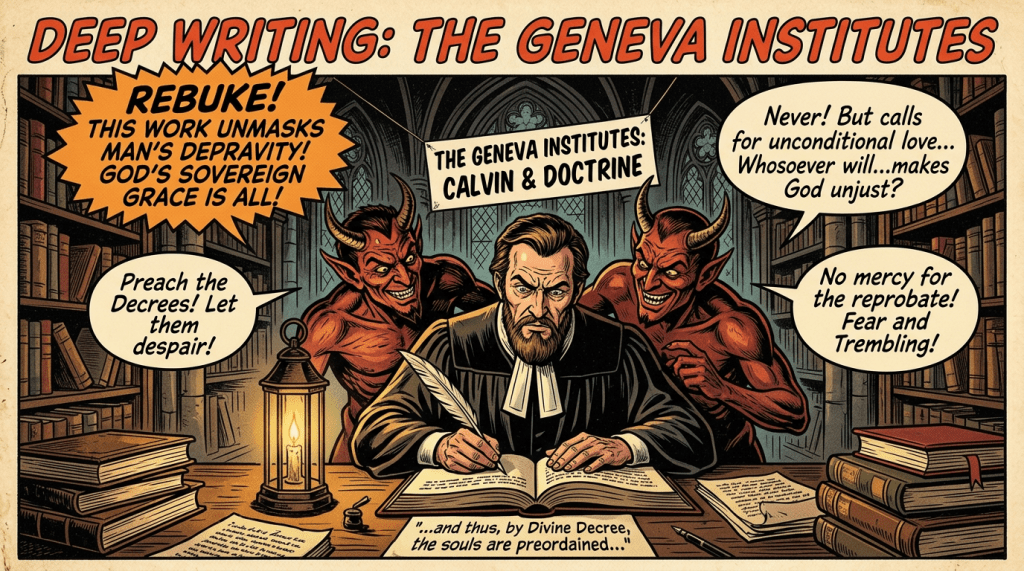
To equate a sixteenth-century system, drawn from Augustine and named for a man, with the apostolic good news is not zeal for grace. It is a substitution.

The most dangerous religious slogans are rarely crude. They arrive dressed as fidelity. They quote Scripture. They sound like courage. One of the most successful of these slogans in modern evangelical life is the claim that “Calvinism is the gospel.” Charles Spurgeon put it with characteristic force: it is “a nickname to call it Calvinism; Calvinism is the gospel, and nothing else.” Later Reformed writers went further. David Engelsma wrote that Calvinism’s outstanding doctrines “are simply the truths that make up the Gospel,” and that departure from Calvinism is therefore “apostasy from the Gospel of God’s grace in Christ.” John Piper has called the five points “the warp and the woof of the biblical gospel.”
That is not a debate about emphasis. It is a claim of identity. It does not say Calvinists preach grace, or that Reformed churches have recovered precious truths. It says a later school is the gospel of salvation. Judged by the Bible—and not by catechisms, canons, or “Reformed principles” written centuries after the apostles—the statement is both heretical and blasphemous. Heretical, because it adds a human system to the faith once delivered. Blasphemous, because it gives to John Calvin, Augustine of Hippo, and the Synod of Dort the honor that belongs only to the gospel of God.
The apostles did not leave the church waiting for Geneva.
Paul defined the message by which men are saved if they keep it in memory: “how that Christ died for our sins according to the scriptures; And that he was buried, and that he rose again the third day according to the scriptures” (1 Corinthians 15:3–4). That gospel is “the power of God unto salvation to every one that believeth” (Romans 1:16). The jailer asked what he must do to be saved and received no five-point primer. “Believe on the Lord Jesus Christ, and thou shalt be saved” (Acts 16:31). The most famous sentence in the English Bible is not an allegory for a secret decree: “For God so loved the world, that he gave his only begotten Son, that whosoever believeth in him should not perish, but have everlasting life” (John 3:16).Search the New Testament for “gospel.” You will find the gospel of Christ, of God, of the grace of God, of peace. You will not find TULIP. You will not find Calvin. You will not find Augustine. If Calvinism were the gospel, the Holy Ghost forgot to say so for fifteen centuries.

Paul also drew a line later systems may not cross. “But though we, or an angel from heaven, preach any other gospel unto you than that which we have preached unto you, let him be accursed” (Galatians 1:8). The test is the gospel the churches had already received. It is not agreement with the Institutes, the Canons of Dort, or the Westminster Confession. To make departure from Calvinism “apostasy from the gospel” is to move the anathema from Christ crucified to a seventeenth-century answer to the Remonstrants. That is to add to the Word. “Add thou not unto his words, lest he reprove thee, and thou be found a liar” (Proverbs 30:6).
A man’s name is not the gospel.
“Calvinism” is named after John Calvin (1509–1564). The five points, as a packaged reply, were formulated after his death at the Synod of Dort in 1618–1619. TULIP as an English memory device is later still. Calvin himself leaned on Augustine of Hippo (354–430) with an intensity that should embarrass anyone who treats the system as raw Bible. Calvin wrote that Augustine was so much at one with him that a confession of faith could be made by quoting Augustine wholesale. Reformed historians have long admitted the point: in soteriology, Calvinism is Augustinian. Augustine never met Jesus. He was not at Pentecost. Not one word he wrote is Scripture. His later predestinarianism was sharpened in the Pelagian controversy, after years among the Manichaeans. Priority is not authority. “Beware lest any man spoil you through philosophy and vain deceit, after the tradition of men… and not after Christ” (Colossians 2:8).
Scripture forbids the dividing of Christ under men’s names. “Is Christ divided? was Paul crucified for you? or were ye baptized in the name of Paul?” (1 Corinthians 1:13). If it is carnal to say “I am of Paul,” it is not spiritual to say the gospel is Calvin. Salvation is in one name under heaven (Acts 4:12). That name is Jesus Christ of Nazareth—not John Calvin of Noyon and Geneva, not Augustine of Hippo, not a Dutch synod.

The historical implication of the slogan is rarely faced. The gospel was preached from Pentecost onward. If Calvinism is the gospel, then the church had no full gospel until a French lawyer-theologian and a North African bishop supplied its essence. That is historically false and spiritually arrogant. It makes the faith once delivered to the saints (Jude 3) incomplete until the Reformation’s Augustinian wing finished the definition.
The God of the text and the God of the scheme
Before TULIP is allowed to qualify a single verse, hear the words as they stand. “The Lord is… not willing that any should perish, but that all should come to repentance” (2 Peter 3:9). He “will have all men to be saved, and to come unto the knowledge of the truth” (1 Timothy 2:4). Christ “gave himself a ransom for all” (1 Timothy 2:6). He is “the propitiation for our sins: and not for ours only, but also for the sins of the whole world” (1 John 2:2). He “tasted death for every man” (Hebrews 2:9). “And the Spirit and the bride say, Come… And whosoever will, let him take the water of life freely” (Revelation 22:17). “God is no respecter of persons” (Acts 10:34). “For whosoever shall call upon the name of the Lord shall be saved” (Romans 10:13).
TULIP survives only by treating those texts as half-truths that must be qualified, narrowed, or redefined until they fit a predetermined philosophical scheme. “World” becomes the elect. “All men” becomes all kinds of men. “Every man” becomes every elect man. “Whosoever will” becomes whosoever was made willing by an irresistible decree. That is not literal interpretation. That is a grid laid over the page. What the system produces is not the God of Scripture but a character of its own making: a deity whose love is partial, whose invitation is not sincere toward the non-elect, and whose decrees quietly override the words He caused to be written.
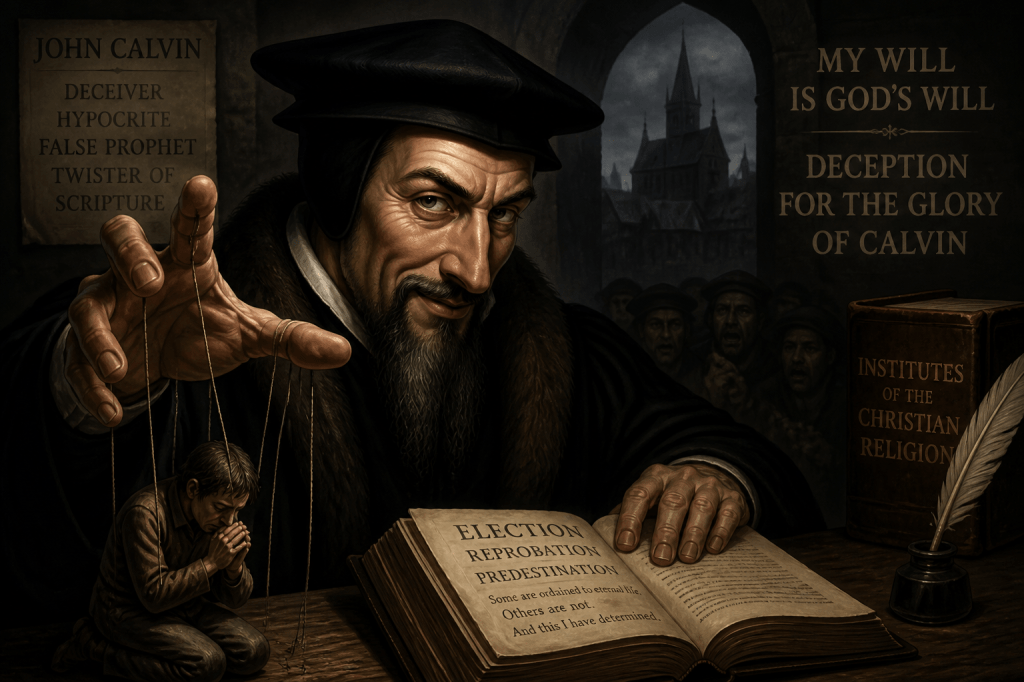
Total depravity, in the Bible’s own speech, is terrible enough. “There is none righteous, no, not one” (Romans 3:10). Men are “dead in trespasses and sins” (Ephesians 2:1). Calvinism is not content with that. It stretches “dead” until the sinner cannot believe the gospel until he is first regenerated, and then treats the commands of God as if they were spoken to a corpse He Himself has forbidden to hear. Yet God still says, “Repent ye, and believe the gospel” (Mark 1:15). “Ye will not come to me, that ye might have life” (John 5:40). “Ye do always resist the Holy Ghost” (Acts 7:51). The resulting portrait is of a God who holds creatures accountable for an inability His own decree has imposed.
Unconditional election, in the system’s sense, is not the Bible’s “elect according to the foreknowledge of God the Father” (1 Peter 1:2), nor “whom he did foreknow, he also did predestinate to be conformed to the image of his Son” (Romans 8:29). New Testament election is “in Christ” (Ephesians 1:4) and is tied to faith (Galatians 3:7). Israel remains “beloved for the fathers’ sakes” (Romans 11:28). The slogan’s version of election makes the open invitation, in practice, a theatrical performance directed only at those already chosen.
Limited atonement is where the other Christ becomes unmistakable. If Jesus did not die for the man in the pew, then “ransom for all,” “whole world,” and “every man” are pious frauds unless rewritten. The result is a Saviour whose blood is deliberately insufficient for the non-elect. That is not the Jesus who “wept over” Jerusalem (Luke 19:41). It is a Christ whose compassion is as narrow as the decree. 2 Peter 2:1 still speaks of false teachers “denying the Lord that bought them.” The sentence is unintelligible if the Lord never bought them.
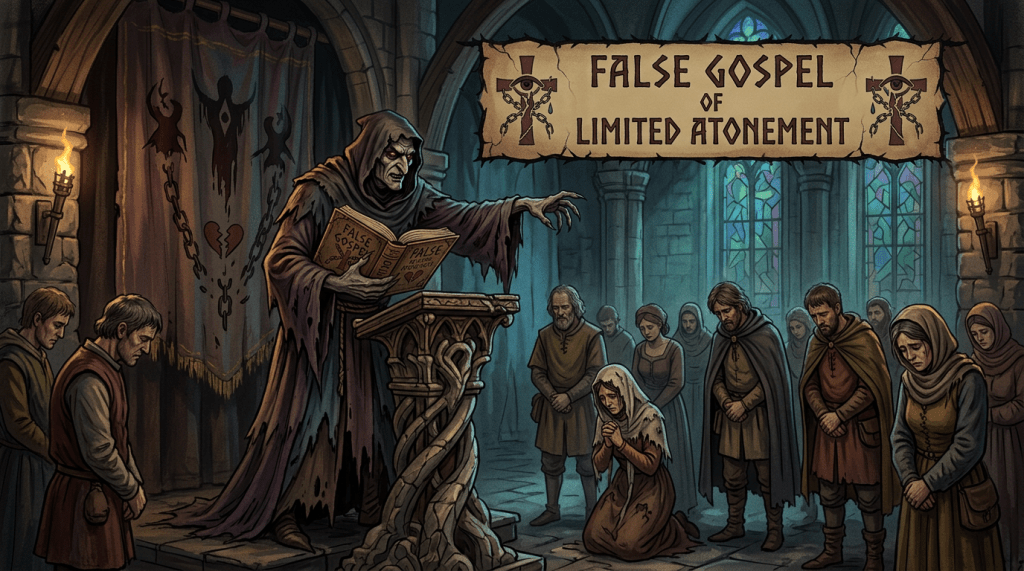
Irresistible grace denies the force of real refusal. Perseverance, if it only means God keeps those who are in Christ, can be argued from John 10:28–29. If it means the elect cannot fall because the decree has already settled the story, then every warning to “brethren” becomes stage scenery. “Take heed, brethren, lest there be in any of you an evil heart of unbelief, in departing from the living God” (Hebrews 3:12).
Taken together, TULIP does not merely arrange salvation. It produces a dual-will deity: a revealed will that says “come,” and a secret will that never meant the non-elect to come. The Bible is not obligated to that philosophy. God can be sovereign—“Our God is in the heavens: he hath done whatsoever he hath pleased” (Psalm 115:3)—without making His own invitations insincere. “Salvation is of the LORD” (Jonah 2:9) does not equal TULIP. Spurgeon’s attempt to reduce the system to that verse is a verbal sleight of hand. The slogan always expands again into particular redemption and an effectual call the rest cannot receive.
Sardis: a name that thou livest
Christ’s letter to Sardis is first a letter to a real congregation. Its words also judge any church that boasts life while mixing the living with the dead. “I know thy works, that thou hast a name that thou livest, and art dead… for I have not found thy works perfect before God” (Revelation 3:1–2).
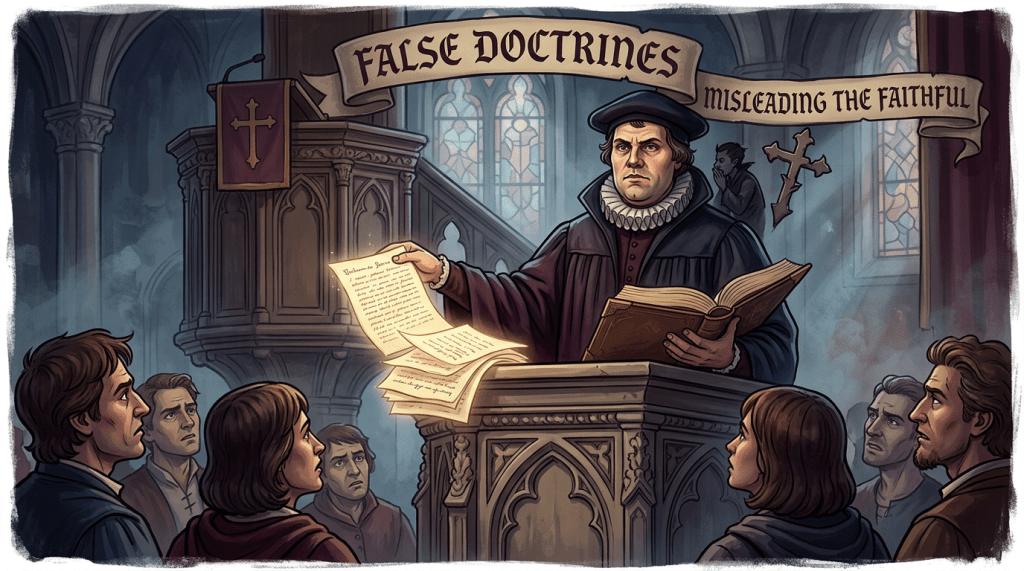
That description fits the magisterial Reformation with uncomfortable exactness. Luther and Calvin recovered real light: Scripture over papal tradition, justification without the merits of Rome, the exposure of indulgences. That is why the reputation of life was so powerful. The death lay in what they refused to finish. They would not complete the separation of the living body of Christ from the institutional and political forms they inherited. Lutheran territories, Calvin’s Geneva, the Church of England, and Reformed principalities became state churches. Membership tracked geography, citizenship, and infant baptism more than personal regeneration. Augustine’s older vision of the heavenly city guiding the earthly city was kept in Protestant dress. Civil magistrates enforced conformity. Infants were enrolled as church members before they believed. The inevitable fruit was rolls filled with the unregenerate sitting under sermons about justification by faith.
Scripture knows one doorway into the church Christ builds: the new birth. “Except a man be born again, he cannot see the kingdom of God” (John 3:3). In Acts, “they that gladly received his word were baptized,” and “the Lord added to the church daily such as should be saved” (Acts 2:41, 47). Infant baptism as the ordinary door of the visible church reverses that order and manufactures a Christian name without the thing. A body filled with those who have never passed from death unto life cannot produce the living fruit Christ requires. The indictment of Sardis is not that the Reformers never knew the truth. It is that they refused to separate the living from the dead, and in that refusal their works were found imperfect before God.
This does not mean every Lutheran or Calvinist in history was lost. The Lord Himself said there were “a few names even in Sardis.” The rebuke is against the system that treats territorial membership and confessional pedigree as life, then dares to call that system the gospel.
The stealth that makes the slogan deadly

Prosperity teaching is loud and crude. It is easy to smell. Calvinism, when it announces itself as the gospel and nothing else, does not ask men to sow a financial seed. It asks them to surrender the plain sense of Scripture to a system that redefines election, atonement, and grace. Dissent is then framed as rebellion against God Himself. That is the stealth. Unlike ostentatious materialism, the subversion lies in an intellectual veneer and a claim to biblical fidelity. It presents a God who elects a fixed number and consigns the rest, a Christ whose death is efficacious only for that group, and a gospel that is not genuinely offered to all.
Reach does not turn error into truth. Influential pulpits, seminaries, conferences, and media can normalize a theology that, on literal scrutiny, constructs a Christ who did not die for the world. The church’s greatest threat is not only the loud heresy that repels, but the subtle one that seduces with half-truths and then claims the name of the gospel for itself.
The same stream often spiritualizes Israel into the church and treats the Jewish people as a canceled witness. Romans 11:26–29 still stands. “All Israel shall be saved.” They are “beloved for the fathers’ sakes.” The gifts and calling of God are without repentance. A “gospel” that cancels those promises is not the whole counsel of God. Augustine’s anti-Jewish writings and the long institutional harvest that followed them are not a footnote. They are a warning about what happens when philosophy is allowed to overrule the prophets.
Lordship as the working face of the system

The slogan reaches its pastoral end in what is commonly called Lordship Salvation: the insistence that one cannot receive Jesus as Saviour without an upfront total submission of every area of life, and that genuine faith must prove itself by visible fruit and perseverance—or the person was never saved. This sounds holy. It is a back-loaded works gospel. It front-loads surrender as a condition of receiving eternal life and back-loads performance as the proof one ever received it. The free gift (Romans 6:23) becomes a lifelong exam.
Paul rebuked the Galatians for beginning in the Spirit and then turning to works (Galatians 3:1–5). Lordship Salvation does the same under the language of “true faith.” It confuses the one-time act of justification with the lifelong process of sanctification. It sends the believer into endless self-examination instead of rest in Christ’s finished work. The result is pride or despair.
The Bible was written so that those who believe “may know that ye have eternal life” (1 John 5:13). Jesus gave three guarantees to the believer in one sentence: he hath everlasting life, shall not come into condemnation, and is passed from death unto life (John 5:24). Present tense. Certain. Finished. “There is therefore now no condemnation to them which are in Christ Jesus” (Romans 8:1). Now—not after sufficient fruit inspection. Following Christ is the result of life, not the purchase price of it. “I give unto them eternal life; and they shall never perish, neither shall any man pluck them out of my hand” (John 10:28). The sheep are held by His grip, not theirs.
When this package is called the gospel and nothing else, the simple word of Acts 16:31 is treated as incomplete or dangerous unless the full Augustinian-Calvinist machinery is attached. That is to pervert the gospel of Christ.
Why the equation is heresy and blasphemy

Heresy, in the New Testament sense, is a choosing—a party-truth raised against the faith once delivered. Blasphemy here is not a casual insult. It is the act of giving to a human scheme the honor that belongs only to the gospel of God.
The slogan does four things Scripture forbids.
First, it adds to the apostolic definition. Paul listed death, burial, and resurrection for sins, received by faith. He did not list particular redemption and irresistible effectual calling as the gospel itself.
Second, it makes a later confession the rule of faith. Dort and Calvin become the touchstone. Scripture says the Word judges every later writing.
Third, it anathematizes by a test God never gave. If Calvinism is the gospel and nothing else, then believers who trust Christ’s blood and confess His resurrection—but will not preach limited atonement as the gospel—are cast out. Galatians 1 is turned into a party weapon.
Fourth, it confuses the Saviour with a system. The gospel reveals God “in the face of Jesus Christ” (2 Corinthians 4:6). If the face you preach is a Christ who did not die for the hearer, you have not preached the glory of the God of John 3:16. You have preached the glory of a scheme.

Rome adds sacraments and merit. Paul called additions another gospel. Calvinism, when it says Calvinism is the gospel and nothing else, adds a scholastic system to the apostolic announcement and then treats the system as the announcement. The cross is not enough unless it is the cross as Dort defined its extent. That is the same kind of move: Christ plus a scheme.
Augustine’s larger project—processive justification, inherited infant guilt removed by baptism, the church as Israel, the state enforcing doctrine, allegorical method that dissolves “world” and “whosoever”—became the water in which much of Western Christianity still swims. The Reformation recovered light. It did not escape the well. Luther was an Augustinian monk. Calvin quoted Augustine as a master. Trent and Westminster, enemies on many points, both drank from the same source. To call the Calvinist branch of that tree the gospel is to baptize the tree.
None of this requires the slander that no Calvinist has ever been saved. Men are saved by believing on the Son, not by first passing a systematic exam. The question is whether the system may wear the name of the gospel. It may not. A man can be learned, morally serious, and useful against real corruptions, and still lead others to a restricted Saviour under the language of orthodoxy. Reformation credentials do not immunize doctrine from the verdict of the Book.
The only safe ground

Christ did not tell Sardis to write a better confession. He said: Be watchful. Strengthen the things which remain that are ready to die. Remember how thou hast received and heard. Hold fast. Repent. What was received was the apostolic gospel, not TULIP.
Remember the words as they stand. Christ died for all. Election is in Him through faith. The call is to whosoever will. Faith comes by hearing the word of God (Romans 10:17). The Spirit can be resisted. God is no respecter of persons. Israel’s calling is not canceled. The Saviour who wept over Jerusalem is the same Saviour who tasted death for every man. The moment a sinner believes, he hath everlasting life. Good works follow as the grateful fruit of life already given, not as the price of admission or the ongoing proof of a secret decree.
“Little children, keep yourselves from idols” (1 John 5:21). An idol can be carved from wood. It can also be carved from decrees, confessions, and a famous name. The idol here keeps Christian vocabulary while changing the face of Christ and the heart of God.

Calvinism is not the gospel. Augustinianism is not the gospel. Lordship Salvation is not the gospel. The gospel is that Christ died for our sins according to the Scriptures, was buried, and rose again the third day according to the Scriptures, and that this message is the power of God unto salvation to every one that believeth. Call men to that. Do not baptize a later school with the name of the gospel. To do so is to put man’s doctrine where only Christ’s blood and the apostles’ witness belong—and that is both error and a high slight against the Word God has already magnified above all His name (Psalm 138:2).





Leave a Reply