
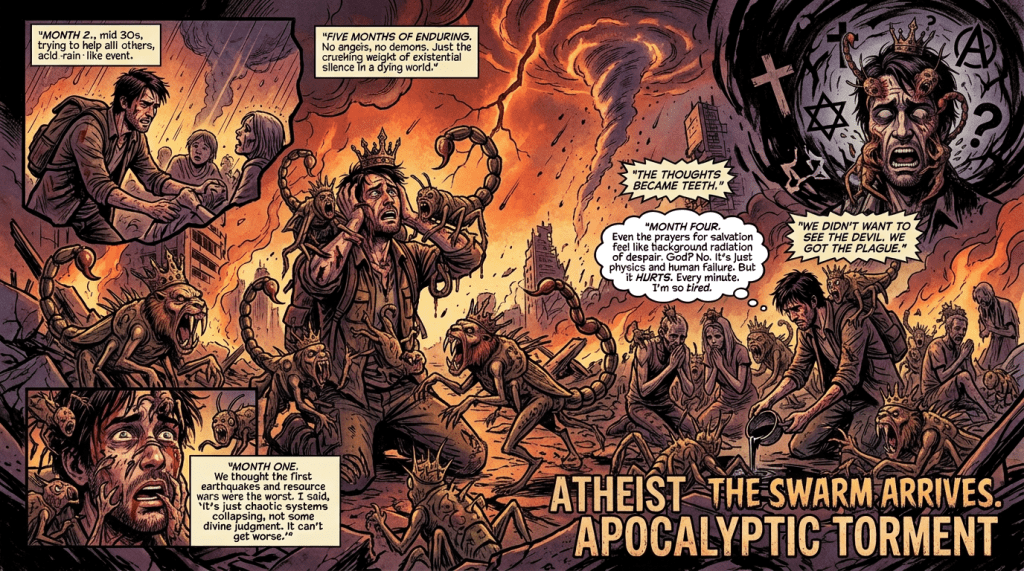
In the Book of Revelation, chapter 9, the fifth and sixth trumpets sound during a period of escalating judgment. The text describes events that fall only on those without the seal of God in their foreheads.

For an atheist who has rejected Jesus Christ and continues in unbelief through the rapture, the preceding seals, and earlier trumpets, these judgments form a sustained ordeal of supernatural suffering. Scripture presents them as a limited preview of Sheol, the realm of destruction and the dead, before greater judgment follows.
The fifth angel sounds. A star falls from heaven to the earth, and to him is given the key of the bottomless pit. He opens it, and smoke rises “as the smoke of a great furnace,” darkening the sun and the air. Out of the smoke come locusts with power “as the scorpions of the earth have power.” They are commanded not to hurt the grass of the earth, neither any green thing, neither any tree, “but only those men which have not the seal of God in their foreheads.” To them it is given that they should not kill, “but that they should be tormented five months: and their torment was as the torment of a scorpion, when he striketh a man. And in those days shall men seek death, and shall not find it; and shall desire to die, and death shall flee from them.”
The shapes of these locusts are like horses prepared unto battle, with crowns like gold, faces as the faces of men, hair as the hair of women, teeth as the teeth of lions, breastplates as of iron, wings sounding as chariots of many horses running to battle, and tails like scorpions with stings. They have a king over them, the angel of the bottomless pit, whose name in the Hebrew tongue is Abaddon, and in the Greek tongue Apollyon—the Destroyer.

In the Old Testament, Abaddon stands parallel to Sheol, the place of destruction and the dead. The bottomless pit, the furnace-like smoke, the unrelenting sting, and the denial of death together form a temporary, earthly experience drawn from that realm.
An atheist in this hour has no seal of God. The torment lasts five full months. Pain strikes like a scorpion’s sting—sharp, burning, continuous—yet death, the only relief the mind can imagine, flees. The creatures themselves are unnatural hybrids, their king named for destruction.
This is not metaphor in the text; it is sequential judgment after the seals and the first four trumpets. The atheist who has rejected Jesus Christ lives through it conscious, seeking an end that will not come.
Then the sixth angel sounds. A voice from the four horns of the golden altar which is before God commands the sixth angel to loose the four angels bound in the great river Euphrates. Those angels, prepared for an hour, and a day, and a month, and a year, are loosed “for to slay the third part of men.”

An army of two hundred thousand thousand (200 million) horsemen appears, with breastplates of fire, and of jacinth, and of brimstone. The heads of the horses are as the heads of lions; out of their mouths issue fire and smoke and brimstone. By these 1/3 of the surviving human population of men killed. Their power is also in their tails, like serpents with heads that hurt.
The atheist faces either death in this slaughter or survival among the rest. One-third of mankind dies by fire, smoke, and brimstone. Those who remain have already endured the five months of denied death. The text records their response: “And the rest of the men which were not killed by these plagues yet repented not of the works of their hands, that they should not worship devils, and idols of gold, and silver, and brass, and stone, and of wood: which neither can see, nor hear, nor walk: Neither repented they of their murders, nor of their sorceries, nor of their fornication, nor of their thefts.”
The refusal is explicit. After the preview of Sheol and the killing of a third of the population, the survivors continue in the same works. Scripture elsewhere accounts for such hardness. Light has come into the world, and men loved darkness rather than light because their deeds were evil; every one that doeth evil hateth the light, neither cometh to the light, lest his deeds should be reproved. Men hold the truth in unrighteousness; when they knew God, they glorified him not as God, neither were thankful, but became vain in their imaginations, and their foolish heart was darkened. God gives them up to a reprobate mind. Those who received not the love of the truth that they might be saved are sent strong delusion, that they should believe a lie, that they all might be damned who believed not the truth but had pleasure in unrighteousness.

The atheist’s plight under these trumpets is therefore twofold: the body suffers the scorpion-like torment for five months while death flees, then faces the fire, smoke, and brimstone that claim a third of mankind; the will remains fixed in rejection of Jesus Christ and in the listed sins. The judgments are public and supernatural—the pit opened, the locusts released under the Destroyer, the bound angels loosed, the army of two hundred million. No naturalistic account fits the text. Still the heart does not turn.
This sequence reveals the depth of continued unbelief. External catastrophe, even a measured experience of the realm associated with Abaddon and Sheol, does not compel repentance when the love of darkness and pleasure in unrighteousness remain. The five months stand as a preview: temporary, limited to the unsealed, ending with the possibility of further judgment. The sixth trumpet reduces the population and leaves the survivors unrepentant. The text of Revelation 9 does not soften the record. It states the facts of the torment, the slaughter, and the refusal.
For the atheist who rejects Jesus Christ through these events, the chapter offers no consolation of eventual relief within the tribulation itself. The suffering is real, the source is the bottomless pit, the king is the Destroyer, and the response is continued unbelief. Scripture presents this as the condition of those who have already set themselves against the truth, now confronted with its consequences in the most severe supernatural terms yet recorded. The preview ends; the greater judgments follow.


Leave a Reply