
In the closing years of the first century, on the rocky island of Patmos, a vision unfolded that would echo across two millennia of Christian history. The risen Christ, described in the King James Version of Revelation as one “like unto the Son of man,” clothed in a garment to the foot, girt with a golden girdle, his hair white like wool, his eyes as a flame of fire, his feet like fine brass, and his voice as the sound of many waters, dictated a series of messages to seven churches in Asia Minor.

The first of these, addressed to the assembly in Ephesus, remains one of the most searching diagnoses of spiritual condition ever recorded. It is a letter that praises diligence while exposing a quiet catastrophe of the heart—and its implications for believers today are as pointed as they were for those who first received it.
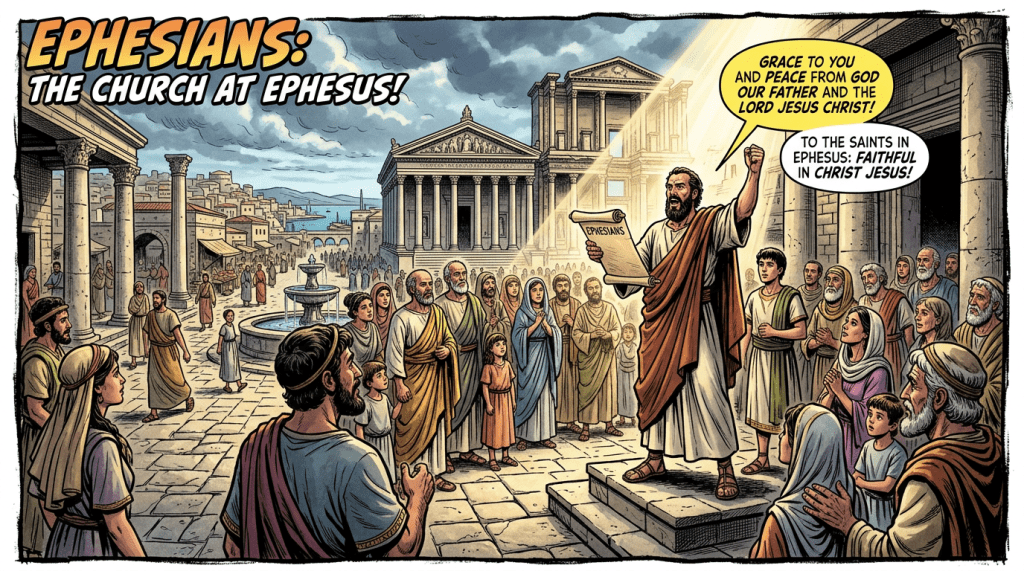
Ephesus was no obscure outpost. As a major port and commercial hub of the Roman province of Asia, it was a city of wealth, culture, and intense religious competition, dominated by the vast temple of Artemis. Into this environment the early Christian community had been planted with notable success. According to the text of Revelation 2:1-7, the risen Lord begins by identifying himself as the one who “holdeth the seven stars in his right hand, who walketh in the midst of the seven golden candlesticks.” The imagery, drawn from the preceding vision in Revelation 1:13-16, establishes both intimacy and authority: Christ is present among his churches and holds their messengers securely.
What follows is a detailed commendation. “I know thy works, and thy labour, and thy patience,” the letter states. The church could not bear those who were evil. It had tested individuals who claimed to be apostles and exposed them as liars—an act of discernment that resonates with the warning in 2 Corinthians 11:13 about false apostles who transform themselves into apostles of Christ. The believers had borne hardship, exercised patience, labored for the name of Christ, and had not fainted. These qualities align with the exhortation of Galatians 6:9 not to grow weary in well-doing and with the call in Hebrews 12:3-5 to consider Christ’s endurance lest one become wearied and faint in mind. The Lord, whose knowledge of the righteous is intimate (Psalms 1:6), acknowledges genuine faithfulness in doctrine and endurance.

Then comes the pivot that has unsettled readers for centuries: “Nevertheless I have somewhat against thee, because thou hast left thy first love.”
The phrase “first love” is not sentimental nostalgia. In the Greek underlying the King James text it is prōtēn agapēn—the foremost, primary, chief love. Cross-referenced with Mark 12:30-31, the meaning sharpens. There Jesus declares the greatest commandment: “Thou shalt love the Lord thy God with all thy heart, and with all thy soul, and with all thy mind, and with all thy strength: this is the first commandment. And the second is like, namely this, Thou shalt love thy neighbour as thyself.” The Ephesian believers had retained labor, orthodoxy, and moral vigilance, yet they had drifted from the all-encompassing devotion that Scripture itself designates as first. Works continued; the animating relationship had cooled.
This diagnosis is not an attack on the unfaithful but a warning directed precisely at the faithful. The church in Ephesus was not charged with heresy or moral collapse in the primary sense. It hated the deeds of the Nicolaitanes, which Christ also hated. Those deeds, illuminated by the parallel language in Revelation 2:14-15 concerning the doctrine of Balaam, involved teaching or practicing the consumption of things sacrificed to idols and fornication—compromises with surrounding pagan culture under a banner of religious liberty. The Ephesians rejected that error. Their failure was subtler and, in the Lord’s estimation, more dangerous: the displacement of the greatest commandment by secondary virtues.
The prescribed remedy is as precise as the diagnosis. “Remember therefore from whence thou art fallen, and repent, and do the first works; or else I will come unto thee quickly, and will remove thy candlestick out of his place, except thou repent.” Three steps form the corrective path. First, remember—the deliberate recollection of the former height of wholehearted love for God. Second, repent—the Greek metanoeō signifying a change of mind and direction, a turning back from the drift. Third, do the first works—the resumption of labors that once flowed from that primary love rather than from mere duty or institutional momentum. The alternative is the removal of the candlestick, the loss of the church’s place of witness and light, a principle echoed in the parable of the vineyard in Matthew 21:41, where unfaithful husbandmen are replaced by those who will render the fruits in their seasons.

The letter closes with a universal call and a promise. “He that hath an ear, let him hear what the Spirit saith unto the churches”—language that repeats the summons of Matthew 11:15 and appears throughout the messages to the other assemblies (Revelation 2:11-17; 3:6-22). To the overcomer is granted the right to eat of the tree of life in the midst of the paradise of God, restoring access to that which was barred after the fall in Genesis 3:22 and which reappears in the final vision of Revelation 22:2.For believers today the letter functions less as distant history than as a mirror. Contemporary Christian communities, particularly those that prize doctrinal precision, moral clarity, and active service, often resemble the Ephesian profile. They labor. They test teachings and reject obvious error. They endure cultural pressure without fainting. Yet the danger remains that the first commandment—love of God with the entirety of heart, soul, mind, and strength—can be displaced by the very activities meant to express it. Programs multiply, statements of faith are refined, and boundaries against compromise are maintained, while the inward affection that should govern all grows formal or secondary.
The Nicolaitane impulse has not vanished. In every age the temptation arises to soften the boundaries of holiness in the name of relevance or freedom, whether through accommodation to surrounding ethical norms or through teachings that treat moral and spiritual compromise as matters of indifference. The related pattern seen later in the letter to Thyatira, where a figure called Jezebel taught and seduced servants of Christ into fornication and idolatrous participation, illustrates how tolerated error can embed itself when first love has already weakened. Faithful believers are called not merely to reject such deeds but to examine whether their own orthodoxy still rests on the foundation of wholehearted devotion.
Correction of the heart, according to the text, begins with honest recollection. Believers are invited to remember the season when love for God ordered their thoughts, energies, and relationships without dilution. That memory is not an exercise in sentiment but a diagnostic tool. Repentance follows as a decisive reorientation of mind and will. It is not vague regret but a change that realigns priorities with the first commandment. The final movement is practical: the first works are taken up again—service, endurance, and discernment now flowing once more from love rather than from habit or institutional expectation.

The stakes are institutional as well as personal. The threat of the candlestick’s removal suggests that a community can lose its distinctive light and place of witness even while continuing outward activity. History offers sobering illustrations of once-vibrant assemblies that retained forms after the animating love had departed. Yet the letter is not primarily a sentence of doom. It is an invitation extended to those who still have ears to hear. The same Christ who walks among the candlesticks and searches the reins and hearts offers the tree of life to those who overcome by recovering what was left.
In an era of religious noise, institutional fatigue, and cultural pressure, the message to Ephesus cuts through with unusual clarity. It does not demand the abandonment of labor or discernment. It demands that these be restored to their proper place beneath the first and greatest commandment. Faithful believers who recognize the cooling of first love are not called to despair but to the specific sequence the text provides: remember the height from which they have fallen, repent, and do again the works that once expressed undivided love for God. The promise that follows is not abstract. It is the recovery of life in the presence of God, the very life symbolized by the tree that stands in the paradise of God.
The letter remains open. The Spirit still speaks to the churches. Those who have ears are invited to listen—and to act.





Leave a Reply