
America and warfare go together like pancakes and maple syrup.
But wars don’t equip themselves. Someone has to deliver the body armor, helmets, camouflage, communications gear, guns, and ammunition. War is a massive supply-and-demand business, yet we rarely hear about the suppliers—the people who profit from conflict without ever setting foot on a battlefield. During the early years of the Iraq War, the Bush administration opened military contracts to a wide range of bidders. While major defense conglomerates dominated the big deals, the system also allowed a pair of inexperienced twenty-somethings named Efraim Diveroli and David Packouz to work their way into millions of dollars in contracts.
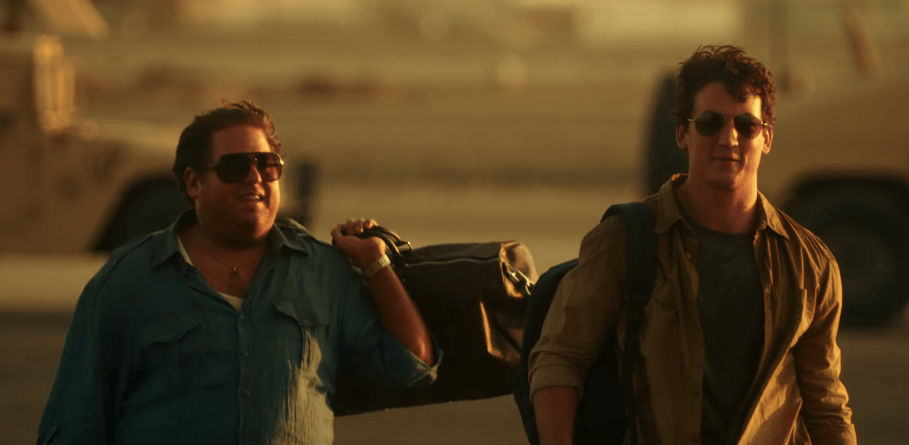
That real-life story is the basis for War Dogs. The film stars Jonah Hill as Efraim and Miles Teller as David. We first meet David living in South Florida, scraping by as a massage therapist for wealthy clients and struggling to afford even basic expenses for himself and his girlfriend. After the funeral of a mutual acquaintance, he reconnects with his old childhood friend Efraim, who is running a small company called AEY Inc. that bids on low-level government weapons contracts. The two decide to team up. After landing a $3 million deal, they set their sights much higher—on a massive $300 million contract to supply ammunition—even if it means cutting corners and defrauding the U.S. military. The first hour of War Dogs is a struggle.
The movie is marketed as a war comedy, but it simply isn’t very funny. Todd Phillips, the director behind the Hangover films and Old School, appears to be aiming for something in the vein of Michael Bay’s Pain & Gain—a dark, semi-comic true-crime story. The problem is that the tone never settles. At times the film feels closer to a generic Seth Rogen-style bro comedy with Jonah Hill in the lead, and the results are uneven at best. Hill plays Efraim as an abrasive, vulgar, deeply unlikable character who spends much of his screen time doing coke, smoking weed, bragging about prostitutes, or delivering one of the most grating fake laughs in recent memory. If the goal was to make the audience despise him, the mission is accomplished.
When a cameo by Dan Bilzerian appears, it only reinforces the sense that the film is straining for a certain kind of shallow, frat-boy energy. The saving grace, surprisingly, is Miles Teller. His portrayal of David is what prevents War Dogs from collapsing into something resembling an episode of Entourage with guns. Teller brings a degree of humanity and internal conflict that the movie badly needs. As with most “based on a true story” films, it can be difficult to separate fact from Hollywood invention. The third act hews more closely to actual events, while several earlier sequences—such as the pair driving a truckload of weapons through Fallujah, the full depiction of David’s relationship, and a kidnapping in Albania—are either heavily dramatized or invented.
The film also omits a third partner who was involved in AEY’s day-to-day operations and soft-pedals darker elements of the real story, including the treatment of workers and the fate of potential whistleblowers. These choices appear to have been made in order to keep the tone relatively light despite the serious subject matter.If the filmmakers intended to provoke outrage about the business of war, the movie is unlikely to change many minds. It takes the expected shots at the Bush administration and Dick Cheney, but those criticisms feel familiar rather than revelatory. The more frustrating issue is the sense of wasted potential. There is a strong, stranger-than-fiction story here, but it is undermined by the decision to frame it primarily as a comedy—specifically, as a kind of Hangover-style romp.
At roughly 114 minutes the film is not especially long, yet the meandering subplots and uneven tone make it feel longer than it is. Phillips never fully succeeds at either sharp satire or consistent raunchy comedy.Miles Teller does his best to ground the material, and his work is most effective in the quieter, more serious moments. Jonah Hill is actually more compelling when he stops trying to generate laughs and simply leans into the character’s repellent qualities; he generates genuine “heel heat” as the reckless, amoral partner. War Dogs
2/5



Leave a Reply