
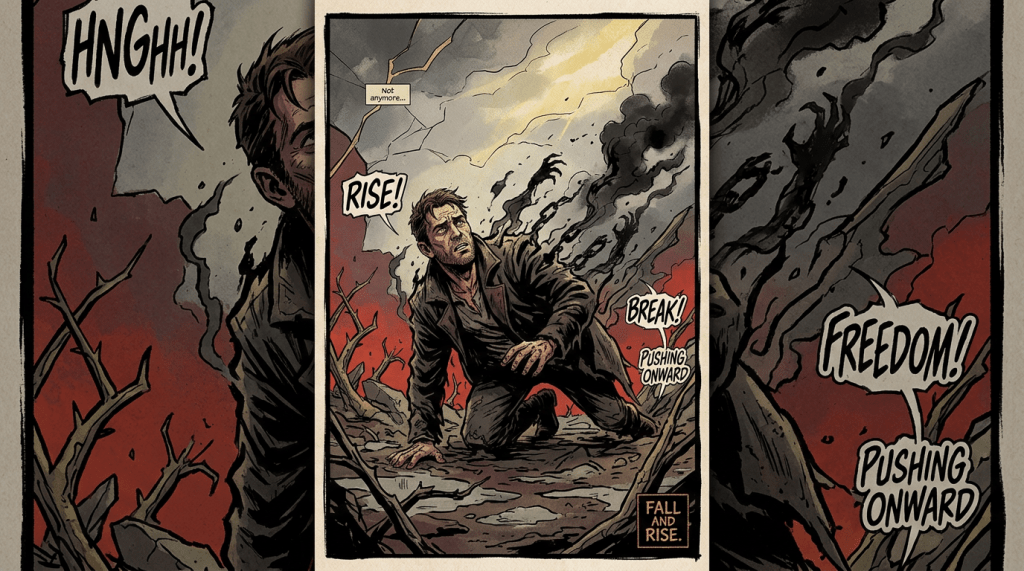
There is a peculiar loneliness that settles over the believer who keeps stumbling. You know the pattern: resolve at dawn, failure by noon, shame by evening. You open the Scriptures expecting a clean ledger and find instead a mirror that shows the same old cracks.

The voice that whispers, “If you were truly His, you would not still be fighting this,” grows louder with every fall. I write to that voice, and to the one who hears it.
The Bible does not flinch from this reality. Proverbs 24:16 states it with the bluntness of a carpenter’s rule: “For a just man falleth seven times, and riseth up again: but the wicked shall fall into mischief.” Notice the subject. It is the just man—the righteous one—who falls. Not once, not twice, but seven times, a number that in Scripture often signals completeness. The text does not pretend the fall never happens. It simply refuses to let the fall have the last word.
The difference between the just and the wicked is not the absence of falling; it is the presence of rising. Paul knew this terrain intimately. In Romans 7 he confesses, with a candor that still startles, that the good he would he does not, and the evil he would not, that he does. “O wretched man that I am!” he cries, not as an unbeliever discovering sin for the first time, but as a man already claimed by Christ and still at war with the flesh that remains.
The conflict is not evidence that the Spirit has departed; it is evidence that the Spirit is present and the flesh has not yet been finally put off. Galatians 5:17 puts the same tension in military terms: the flesh lusteth against the Spirit, and the Spirit against the flesh, so that ye cannot do the things that ye would. The war is real. The command is not to pretend the war is over, but to keep walking in the Spirit while the battle rages.

James is no gentler. “For in many things we offend all,” he writes. Only the one who never stumbles in speech would be perfect—and James is not describing any living Christian of his acquaintance. The sin that “doth so easily beset us,” as Hebrews 12:1 names it, is precisely the kind that keeps finding the same soft place in our defenses. The remedy is not denial. 1 John 1:8 warns that if we say we have no sin, we deceive ourselves, and the truth is not in us. The next verse offers the only honest path forward: confession, followed by the faithful and just forgiveness of the One who cleanses.
This is not a counsel of despair. It is a counsel of realism and resilience. Psalm 37:24 adds the crucial assurance: though the good man fall, he shall not be utterly cast down, for the Lord upholds him with His hand. Micah 7:8 turns the same truth into a defiant declaration against the enemy who gloats: “When I fall, I shall arise.” The rising is not self-generated heroism. It is the upholding hand of God meeting the confession of a sinner who refuses to stay down.
So what does “still fighting” look like when the falls keep coming? It looks like refusing the lie that one more failure proves you were never His. It looks like getting up the eighth time, and the ninth, not because you trust your own record, but because you trust the Advocate who stands with the Father—Jesus Christ the righteous (1 John 2:1). It looks like walking again in the Spirit even when the flesh is loud. It looks like treating each confession not as a reset to zero but as another act of faith that the blood still cleanses.
The culture around us often treats struggle as either proof of authenticity or proof of failure. Scripture treats it as the ordinary condition of the just man on the way home. The wicked fall into mischief and stay there. The just fall and rise. The difference is not moral perfection achieved in advance; it is the stubborn refusal to let the fall become the final chapter.

If you are weary of rising, rise anyway. If you are ashamed of the number of times you have already fallen, remember that the proverb does not count to six and then stop. Seven times is not a limit; it is a portrait of the life of faith under grace. The same Lord who ordered the steps of the good man also upholds him when those steps falter. The fight itself—the repeated decision to get up, confess, and walk again—is part of the obedience to which you are called.
Do not wait for the day when the war ends before you fight. Fight now. Fall if you must. Then rise. The just man does. And the God who upholds him has not finished with you yet.





Leave a Reply