
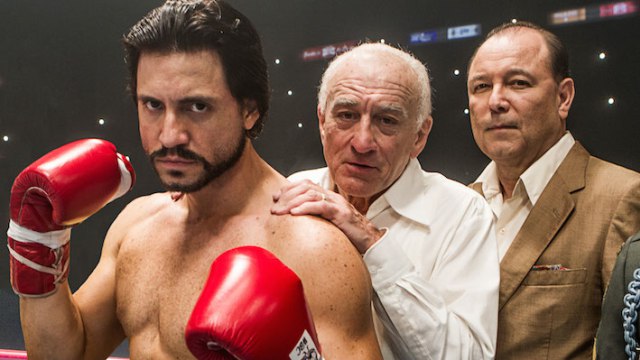
Anyone born after the Mike Tyson era probably thinks Floyd Mayweather is the greatest boxer of all time (insert laughter here). For those who actually know boxing history, the list of all-time greats is long and formidable: Muhammad Ali, Sugar Ray Leonard, Marvin Hagler, Thomas Hearns, and many others. One name that cannot be left off that list is Roberto Durán, regarded by many historians as the greatest lightweight of all time. Durán compiled an astonishing record of 72 wins in his first 73 professional fights. Born and raised on the tough streets of Panama, his was a genuine rags-to-riches story that inspired an entire country. That story reached the screen this year in Hands of Stone, which premiered at Cannes in May and was acquired by The Weinstein Company for wide release. Unfortunately, the film is destined to be remembered as one of 2016’s clearest examples of wasted potential.
Hands of Stone opens in the early 1980s. A young Roberto Durán (Édgar Ramírez) is the exciting new contender fighting at the legendary Madison Square Garden. His manager seeks out legendary trainer Ray Arcel (Robert De Niro), hoping the veteran can mold Durán into a world champion. Arcel, who had been forced out of boxing years earlier by mob pressure, agrees to train the young fighter for free. He quickly discovers he has taken on an enormous challenge. Durán grew up in extreme poverty in Panama during a period of intense conflict with the United States over control of the Canal Zone. Arrogant, volatile, and deeply resentful of America because of that history, he took dangerous risks simply to put food on the table for his family. He learned to box on the streets and became a local force before eventually making his way to the United States.One of the film’s biggest problems is that it is difficult to feel much sympathy for Durán as a person.
Calling him hard-headed would be generous. While his trust issues and anger are understandable given his upbringing, the lengths to which the character goes to be abrasive and self-destructive make it hard for the audience to stay invested. Even after years of training, success, and life experience, he seems to have learned almost nothing about how to conduct himself. In his mid-30s he is still operating with the same angry, impulsive mindset he had as a teenager. This leaves the viewer stuck between rooting for a difficult anti-hero and simply watching a man repeatedly sabotage himself. The problem is compounded by the film’s decision to position Sugar Ray Leonard (Usher) as the primary antagonist, when the emotional logic of the story often makes Durán himself feel like the more antagonistic presence.
On a purely practical level, Édgar Ramírez is simply too old to convincingly play Durán in his early twenties. The decision not to cast a younger actor for the early portions of the story is a glaring one. Scenes in which Ramírez tries to romance his future wife (Ana de Armas), who looks barely out of high school, while he himself appears a full generation older, pull you out of the movie.
The film does cover the infamous 1980 rematch with Sugar Ray Leonard and the “No Más” moment that defined the later stage of Durán’s career. After defeating Leonard to win the WBC welterweight title, Durán’s team hastily arranges a rematch. Undertrained and overweight, Durán is outboxed by a sharper, more focused Leonard. Unable to accept the reality of what is happening, Durán quits in the eighth round, surrendering the title and, in the eyes of many, his reputation.
This is by far the most compelling section of the film. Anyone interested in the sport would be better served by simply rewatching the actual fight footage. Hands of Stone has a rich true story at its disposal but tells it in a predictable, overly melodramatic fashion. The depiction of Durán’s decline leans heavily on familiar Hollywood biopic beats and strained emotional dialogue that often feels forced. The screenplay races through too many plot points too quickly, skipping over details of Durán’s life and career that could have provided greater depth and insight.
The fight choreography itself is only serviceable, and the shaky-cam work during the bouts frequently makes the action harder rather than easier to follow. Coming so soon after a film like Creed (which wasn’t even based on a real fighter), the shortcomings in the ring sequences are especially noticeable.The performances are generally fine. De Niro brings quiet authority to Ray Arcel, and there is even a serviceable Don King impersonation. The period recreation of 1970s Panama and 1980s New York has a solid visual texture. What ultimately sinks the movie is the writing and the lack of a coherent point of view.
Hands of Stone never quite decides what it wants to say about its complicated subject. The result is a missed opportunity to explore one of boxing’s most fascinating and influential figures.
1/5





Leave a Reply