
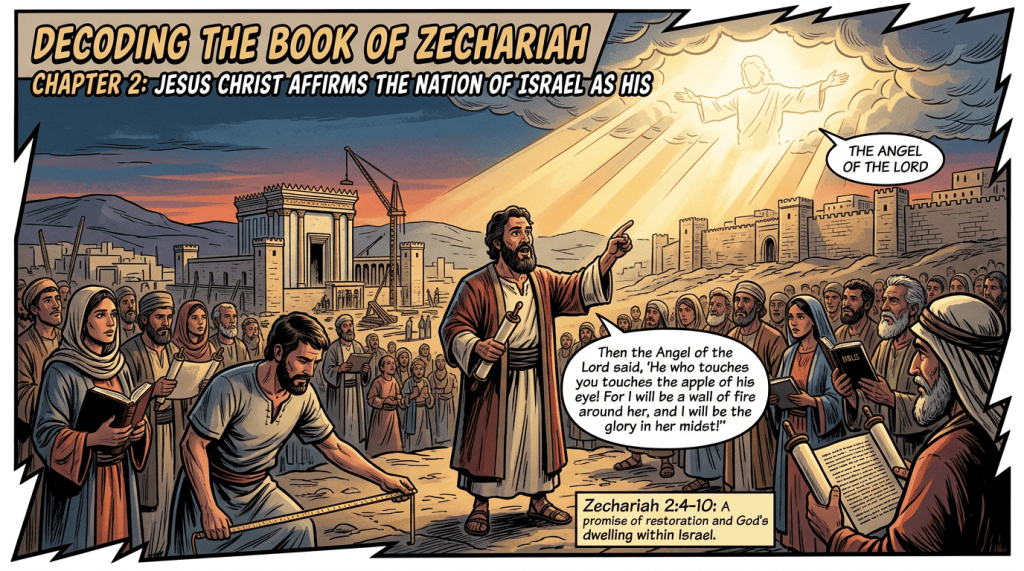
Zechariah functions as the Old Testament counterpart to Revelation. Both books are apocalyptic visions given through an interpreting angel, packed with recurring symbols found almost nowhere else.
Zechariah 2
1 I lifted up mine eyes again, and looked, and behold a man with a measuring line in his hand.
Zechariah sees a man holding a measuring line. Measuring a city or temple recurs in apocalyptic visions; Revelation 11:1 has a reed given to measure the temple, the altar, and those who worship there, while the outer court is left out.
2 Then said I, Whither goest thou? And he said unto me, To measure Jerusalem, to see what is the breadth thereof, and what is the length thereof.
The man is going to measure Jerusalem (Israel) for its width and length. The action implies a determined, future extent of the city rather than an abandoned ruin.
3 And, behold, the angel that talked with me went forth, and another angel went out to meet him,
The interpreting angel who has been speaking with Zechariah goes out, and a second angel meets him. Multiple angels appear in both Zechariah’s visions and Revelation.
4 And said unto him, Run, speak to this young man, saying, Jerusalem shall be inhabited as towns without walls for the multitude of men and cattle therein:
The second angel tells the first to run and tell the young man (Zechariah) that Jerusalem will be inhabited as open villages without walls because of the great number of people and livestock. The picture is expansion beyond fortified limits, not a permanently besieged remnant.
5 For I, saith the LORD, will be unto her a wall of fire round about, and will be the glory in the midst of her.
The LORD (Jesus Christ) Himself will be a wall of fire around her and the glory in her midst. Protection and presence replace ordinary walls. Revelation 21:23 likewise pictures the glory of God illuminating the city so that it needs no sun or moon; Revelation 21:12–14 describes walls, but the divine presence is the central feature in both books.
6 Ho, ho, come forth, and flee from the land of the north, saith the LORD: for I have spread you abroad as the four winds of the heaven, saith the LORD.
A summons to flee from the land of the north. In the post-exilic setting the north was the direction of the Babylonian captivity (modern Iraq), from which the exiles had been spread. “Four winds” language reappears in Revelation 7:1, where four angels hold the four winds of the earth.
7 Deliver thyself, O Zion, that dwellest with the daughter of Babylon.
Zion (Israel) is told to deliver herself—escape—from dwelling with the daughter of Babylon (Iraq). The call is to leave the place of exile. Revelation 18:4 later uses similar language (“Come out of her, my people”) addressed to those linked with Babylon, though that later Babylon is the symbolic figure, not the geographic city named here.
8 For thus saith the LORD of hosts; After the glory hath he sent me unto the nations which spoiled you: for he that toucheth you toucheth the apple of his eye.
The LORD of hosts says that after the glory He has sent the speaker to the nations that plundered them. Whoever touches them touches the apple (pupil) of His eye. The nations that spoiled Zion are treated as touching what belongs to the LORD Himself.
9 For, behold, I will shake mine hand upon them, and they shall be a spoil to their servants: and ye shall know that the LORD of hosts hath sent me.
He will shake His hand against those nations, and they will become spoil to those who had served them. The result will confirm that the LORD of hosts has sent the speaker.
10 Sing and rejoice, O daughter of Zion: for, lo, I come, and I will dwell in the midst of thee, saith the LORD.
Daughter of Zion is told to sing and rejoice because the LORD comes and will dwell in her midst. The promise of divine dwelling in Zion is repeated in Zechariah 8:3 and is thematically parallel to Revelation 21:3 (“the tabernacle of God is with men, and he will dwell with them”).

11 And many nations shall be joined to the LORD in that day, and shall be my people: and I will dwell in the midst of thee, and thou shalt know that the LORD of hosts hath sent me unto thee.
Many nations will join themselves to the LORD in that day and become His people. He will dwell in the midst of Zion, and Zion will know that the LORD of hosts has sent the speaker. The joining of nations is stated positively; the verse does not identify those nations with any single later religious system.
12 And the LORD shall inherit Judah his portion in the holy land, and shall choose Jerusalem again.
The LORD will inherit Judah as His portion in the holy land and will choose Jerusalem (Israel) again. The choice of Jerusalem is presented as future and certain from the standpoint of the vision.
13 Be silent, O all flesh, before the LORD: for he is raised up out of his holy habitation.
All flesh is commanded to be silent before the LORD, because He is aroused from His holy habitation. The verse closes the vision with a call for universal stillness before His action.

Chapter 2 therefore measures a future inhabited Jerusalem, promises the LORD Himself as her protection and glory, summons Zion to leave Babylon (Iraq), declares that harm to Zion touches the LORD’s own eye, and announces that He will dwell in her midst while many nations join Him and He again chooses Jerusalem. The measuring, the divine dwelling, and the call to come out of Babylon are the clearest verbal and thematic links to Revelation.





Leave a Reply