

“The Day of the Lord” is one of those biblical phrases that sounds like weather, or like a hymn title, or like the kind of thing a street preacher shouts without expecting to be asked what he means. The Bible treats the Day of the Lord as a real stretch of divine intervention in history: a period that begins without courtesy, falls as destruction on a world still congratulating itself, and finally unmakes the present heavens and earth. It is not a metaphor for private hardship. It is not a synonym for Sunday. And it is not, in the plain sequence of the text, identical with the public appearing of Christ after the tribulation of those days.
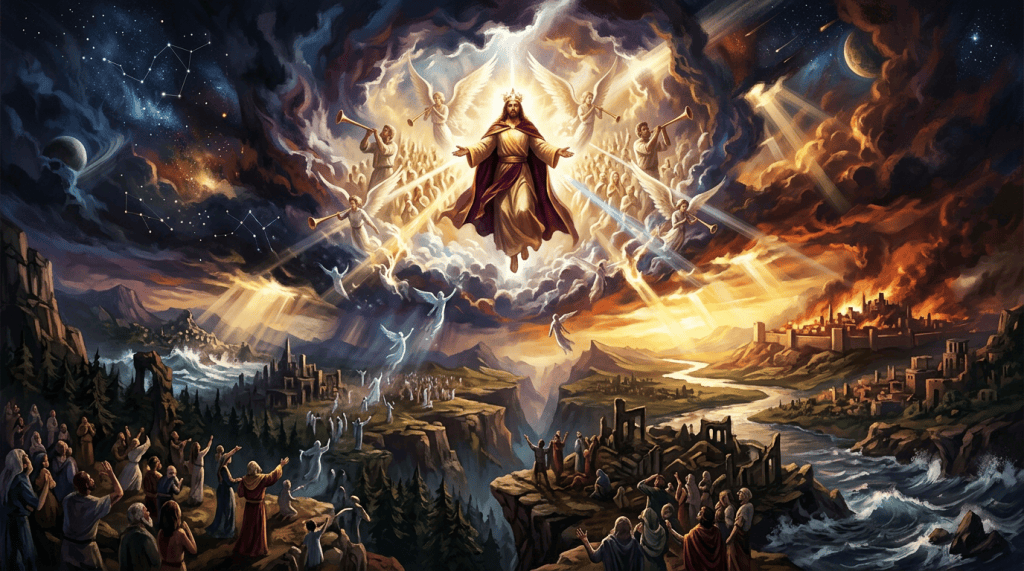
The New Testament assumes the Old. Isaiah does not ease into the subject. “Howl ye; for the day of the LORD is at hand; it shall come as a destruction from the Almighty. Therefore shall all hands be faint, and every man’s heart shall melt: And they shall be afraid: pangs and sorrows shall take hold of them; they shall be in pain as a woman that travaileth: they shall be amazed one at another; their faces shall be as flames.” The images are not decorative. Destruction from the Almighty. Hearts melting. Labor pains. Faces like fire. This is the vocabulary Paul will pick up without apology when he tells the Thessalonians how that Day arrives.
He has just finished describing the Lord descending, the dead in Christ rising, and the living being “caught up… to meet the Lord in the air.” Then: “But of the times and the seasons, brethren, ye have no need that I write unto you. For yourselves know perfectly that the day of the Lord so cometh as a thief in the night. For when they shall say, Peace and safety; then sudden destruction cometh upon them, as travail upon a woman with child; and they shall not escape.” The echo of Isaiah is deliberate. Birth pangs do not follow the birth. They announce that labor has started. Sudden destruction does not describe a world that has already spent years under advertised wrath and is now merely finishing the last battle. It describes onset—the first hour in which the old confidence breaks.
That onset is the offense of the doctrine. Modern readers want either a symbol or a parade. The text gives a break-in. A thief does not negotiate with the household. He does not mail a schedule. He comes when the people inside have decided the night is ordinary. “Peace and safety” is not the slogan of a planet that has watched the sun go black and the tribes of the earth mourn. It is the last unearned calm. The Day of the Lord, judged by these words, begins as an interruption of that calm.
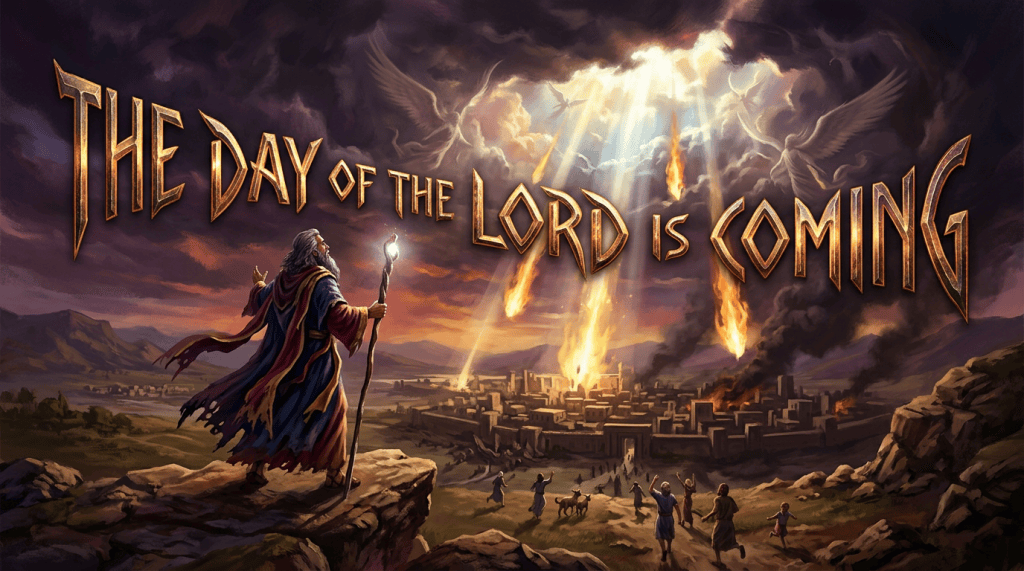
Paul immediately splits the human race into two audiences for the same hour. “But ye, brethren, are not in darkness, that that day should overtake you as a thief. Ye are all the children of light, and the children of the day: we are not of the night, nor of darkness.” The Day is still the Day. The difference is whether it overtakes you as a thief. “For God hath not appointed us to wrath, but to obtain salvation by our Lord Jesus Christ, Who died for us, that, whether we wake or sleep, we should live together with him.”
Wrath is not a mood. In this argument it is the content of the Day for “them” who shall not escape. The church’s promised salvation here is deliverance from that wrath, so that the dead and the living in Christ alike live with Him. The Day of the Lord and the catching-up of the church are therefore not strangers to each other. They meet in one unexpected hour: one company received unto the Lord, the other left to sudden destruction.
This is why the Day of the Lord cannot be collapsed into the Second Coming that Scripture places “immediately after the tribulation of those days.” That later appearing is public by design. The sun is darkened, the moon withholds her light, the sign of the Son of man appears, all tribes mourn, and “they shall see the Son of man coming in the clouds of heaven with power and great glory.” Every eye shall see Him. That is the opposite of theft. Moreover, once the tribulation is underway the Bible becomes almost bureaucratic about time.

A covenant is confirmed for one week; in the midst of the week sacrifice ceases. Two witnesses prophesy 1,260 days. The woman is fed 1,260 days. The beast is given forty and two months. Those who see “all these things” are told it is near, even at the doors. A day whose remaining length can be counted off a page is not arriving as a thief. The thief belongs to the beginning, before the posted numbers, while people are still marrying and giving in marriage, as in the days before Noah entered the ark.
Jesus uses that comparison for a reason. The shock in Noah’s generation was not the final raindrop. It was the day ordinary life proved to have been a countdown no one else was watching. Two in the field, one taken and the other left, belongs to that logic: removal first, destruction after. The Day of the Lord, in Paul’s mouth, is what happens to those left when they are still sure they are fine.
Peter widens the frame without canceling the suddenness. “But, beloved, be not ignorant of this one thing, that one day is with the Lord as a thousand years, and a thousand years as one day. The Lord is not slack concerning his promise… But the day of the Lord will come as a thief in the night; in the which the heavens shall pass away with a great noise, and the elements shall melt with fervent heat, the earth also and the works that are therein shall be burned up.”

Then he looks for “new heavens and a new earth, wherein dwelleth righteousness.” The phrase “in the which” matters. The Day is not a twenty-four-hour holiday. It is a period that contains the final unmaking of the present order. It begins like a thief. It ends in fire and remaking. Slackness is only apparent. The delay is longsuffering, “not willing that any should perish, but that all should come to repentance.” The kindness of the wait does not soften the manner of the arrival.
Revelation shows the interior of that Day without turning it into an allegory of the inner life. Under the sixth vial the Euphrates is dried, unclean spirits gather the kings of the earth “to the battle of that great day of God Almighty,” and a voice interrupts the military staging: “Behold, I come as a thief. Blessed is he that watcheth, and keepeth his garments, lest he walk naked, and they see his shame.” Then they are gathered to Armageddon. Even late, unwatchfulness is still possible. The figure of the thief is not retired merely because judgments have become visible. But the “great day of God Almighty” named here is the climax of a Day already in motion, not its first knock. The world that arrives at Armageddon is not the world that was saying peace and safety. It is the world that did not escape.
The letters to the churches stand on the near side of that hour. Sardis has a name that it lives and is dead. “If therefore thou shalt not watch, I will come on thee as a thief, and thou shalt not know what hour I will come upon thee.” Philadelphia is promised something different: “I also will keep thee from the hour of temptation, which shall come upon all the world, to try them that dwell upon the earth.” Luke’s warning runs in the same direction. That day can come “unawares,” “as a snare… on all them that dwell on the face of the whole earth.” The counsel is to watch and pray “that ye may be accounted worthy to escape all these things that shall come to pass, and to stand before the Son of man.” Escape and standing before Him are not the same assignment as enduring the snare that falls on the whole earth. The Day of the Lord is universal in scope. It is not universal in the sense that every person meets it the same way.
Psalm 127 never names the Day and still explains the human failure that makes the Day a thief. “Except the LORD keep the city, the watchman waketh but in vain.” There is a watching that is only labor and sorrow. There is also this: “for so he giveth his beloved sleep.” Paul will recast the contrast. Some sleep as children of the night, drunk on the ordinary. Others watch as children of the day, wearing “the breastplate of faith and love; and for an helmet, the hope of salvation.” The hope is not that history has no Day of the Lord. The hope is that the beloved are not appointed to its wrath.
If this reading is allowed to stand, literal words, the Day of the Lord is neither a vague spiritual season nor a single afternoon of clouds. It is the Lord’s appointed intervention that interrupts a self-assured world, proceeds as travail and destruction, gathers the kings to a last war, and at last dissolves the elements themselves. It is distinguished from the church’s catching-up not by being unrelated to it, but by being what the world enters when the church is received unto the Lord. It is distinguished from the visible coming after the tribulation not by denying that coming, but by arriving earlier and more quietly than a darkened sun and a mourning planet will later allow.
The culture hears “Day of the Lord” and reaches for spectacle. The prophets reach for labor pains. Paul reaches for a thief. Peter reaches for fire and a new earth. The through-line is not cinematic. It is moral. A world can be sincere about peace and still be unprepared. A church can have a reputation for life and still be asleep. The Day does not ask either party for permission. It comes. The only question the text is interested in is whether it comes upon you as destruction you will not escape, or whether you are already with the Lord who died to keep you from that wrath.

The most important thing about the Day of the Lord is not how many charts it will justify. It is that it begins in an hour when most people are still sure they have time.




Leave a Reply