
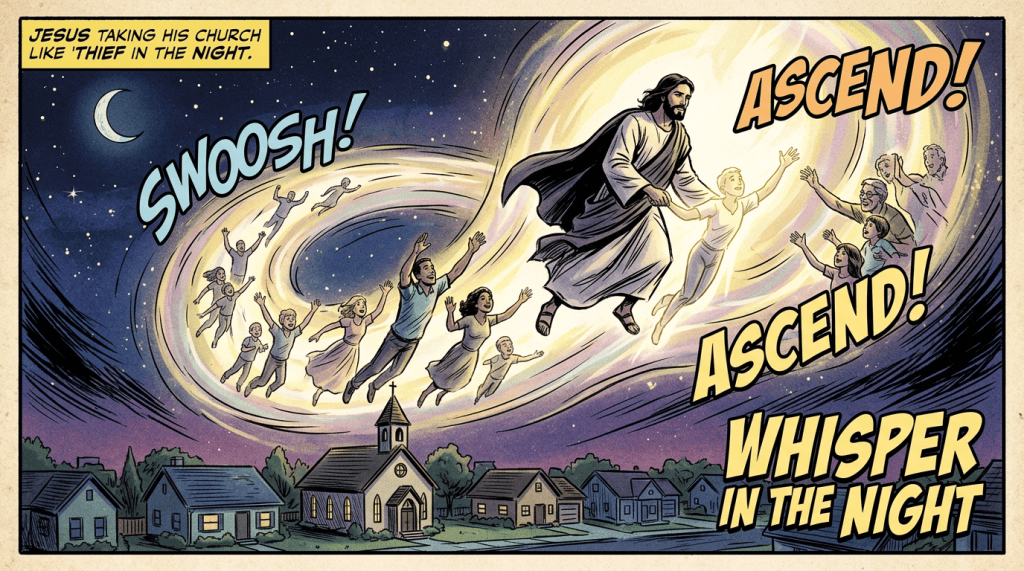
Americans who know the phrase “thief in the night” usually know it as furniture from someone else’s religion. It is treated as either a threat or a punch line. That is a waste of a precise biblical image. Read in the wording of Scripture, “thief in the night” is not a description of Jesus arriving after years of advertised catastrophe. It is the language of an unscheduled taking: the Lord receiving His church to Himself while the rest of the world is still talking about peace.

The mistake is to flatten every future coming of Christ into a single public spectacle. The text does not. One arrival is visible to “all the tribes of the earth.” Another is a meeting “in the air.” One follows “the tribulation of those days.” The other is attached to a world still eating, drinking, marrying, and congratulating itself on safety. The thief belongs to the second of those pictures.
Paul is the clearest witness because he refuses to separate the two paragraphs that modern readers often file in different folders. In 1 Thessalonians 4 he tells the church not to sorrow as others who have no hope. “The Lord himself shall descend from heaven with a shout, with the voice of the archangel, and with the trump of God: and the dead in Christ shall rise first: Then we which are alive and remain shall be caught up together with them in the clouds, to meet the Lord in the air: and so shall we ever be with the Lord.” Then, without changing audience or subject, he turns to times and seasons. “For yourselves know perfectly that the day of the Lord so cometh as a thief in the night. For when they shall say, Peace and safety; then sudden destruction cometh upon them, as travail upon a woman with child; and they shall not escape. But ye, brethren, are not in darkness, that that day should overtake you as a thief.”
Notice the pronouns. Sudden destruction comes upon them. Ye are not in darkness. God “hath not appointed us to wrath, but to obtain salvation by our Lord Jesus Christ, Who died for us, that, whether we wake or sleep, we should live together with him.” The salvation in view is not the conversion they already possess. It is deliverance from the wrath of that day, so that the sleeping and the living in Christ alike “live together with him.” The catching-up is that deliverance. The thief is what the hour feels like to everyone still on the ground.

Jesus had already described the direction of travel. “In my Father’s house are many mansions… I go to prepare a place for you. And if I go and prepare a place for you, I will come again, and receive you unto myself; that where I am, there ye may be also.” He does not say He will come to stay where they are. He will receive them unto Himself. That is the opposite geography from the later scene in which His feet stand on the mount of Olives and the tribes mourn as they see the Son of man coming in power and great glory. One movement gathers a people up. The other brings a King down in public.
Paul calls the upward movement a mystery revealed, not a calendar event announced. “We shall not all sleep, but we shall all be changed, In a moment, in the twinkling of an eye, at the last trump.” A thief does not send a save-the-date. Neither does a twinkling. The moral force of the image is speed without prior negotiation. The household that did not watch discovers the loss only after the fact.
This is why the phrase cannot be made to mean the Second Coming that follows the tribulation. Scripture is not shy about that later appearing, and it is not shy about its precursors. “Immediately after the tribulation of those days shall the sun be darkened, and the moon shall not give her light… and then shall appear the sign of the Son of man in heaven: and then shall all the tribes of the earth mourn, and they shall see the Son of man coming in the clouds of heaven with power and great glory.” That is not how a thief operates. A thief depends on the house remaining ordinary. After the tribulation of those days the house is already on fire.

The same Bible that uses thief language also writes durations in ink. A covenant is confirmed for one week, and in the midst of the week sacrifice ceases. Two witnesses prophesy a thousand two hundred and threescore days. The woman is fed a thousand two hundred and threescore days. Power is given to the beast for forty and two months. Once those clocks start, the remaining time is no longer a secret in the sense the thief requires. Jesus even tells those who see “all these things” that “it is near, even at the doors.” Nearness after signs is the opposite of “in such an hour as ye think not.”
The days of Noah are the controlling comparison, and they are usually misread. “They were eating and drinking, marrying and giving in marriage, until the day that Noe entered into the ark, And knew not until the flood came, and took them all away.” The shock is not the last day of rain. The shock is the day the righteous are shut in and the rest discover that ordinary life has ended. “Then shall two be in the field; the one shall be taken, and the other left.” In that sequence, taking precedes the destruction that overtakes those left. It is the ark logic, not the Armageddon logic.
Isaiah had already given Paul the other half of the metaphor. “Howl ye; for the day of the LORD is at hand; it shall come as a destruction from the Almighty… pangs and sorrows shall take hold of them; they shall be in pain as a woman that travaileth.” Birth pangs do not follow the delivery. They announce that labor has begun. When Paul says sudden destruction comes “as travail upon a woman with child,” he is talking about onset. A world that has already endured seals, trumpets, vials, a global mark, and the murder of the two witnesses is not a world still murmuring “Peace and safety.” The slogan belongs to the last calm hour, not to the last battlefield.

The churches in Revelation are addressed while they still exist as churches, which is to say before that battlefield. To dead Sardis: “If therefore thou shalt not watch, I will come on thee as a thief, and thou shalt not know what hour I will come upon thee.” The rebuke is present-tense unwatchfulness in a congregation that has a name that it lives. To Philadelphia: “Because thou hast kept the word of my patience, I also will keep thee from the hour of temptation, which shall come upon all the world, to try them that dwell upon the earth. Behold, I come quickly.” “From the hour” is not the same promise as “through the hour.” Luke records the same escape language: “Watch ye therefore, and pray always, that ye may be accounted worthy to escape all these things that shall come to pass, and to stand before the Son of man.” Standing before Him is the posture of those received unto Himself, not of those hiding in the rocks.
None of this requires pretending that Scripture uses the thief figure only once. Peter writes that “the day of the Lord will come as a thief in the night; in the which the heavens shall pass away with a great noise, and the elements shall melt with fervent heat.” The Day is a period. It begins without courtesy and it ends in dissolution and a new heaven and a new earth. The unexpectedness attaches to the beginning; the fire is what the Day finally contains.
In the sixth vial, with kings already gathering to Armageddon, a voice still says, “Behold, I come as a thief. Blessed is he that watcheth, and keepeth his garments.” The Lord does not retire the warning merely because judgments have begun. Unprepared people can be surprised more than once. That reuse does not rewrite Thessalonians. It confirms the character of the Lord toward sleepers. The church’s distinctive promise remains the earlier one: that day shall not overtake you as a thief, because you are not appointed to wrath.

Psalm 127, which never uses the word thief, still supplies the contrast the New Testament will need. “Except the LORD keep the city, the watchman waketh but in vain… for so he giveth his beloved sleep.” Human calculation without the Lord’s keeping is theater. The beloved are given rest. In Paul’s vocabulary, the others are the ones who “sleep in the night.” The point is not laziness versus caffeine. It is belonging. Children of the day watch because they expect to be received. Children of the night sleep because they have made peace and safety their creed.
What, then, does watchfulness mean if no man knows the day or the hour? It does not mean charts in the garage and a countdown to a name in the news. The text forbids that kind of certainty even as it commands readiness. Watching means refusing the drunkenness of the age—surfeiting, cares of this life, the sneer that “My lord delayeth his coming.” It means putting on “the breastplate of faith and love; and for an helmet, the hope of salvation.” It means comforting one another with the catching-up itself, which is what Paul says those words are for. The blessed hope in Titus is not a seven-year survival manual. It is “the glorious appearing of the great God and our Saviour Jesus Christ,” looked for as a hope, not as a weather report after the sky has already gone black.
The popular imagination gets the violence of the image and misses its tenderness. A thief is a terror only to the household that did not expect him and did not belong to him. For the people Jesus said He would receive unto Himself, the same hour is reunion. Dead in Christ rise first. The living are changed. They meet Him in the air. They are ever with the Lord. Down below, a sentence that sounded like diplomacy—“Peace and safety”—becomes the epitaph of a world that did not know what time it was.

The New Testament’s own sequence is allowed to stand: first a taking without posted signs, then a Day of the Lord that arrives as destruction and travail, and only afterward the open appearing that every eye will see. If that sequence is wrong, it is wrong on the page, in the plain sense of the words. If it is right, then “thief in the night” is not a slogan for the end of the movie. It is the sound of a door, the absence of people who were just there, and a world that discovers too late that the house was never as safe as it thought.





Leave a Reply