
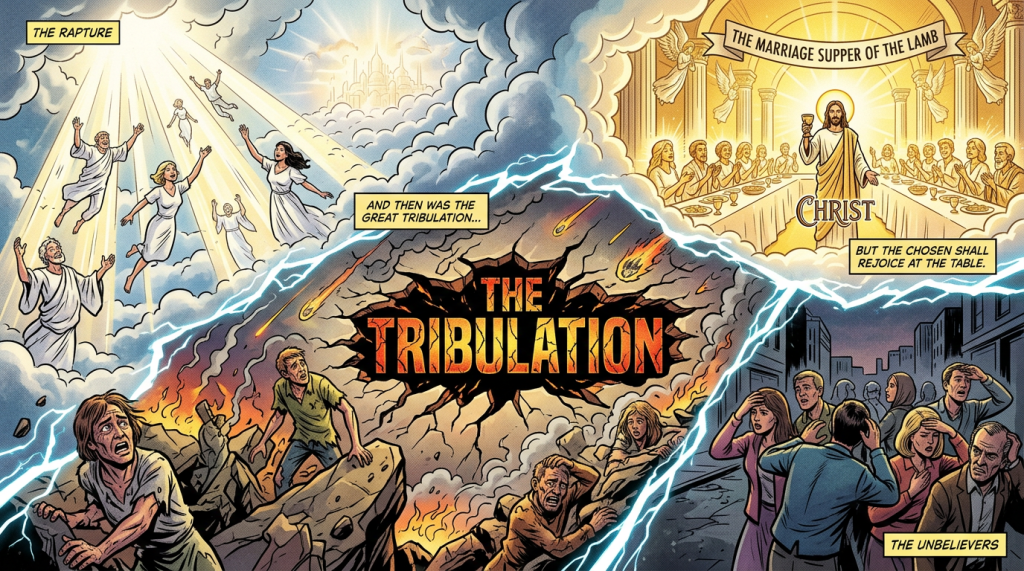
The Bible’s last book Revelation pauses, just before the rider appears, to announce a marriage. The details are more exacting than our sermons usually allow.

Revelation does not reach its climax with a slogan. It reaches it with a feast. After Babylon falls and a multitude like many waters cries that the Lord God omnipotent reigns, the text turns, almost abruptly, to a household event: “the marriage of the Lamb is come, and his wife hath made herself ready.” Fine linen, clean and white, is granted to her, “for the fine linen is the righteousness of saints.” Then a command to write: “Blessed are they which are called unto the marriage supper of the Lamb.” The speaker adds that these are the true sayings of God. John falls to worship and is told not to. The messenger is a fellowservant. Worship God. The testimony of Jesus is the spirit of prophecy.
That is the whole scene, and it is enough to disorder most casual talk about “the bride of Christ.” The passage distinguishes what later piety often collapses. There is a wife who is ready. There is linen that is given and yet described as the saints’ own righteousness. There are others who are called to the supper and declared blessed. The marriage is announced as present—“is come”—and then heaven opens and a rider appears on a white horse to judge and make war. The feast and the campaign stand next to each other on the page.
A literal reading of the text refuses to sand those joints smooth. It also refuses to let seventeenth- or nineteenth-century systems become the court of appeal. The Bible interprets the Bible. The marriage language is not original to John. It is the kingdom’s own idiom.
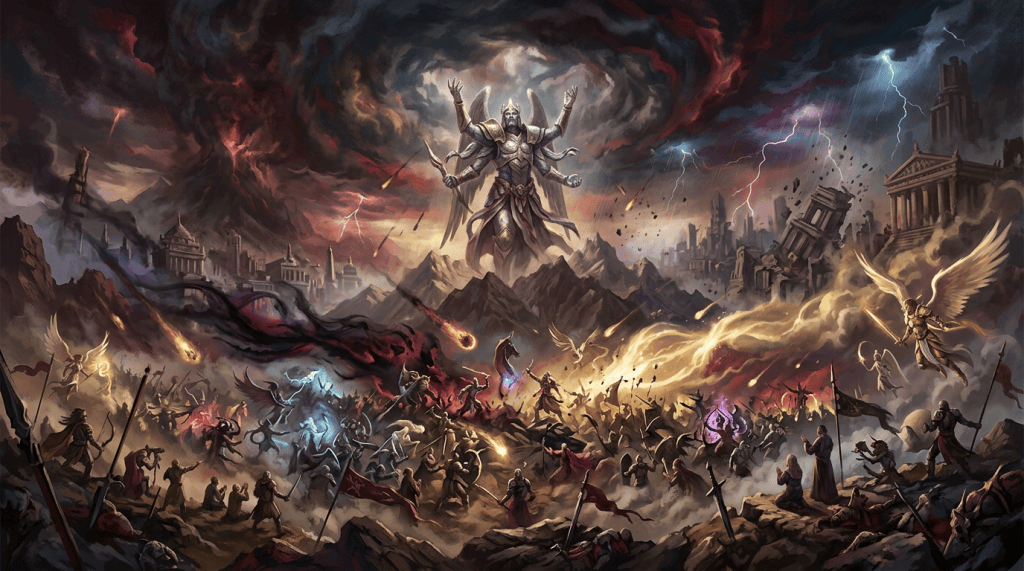
Jesus said the kingdom of heaven is like a king who made a marriage for his son. Servants go to call them that were bidden; they will not come. A second embassy announces that the dinner is prepared, the oxen and fatlings killed, all things ready. Some make light of it and return to farm or merchandise. The remnant seize the servants and slay them. The king is wroth, sends armies, destroys the murderers, and burns their city. Then the wedding is still ready, but the first invited are not worthy. The servants are sent to the highways to bid as many as they find. They gather both bad and good. The wedding is furnished with guests. The king comes in to see them and finds a man without a wedding garment. “Friend, how camest thou in hither not having a wedding garment?” The man is speechless. He is bound and cast into outer darkness. “For many are called, but few are chosen.”
Set that beside Revelation 19 and the correspondences are verbal, not merely thematic. Readiness. A call. A furnished feast. A garment that cannot be improvised at the door. Blessing attached to being called, and exclusion attached to appearing without what the host requires. The linen of the wife and the garment of the guest are not identical images, but they are kin. Both are necessary. Neither is treated as a decorative metaphor.
The ten virgins press the same demand from another angle. They all go forth to meet the bridegroom. Five take oil in their vessels; five do not. He tarries. They all slumber. At midnight the cry comes: “Behold, the bridegroom cometh.” They trim their lamps. The foolish ask for oil and are refused—not from spite, but because there is not enough to split. While they go to buy, he comes. “They that were ready went in with him to the marriage: and the door was shut.” The others cry, “Lord, Lord, open to us.” He answers, “I know you not.” Watch, therefore: you know neither the day nor the hour wherein the Son of man cometh.
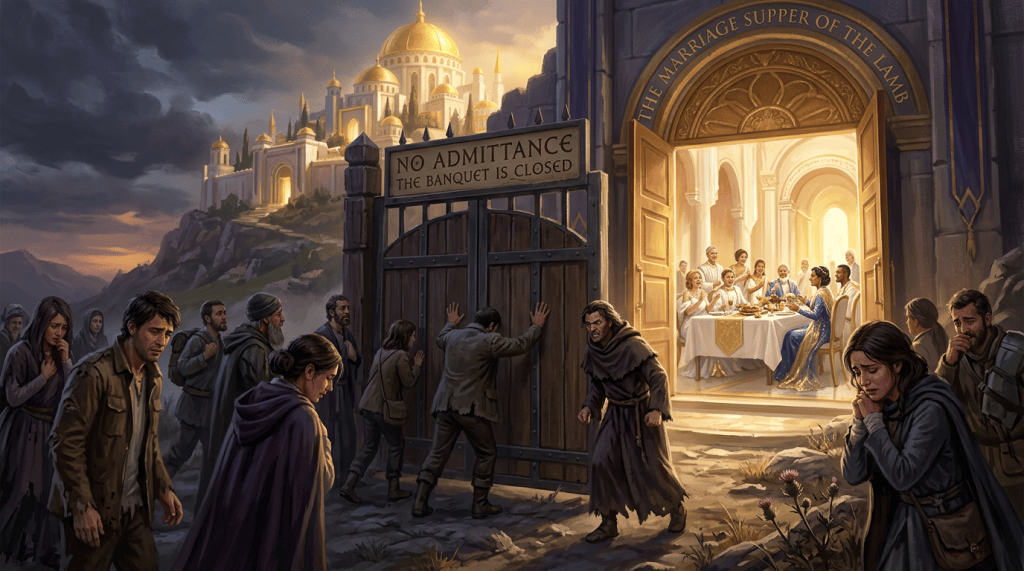
Here the entrance is not described as arriving at a hall already in progress. The ready go in with him. The door’s finality is the point. Delay is real. Shared last-minute virtue is not. Oil cannot be borrowed at the cry.
Luke adds the sentence that most outlines quietly rearrange. Believers are to be like men who wait for their lord “when he will return from the wedding,” so that when he knocks they open immediately. Loins girded. Lights burning. If he comes in the second watch or the third and finds them so, those servants are blessed. He will gird himself, make them sit down to meat, and serve them. The Son of man comes at an hour they think not.
That “from the wedding” matters. In Matthew 25 the ready enter with the bridegroom to the marriage. In Luke 12 another company waits for a return after it. Revelation 19 announces that the marriage has come and then shows the rider. The texts are not a single blur of “Jesus comes back and there is a party.” They are a sequence with roles: a wife made ready, virgins who enter with him, guests called to the supper, servants who watch for a knock after the wedding itself.
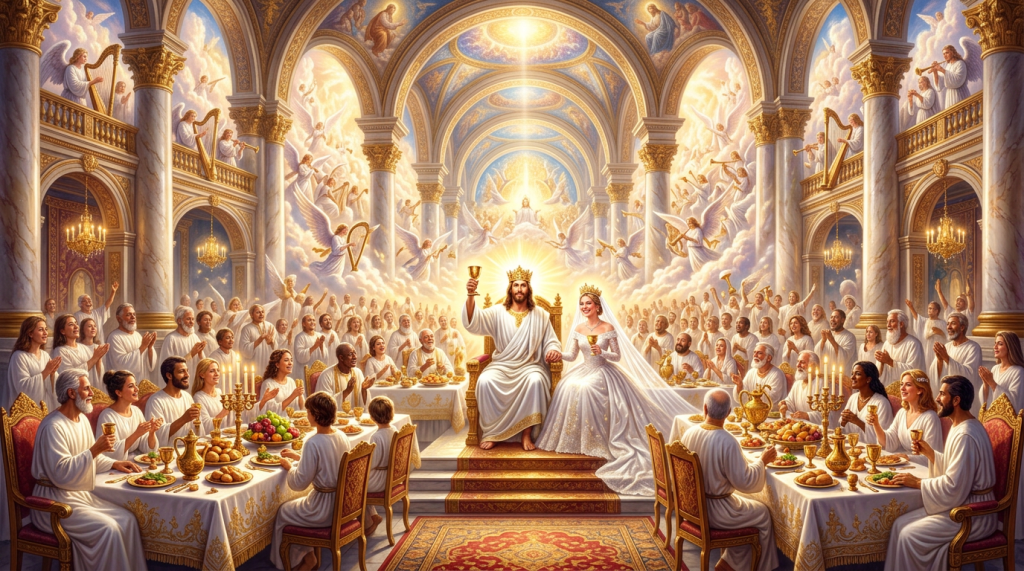
Luke’s table talk supplies etiquette and invitation policy for the same image. When bidden to a wedding, do not take the highest room. A more honorable man may have been invited; shame follows the demotion. Take the lowest room, and the host may say, “Friend, go up higher.” Whoever exalts himself is abased; whoever humbles himself is exalted. Then the host is instructed: when you make a dinner or a supper, do not call friends, brethren, kinsmen, or rich neighbors who can repay you.
Call the poor, the maimed, the lame, the blind. You will be blessed, because they cannot recompense you. You will be recompensed at the resurrection of the just. A guest at that table immediately says, “Blessed is he that shall eat bread in the kingdom of God.” The blessing formula keeps recurring—called, watching, unable to repay, eating bread in the kingdom.
Who, then, is the wife? Paul tells the Corinthians he has espoused them to one husband, to present them as a chaste virgin to Christ. To the Ephesians he says the husband is head of the wife even as Christ is head of the church and saviour of the body; Christ loved the church and gave himself for it, to sanctify and cleanse it, to present it to himself a glorious church without spot or wrinkle. “This is a great mystery: but I speak concerning Christ and the church.”
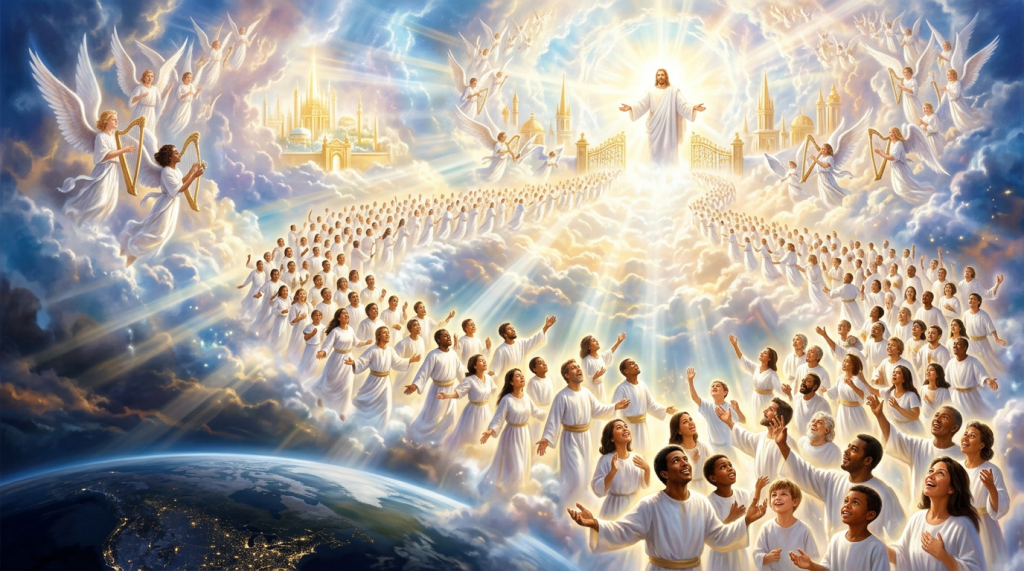
John the Baptist, standing outside that identity, calls himself the friend of the bridegroom who rejoices at the bridegroom’s voice. Later still, an angel tells John, “Come hither, I will shew thee the bride, the Lamb’s wife,” and shows him the holy city, new Jerusalem, coming down from God, prepared as a bride adorned for her husband. The people and the city share the figure. Scripture does not apologize for using both.
A pre-tribulation reading tries to honor these distinctions by inserting an interval the marriage texts do not themselves clock. The church, already betrothed, is caught up first. In heaven the wife is made ready; the linen is associated with the saints’ righteousness and with the white raiment of the armies that later follow the rider. The marriage occurs out of sight of the earth’s distress.
Those called to the supper—friends of the bridegroom, older saints, those gathered after the first invitation fails—are not treated as identical to the wife. The virgins and the waiting servants are often assigned to companies still on the ground after the bride has gone. Christ then returns from the wedding. Revelation 19:11 is the public appearing, not the private taking.
That construction is an attempt to keep Luke 12’s “return from the wedding” and Revelation 19’s “the marriage … is come” from colliding. It is also an inference. The catching away is argued from other passages. Revelation 19 does not pause to date the ceremony against a seven-year chart. What it does say is that readiness is not optional, that calling is not the same as remaining, and that the sayings are true.

The moral center of the image is therefore not speculative timetables. It is inspection. A garment is required. Oil is required. Lights must be burning. The first guest list can fail. A city can burn and the feast still go on. Both bad and good may be gathered, and a speechless man may still be put out. The host may seat the humble higher. The lord who returns may himself serve meat to those he finds watching. Blessing attaches to being called and to being found ready when the hour that no one owns finally arrives.
John’s instinct, facing the announcement, is worship of the messenger. The correction is the last word the scene will bear. Do not. He is a fellowservant of those who have the testimony of Jesus. Worship God. The prophecy is not a puzzle for its own sake. It is testimony.

The marriage supper of the Lamb is the Bible’s way of saying that history ends not only in verdict but in union—prepared, granted, inspected, and closed to those who arrive with nothing to wear and nothing left in the vessel. The door shuts. The rider still has to ride. The texts insist on both.



Leave a Reply