
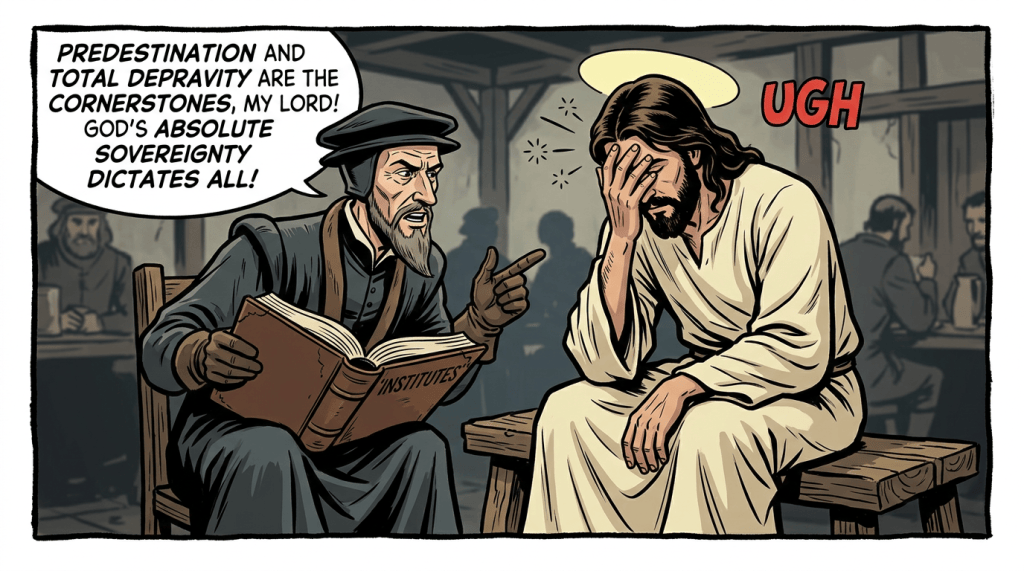
The notion that the God of the Bible withholds love from most of humanity and actively hates those He did not choose for salvation is one of the more persistent distortions of Christian Scripture. It is a reading that takes two verses about ancient national destinies and conscripts them into a Calvinist system that portrays the Creator as either indifferent or hostile toward the vast majority of the people He made in His image. A plain reading of the Bible will not support it.

The claim usually rests on Romans 9:13: “As it is written, Jacob have I loved, but Esau have I hated.” The verse is a quotation of Malachi 1:2-3, where the Lord answers Israel’s post-exilic complaint that He has not loved them. “Was not Esau Jacob’s brother? saith the LORD: yet I loved Jacob, And I hated Esau, and laid his mountains and his heritage waste for the dragons of the wilderness.” The surrounding sentences make the contrast unmistakable. God points to the visible historical difference between two nations that sprang from twin brothers: Israel restored after exile, Edom’s land left desolate. This is covenant history, not a pre-temporal ledger of individual souls.
Paul deploys the same words in Romans 9 to explain why many physical descendants of Abraham have not believed the gospel. “They are not all Israel, which are of Israel,” he writes. The children of the promise, not merely the children of the flesh, are counted for the seed. The examples that follow—Isaac rather than Ishmael, Jacob rather than Esau—illustrate God’s freedom to choose the line through which His redemptive purpose would unfold. Genesis 25:23 already identified the twins as “two nations” and “two manner of people.” The elder serving the younger was a statement about national roles, not a decree of eternal damnation for every descendant of Esau.
Scripture itself uses “hate” in precisely this comparative sense. Jacob “loved also Rachel more than Leah,” and the Lord saw that Leah “was hated.” Jacob still lived with Leah as his wife and fathered children by her. Deuteronomy 21:15 speaks of two wives, one loved and one hated. Jesus tells would-be disciples they must “hate” father and mother if they would follow Him—an obvious idiom of preference, not malice, since it would otherwise contradict the fifth commandment. The same linguistic pattern fits Malachi and Romans 9: God preferred Jacob’s line for the covenant promises. It does not require reading personal, eternal hatred of Esau the man, much less of every person never chosen for salvation.

God even commanded Israel not to abhor an Edomite “for he is thy brother.” Esau himself received earthly blessing, fathered a numerous people, and was reconciled to Jacob. The text simply will not bear the weight Calvinist interpreters place upon it when they treat Jacob and Esau as prototypes for every elect and non-elect individual.
That interpretation collides with the rest of the Bible. “For God so loved the world, that he gave his only begotten Son, that whosoever believeth in him should not perish, but have everlasting life.” The world is the world. He “will have all men to be saved, and to come unto the knowledge of the truth.” He is “not willing that any should perish, but that all should come to repentance.” He has “no pleasure in the death of the wicked; but that the wicked turn from his way and live.” While we were yet sinners—and even enemies—Christ died for us. The grace of God that bringeth salvation hath appeared to all men. Christ is the propitiation “for our sins: and not for ours only, but also for the sins of the whole world.”
These statements are not qualified by later theological systems. They stand as written. God sends rain on the just and the unjust and commands His people to love their enemies so that they may be children of their Father in heaven. A doctrine that must redefine “world,” “all men,” and “whosoever” to mean only the elect is no longer interpreting the text; it is overlaying a grid.

The practical effect of the Calvinist reading is to portray God as loving some with a special, saving affection while regarding the rest with holy indifference or active displeasure from eternity. That picture cannot be reconciled with the God who is love, who takes no pleasure in the death of the wicked, and who gave His Son for the world. It slanders the character of the God revealed in Scripture.
Romans 9–11 as a unit further undermines the individualistic reading. The same people described with strong language are later called “beloved for the fathers’ sakes.” Unbelieving Israelites can still be grafted in if they do not continue in unbelief. “All Israel shall be saved.” The chapter is about God’s faithfulness to His promises amid national unbelief, not a proof-text for divine hatred toward most of the human race.
A God who hates the unelected as a class from before they exist is not the God of the Bible. He is the product of a man made system that privileges a few isolated verses over the consistent testimony of Scripture. The text, taken in context and on its own terms, will not sustain the charge. God so loved the world. That is the declaration that must govern every other argument.




Leave a Reply