
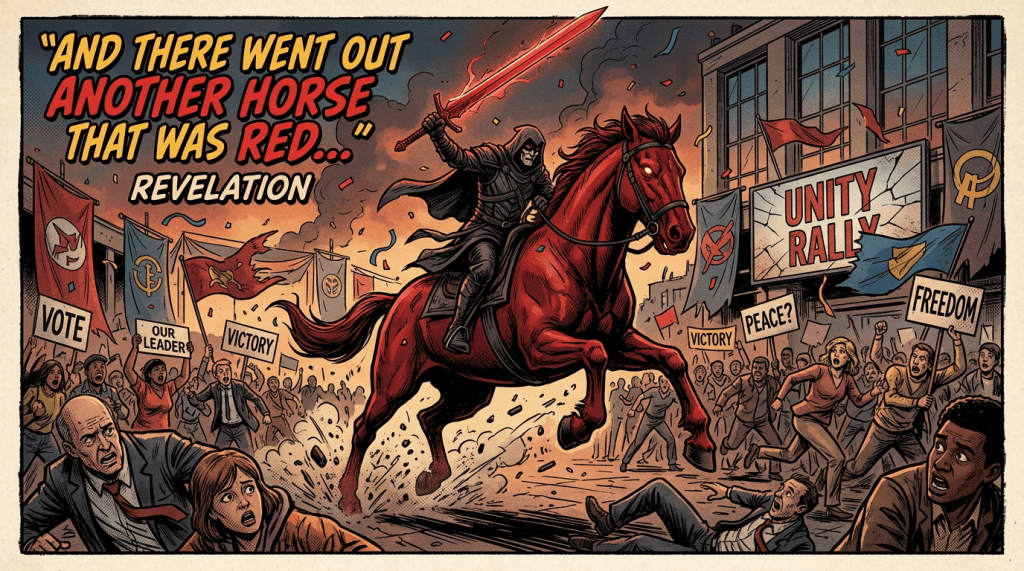
In the sixth chapter of the Book of Revelation, the opening of the second seal releases a rider on a red horse. Power is given to him “to take peace from the earth, and that they should kill one another.” A great sword is placed in his hand. The image is stark: not the chaos of random violence, but the deliberate removal of restraint so that bloodshed becomes ordinary, even celebrated.

That ancient vision feels uncomfortably contemporary. In recent years, certain currents on the American political left have moved beyond policy disagreement into a posture that treats selective killing as understandable, defensible, or even admirable. The pattern is visible in the public reaction to four high-profile cases.
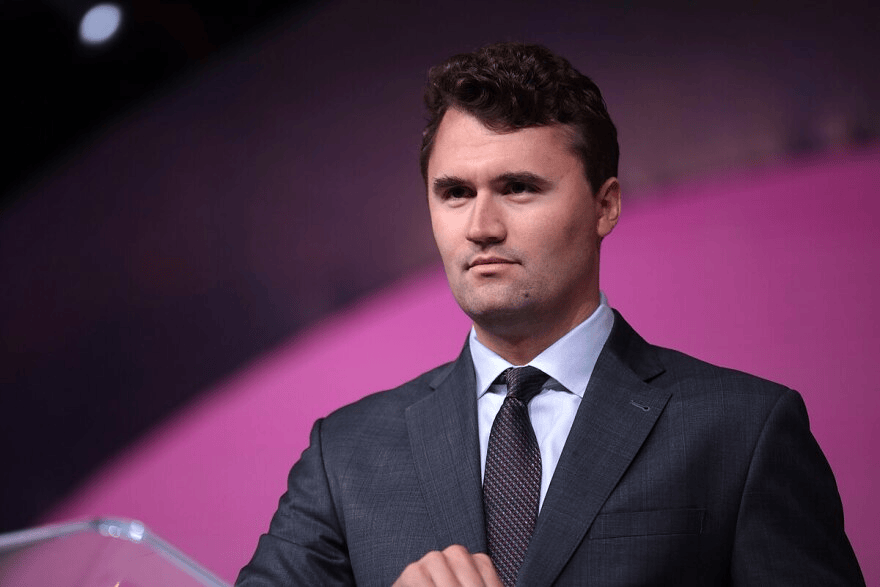
Charlie Kirk, the conservative activist and Turning Point USA founder, was assassinated on September 10, 2025, while speaking at Utah Valley University. The accused shooter, according to authorities, had drifted leftward politically. In the hours and months that followed, online progressive culture responded not only with silence or obligatory regret but with mockery, memes, and open satisfaction. Some lost jobs for the callousness; others doubled down. The murder of a political opponent was treated by a majority of the left as a form of rough justice.
Karmelo Anthony, then 17, fatally stabbed Austin Metcalf, also 17, at a Texas track meet in April 2025 after a confrontation over seating under a team tent. A jury later convicted Anthony of murder and sentenced him to 35 years. Before and after the verdict, supporters framed the killing in racial terms, raised substantial defense funds, and protested outside the courthouse. The unarmed victim’s death was subordinated to a narrative of systemic bias. Self-defense claims were advanced aggressively even as eyewitness accounts described provocation followed by a lethal stab to the chest.
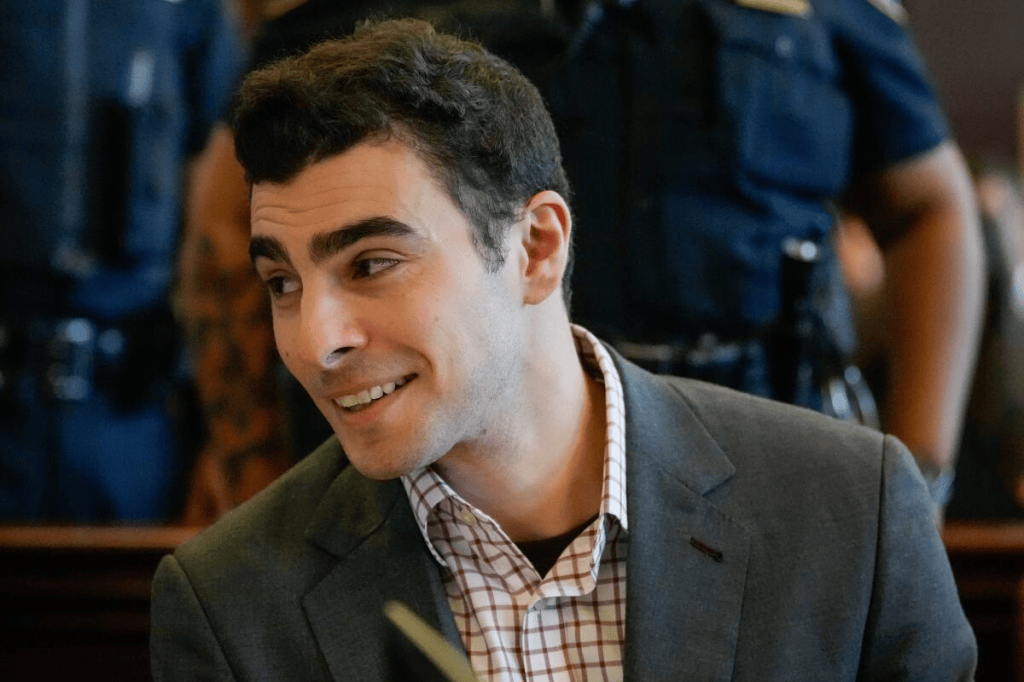
Luigi Mangione gunned down UnitedHealthcare CEO Brian Thompson in December 2024 in an event that was caught on camera. Shell casings carried words associated with insurance-claim denial. A manifesto expressed rage at the industry. What followed was not universal condemnation. Mangione became a folk hero in progressive online spaces. Merchandise appeared. Commentators expressed reduced empathy for the victim or treated the killing as a grim but comprehensible response to a broken system. Polling showed higher sympathy among younger and more left-leaning respondents. Targeted assassination of a civilian was reframed as protest.
Lindsay Clancy is on trial for the 2023 strangling of her three young children. The defense does not dispute the acts but argues postpartum psychosis. In August 2026, hundreds of women, many dressed in pink, rallied outside the Massachusetts courthouse with slogans of solidarity—“Peace for Lindsay,” “She Needed Help.” The public mobilization centered the perpetrator’s suffering more prominently than the extinguished lives of the children.
The common thread runs through the progressive response in each: a willingness to contextualize, fund, romanticize, or reduce empathy for the killer when the victim can be cast as representing an opposed system, class, race, or ideology—or when the perpetrator fits a preferred narrative of oppression or trauma. Scripture’s standard is simpler and harsher. “Thou shalt not kill.” “Whoso sheddeth man’s blood, by man shall his blood be shed.” Celebrating or excusing the shedding of innocent blood is itself a form of moral participation.
This tolerance of violence did not emerge in a vacuum. It has deeper roots in the left’s historical entanglement with communism, an ideology whose practical record is one of industrial-scale death. The Black Book of Communism and related scholarly estimates place the toll of communist regimes in the twentieth century at roughly 85 to 100 million lives—through engineered famine, purges, forced labor, and execution.
Joseph Stalin’s Soviet Union accounts for tens of millions, including the Holodomor. Mao Zedong’s China produced the single largest human catastrophe of the era, the Great Leap Forward famine, with death estimates ranging from 30 to 45 million or higher. Pol Pot’s Cambodia killed roughly a quarter of its population in four years.
Additional millions died under other Marxist-Leninist governments. These were not tragic accidents of underdevelopment. They followed from an ideology that subordinated the individual to historical necessity, treated entire classes as legitimate targets for liquidation, and justified terror as the midwife of the new society. When private property, independent thought, or simple human attachment interfered with the plan, the response was coercion and elimination. A culture that can absorb a hundred million corpses as the cost of utopia has already decided that some lives are expendable for the sake of the collective dream.
Contemporary Western progressivism is not Soviet communism…or at least not yet. Marxist analytical frames—class or identity struggle as the primary lens, skepticism of markets and traditional restraints, willingness to concentrate state power for “equity”—remain influential in activist and academic circles. When those frames encounter real-world violence that can be narrated as resistance, the historical habit of moral flexibility reappears. The red horse does not require every adherent to wield the sword. It requires only that enough people stop regarding the sword with horror.
Revelation’s sequence is sequential and escalating. The red horse removes peace so that people kill one another. Later seals bring scarcity, death over a quarter of the earth’s population (roughly 2 billion people), and greater judgments. A society that normalizes selective bloodshed is already practicing the logic the prophecy describes. Peace is not primarily a geopolitical arrangement; it is a moral restraint rooted in the recognition that every human being bears the image of God. When that recognition erodes—when murder becomes a meme, a fundraising cause, or a symbol of liberation—the restraint weakens.
The red horse is given power only when the world rejects Jesus Christ and then judgment of the lamb falls upon them. The evidence of recent years suggests the collapse is further advanced than many are willing to admit and the time to prepare is rapidly running out.



Leave a Reply