
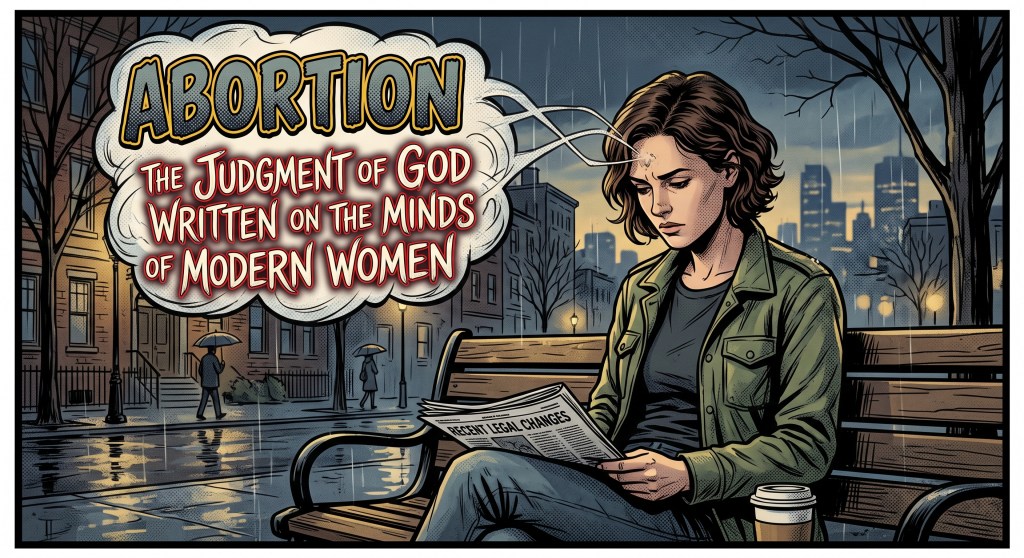
In the modern West, the steep decline in women’s mental health is treated as a puzzle of hormones, social media, or economic pressure. The data tell a darker story. Since the liberalization of abortion laws in the 1960s and 1970s, absolute numbers of induced abortions have exploded into the billions globally.

That explosion coincides precisely with documented surges in female depression, anxiety, self-harm, psychotropic dependence, and family breakdown. Scripture supplies the interpretive key. The Bible, taken as the standard of truth, presents the loss of a sound mind as divine judgment upon knowing rebellion. The prime example is Nebuchadnezzar in Daniel 4:28-33. Modern women, by participating in and celebrating the destruction of the unborn on an industrial scale, and by turning in growing numbers to the occult, have placed themselves under the same judgment.
The account is stark. Nebuchadnezzar, after being warned, walked in pride and declared, “Is not this great Babylon, that I have built… by the might of my power, and for the honour of my majesty?” While the word was still in his mouth, a voice from heaven sentenced him: he would be driven from men, dwell with the beasts, eat grass as oxen, until he knew that the most High rules. Immediately the judgment fell. His reason departed. Hair grew like eagles’ feathers, nails like birds’ claws.
Only after the appointed time, when he lifted his eyes to heaven and blessed the God of heaven, was his understanding restored. Madness was not random biology. It was judicial.
Romans 1 extends the principle. Those who refuse to retain God in their knowledge are given over to a reprobate mind. The fruit includes darkened understanding, inverted affections, and every form of disorder. When a culture institutionalizes the shedding of innocent blood, it multiplies the conditions for that judicial abandonment.

Abortion is not a private medical choice in biblical terms. It is the deliberate ending of a life formed by God in the womb. The post-1960s legalization and subsequent cultural normalization of the practice therefore constitute national and personal rebellion of the first order.
The numbers are staggering. Reliable global census figures do not exist because of underreporting. Estimates drawn from Guttmacher-WHO models and related compilations place annual induced abortions at roughly 50.4 million in 1990–94, 56 million in 2010–14, 73 million in 2015–19, and 73–75 million in recent years. The 1980s are estimated in the 40–50-plus million range annually. Cumulative totals from 1980 through the mid-2020s reach approximately 2.5–2.7 billion. In the United States the annual peak approached 1.4–1.6 million in the late 1980s and early 1990s.
These figures represent lives ended and, for the women involved, a repeated act of severing the natural order of motherhood that Scripture presents as a blessing.

Empirical patterns track the timeline. Women’s rates of any mental illness, depression, and anxiety run substantially higher than men’s—26.7 percent versus 20 percent for past-year mental illness in recent U.S. data, with anxiety and major depression nearly twice as common among women. The disparity is sharpest among the young: more than half of women aged 18–24 report frequent poor mental-health days.
Adolescent girls and young adult women have driven the post-2010 acceleration in major depressive episodes, emergency visits for self-injury, and suicide rates that now exceed previous generational records in several Western countries. Antidepressant use follows the same gender gap: 15.3 percent of adult women versus 7.4 percent of men in 2023 data, with earlier surveys showing nearly double the female rate.
Single mothers report markedly higher psychological distress than married mothers; divorce elevates women’s risk of mental-health diagnoses. Family breakdown and psychotropic dependence have risen in lockstep with the abortion regime.

Studies examining abortion and subsequent mental health are contested, yet a consistent body of research finds elevated risks. Meta-analyses and longitudinal cohorts report 30–81 percent higher odds of depression, anxiety, substance-use disorders, and suicidal behavior among women with abortion histories after adjustment for various confounders. Psychiatric hospitalization rates after abortion have been measured at more than double those following other pregnancies.
Pre-existing mental illness amplifies the risk, but the association itself appears repeatedly. The cultural response—affirmation of the procedure as empowerment and pharmacological management of the aftermath—treats symptoms while the underlying rebellion continues.
Layered onto this is the parallel rise of occult involvement among women. The 1960s and 1970s counterculture and second-wave feminism fueled a revival of witchcraft, Wicca, goddess spirituality, and New Age practices. Estimates of U.S. Wiccans and Pagans grew from a few thousand in the early 1990s to hundreds of thousands by the 2000s and potentially over a million in later surveys; women consistently form the large majority—often 65–75 percent or higher—of practitioners.

Social-media phenomena such as “WitchTok” have amplified recreational and serious interest, especially among younger women. Scripture treats consultation with familiar spirits, witchcraft, and idolatry as abominations that invite further darkness (Deuteronomy 18:10-12; Galatians 5:20). Studies of possession experiences and paranormal beliefs frequently note associations with trauma, dissociation, and mental distress. When women turn from the living God to spirits and self-deification, they invite the very disordered minds the Bible records in cases of demonic affliction.
The convergence is not accidental. The liberalization of abortion, the explosion in its absolute numbers, the cultural celebration of female autonomy over biblical design, the breakdown of marriage and motherhood, and the turn toward the occult form a single trajectory of rebellion. Nebuchadnezzar lost his reason because he refused to acknowledge the Most High. Modern women, formed in a culture that authorizes the destruction of the unborn by the hundreds of millions and that increasingly courts occult powers, stand under the same principle.
The statistics of anxiety, depression, self-harm, medication, and relational chaos are the contemporary equivalent of eating grass as oxen. Affirmation and pharmaceuticals cannot restore what only repentance and the acknowledgment of God’s rule can renew. Until that acknowledgment occurs, the judgment written on the minds of a generation will continue.




Leave a Reply