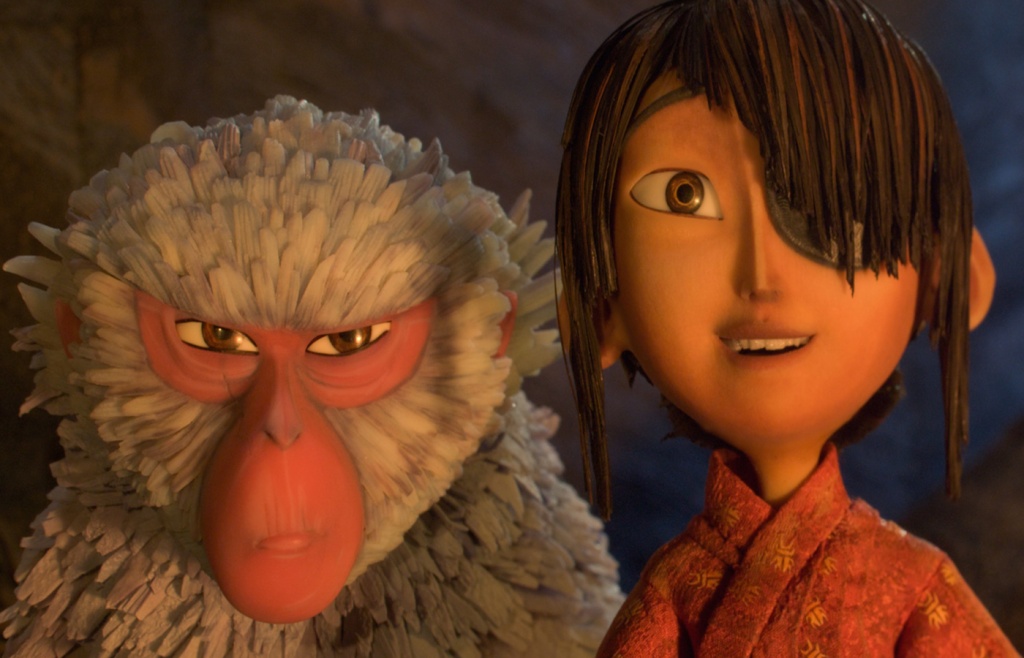
This film actually did something that few animated movies manage to accomplish: it genuinely intrigued me with its story. Drawing heavily on Shinto-inspired elements, Japanese folklore, and classic rite-of-passage themes, Kubo and the Two Strings pulled me in immediately. As someone who has always been a sucker for Japanese art and mythology, I was hooked from the start. Stop-motion studio Laika—responsible for earlier films like ParaNorman and The Boxtrolls—has maintained a strong critical track record for a company that is still relatively young.
I wanted to see whether that streak would continue, and it absolutely did. Kubo and the Two Strings follows a young boy named Kubo (voiced by Art Parkinson). Honestly, based on the trailers I initially thought Kubo was a girl—shows how much attention I sometimes pay to detail. The film opens with his mother (Charlize Theron) fleeing an evil force across a stormy sea. A massive wave strikes, leaving her with a severe head injury.
She and infant Kubo take refuge in a cave on the shore near an ancient Japanese village. Years later, Kubo supports them by using his magical shamisen (a banjo-like instrument) to bring origami figures to life and tell stories in the village square. Trouble arrives when members of his mother’s sinister family track him down. Forced to flee, Kubo loses his mother and awakens in the wilderness beside a talking monkey who informs him that he must locate his late father’s legendary armor if he hopes to survive the evil now hunting him—an evil that includes his own grandfather, the Moon King.
One of the most compelling aspects of the story is its emphasis on traditional family values, legacy, and the importance of remembering those who came before us. Kubo comes from an extraordinarily dysfunctional family. His father, the warrior Hanzo, died protecting him and his mother. His mother defied her immortal family by falling in love with a human and showing compassion toward humanity. In retaliation, Kubo’s grandfather stole one of the boy’s eyes in an attempt to strip him of empathy and turn him into a cold-hearted weapon. And you thought your Thanksgiving dinners were awkward. Having never known a normal family life, and carrying the weight of a father he never met, Kubo’s journey is as much about discovering who he is as it is about defeating external threats.Visually, the film is often breathtaking. Laika’s team doesn’t overwhelm the screen with unnecessary spectacle; instead they craft stunning, carefully composed set pieces that deepen the emotional impact of the story.
Aimed at a family audience, the movie frequently adopts the tone and structure of a bedtime story. Many of the backstory sequences are presented in a dreamlike, almost storybook fashion, often using living origami figures as narrators who both advance the plot and clarify objectives for the characters. The stop-motion craftsmanship is extraordinary—you can feel the care and labor in every frame.With all the praise the film earns, there is one notable disappointment: the ending. After a long buildup to the confrontation with the Moon King (Ralph Fiennes), the final battle resolves more quickly and quietly than expected.
I understand this is a children’s film and a brutal, drawn-out fight would have been inappropriate. Still, after everything the story had done right, I found myself craving a more substantial and cathartic climax.Even with that reservation, Kubo and the Two Strings stands as one of the best films of the year and, in my view, the strongest animated feature of 2016 so far. Younger children may find some of the imagery frightening, but most will be completely absorbed by the adventure. The voice performances are solid across the board—Charlize Theron, Matthew McConaughey (as the amnesiac Beetle), and the rest of the cast deliver both emotional weight and welcome moments of humor.
The film carries a sincere, positive message about family, memory, and compassion that parents can appreciate and children can enjoy. The story feels original and carefully considered, and the sheer amount of detailed, handmade work that went into the stop-motion animation is impossible not to respect.In short, Kubo and the Two Strings
4/5



Leave a Reply