
In the quiet of a spring afternoon nearly two millennia ago, a man was executed outside the walls of Jerusalem. The four Gospels record the event with unusual chronological precision: it occurred on the day of preparation for the Passover, a Friday, and the following Sunday morning the tomb was empty.
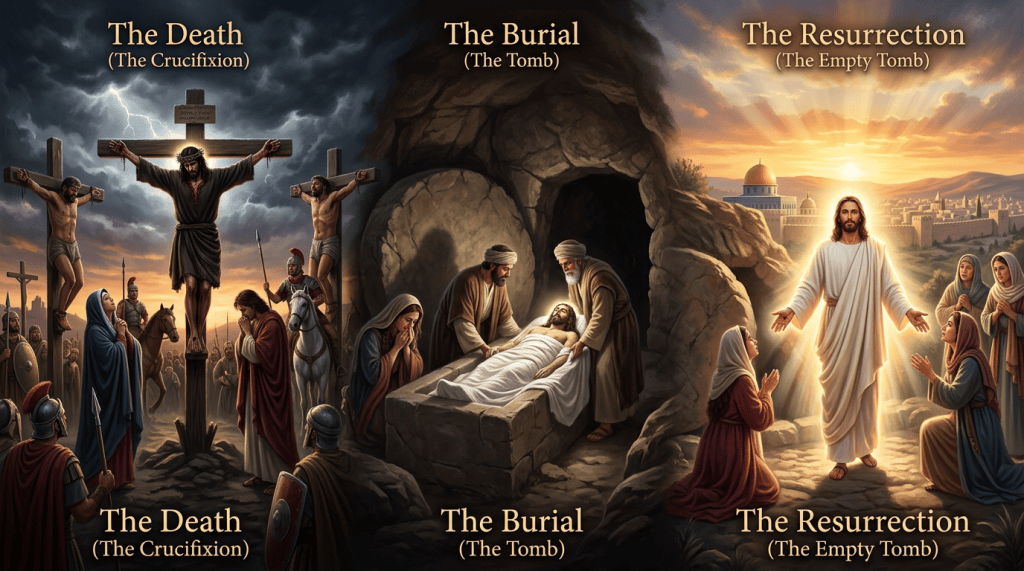
What they do not supply is a year in the Roman reckoning we still use. That absence has invited centuries of calculation. When the internal evidence of Scripture is taken at face value and arranged in sequence, however, the year that emerges is AD 33.
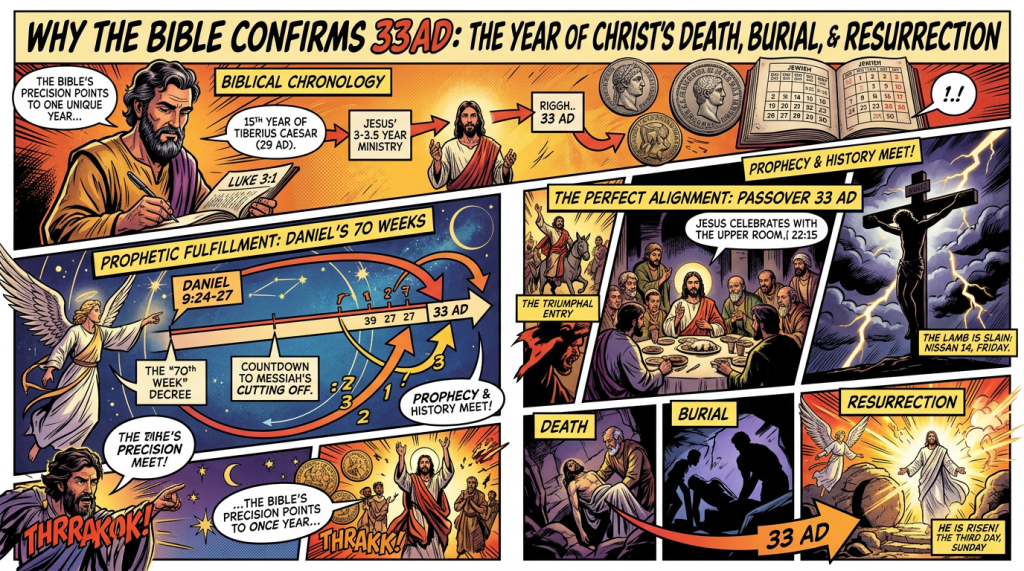
The starting point is the only explicit imperial date in the Gospels. Luke 3:1 places the beginning of John the Baptist’s ministry “in the fifteenth year of the reign of Tiberius Caesar,” while Pontius Pilate was governor of Judea and Annas and Caiaphas held the high priesthood. Augustus, named in Luke 2:1 as emperor at the time of Jesus’ birth, died in AD 14; Tiberius therefore began his sole rule that same year.
His fifteenth year falls in AD 28 or 29. Luke 3:23 adds that Jesus, at the moment he began his public work, was “about thirty years of age.” The two statements together locate the baptism and the start of the ministry in the late twenties of the first century.
The length of that ministry is fixed by the Passovers recorded in the Gospel of John. The first occurs in John 2:13, when Jesus goes up to Jerusalem, cleanses the temple, and is told by the Jews that the temple has been “forty and six years” in building (John 2:20). A second Passover appears in John 6:4, near the feeding of the five thousand. The third, and final, Passover is the one at which he is arrested and crucified (John 11:55; 12:1; 13:1).
Three annual festivals require a ministry of at least three years. Adding that span to a start in AD 29 brings the final Passover to the spring of AD 33. An intervening feast in John 5:1, often understood as another Passover or a major pilgrimage festival, lengthens the period still further without disturbing the terminal year.
The temple reference supplies an independent check. Herod’s reconstruction of the sanctuary began in his eighteenth year, conventionally dated to 20 or 19 BC. Forty-six years later lands between AD 27 and AD 30. The first Passover of Jesus’ ministry therefore sits comfortably near the beginning of that range, leaving room for the two subsequent Passovers and a crucifixion in AD 33.
The day of the week is equally fixed. All four Gospels place the crucifixion on “the preparation,” the day before the Sabbath (Mark 15:42; Luke 23:54; John 19:31, 42). The body is buried before sunset, when the Sabbath begins. The empty tomb is discovered “the first day of the week” (Matthew 28:1; Mark 16:2; Luke 24:1; John 20:1). In the Jewish calendar the preparation day for Passover is the fourteenth of Nisan (Exodus 12:6). The only years between AD 26 and AD 36 in which Nisan 14 falls on a Friday are AD 30 and AD 33. The longer ministry required by John’s Passovers selects the later date.

A final biblical marker appears in the prophecy of Daniel 9:24–27. Seventy weeks are decreed “from the going forth of the commandment to restore and to build Jerusalem unto the Messiah the Prince.” The commandment is the one given to Nehemiah in the twentieth year of Artaxerxes (Nehemiah 2:1–8).
Using the 360-day year attested elsewhere in Scripture (Revelation 11:2–3; 12:6; 13:5), the sixty-nine weeks equal 173,880 days. Counted from the Nisan of that twentieth year, the period closes in the spring of AD 33—the same season in which the Gospels place the cutting off of the Messiah.
These strands are not independent speculations; they are the same narrative read in order. The fifteenth year of Tiberius sets the opening of the ministry; the three Passovers measure its length; the temple’s forty-six years anchors the first Passover; the Friday of Nisan 14 fixes the day; Daniel’s sixty-nine weeks confirms the year. The result is consistent: death on Friday, 3 April AD 33; burial the same afternoon; resurrection on Sunday, 5 April.

Ancient writers outside the New Testament supply secondary corroboration. Phlegon of Tralles, a second-century chronologer, recorded that in the fourth year of the 202nd Olympiad—corresponding to AD 32/33—“a great eclipse of the sun occurred at the sixth hour,” turning day into night so that stars appeared, accompanied by an earthquake in Bithynia. Julius Africanus, writing early in the third century, notes that the historian Thallus had earlier attributed the darkness at the time of these events to a solar eclipse.
Africanus himself rejects the explanation, observing correctly that Passover falls at full moon, when a solar eclipse is impossible. Tertullian, later in the second century, claimed the darkness was still noted in the Roman archives. These notices are fragmentary and preserved largely by Christian authors; they do not prove a natural solar eclipse in Judea. They do, however, preserve an independent memory of an extraordinary midday darkness in the Olympiad year that matches the biblical chronology.
Astronomical reconstruction of the first-century Jewish calendar adds a further check. The month of Nisan began with the first visible lunar crescent after conjunction, observed from Jerusalem, and was positioned so that Passover followed the vernal equinox. Calculations of conjunction times and crescent visibility show that Nisan 14 fell on Friday, 3 April (Julian calendar) in AD 33—the only year in Pilate’s governorship that simultaneously satisfies the Friday requirement, the multi-year ministry, and the temple reference.

On the evening of that same day a partial lunar eclipse was visible from Jerusalem at moonrise. Roughly a fifth of the disk was in Earth’s shadow; the remainder appeared reddish. It is the sole lunar eclipse at Passover time visible from the city between AD 26 and AD 36.
The Gospels do not describe a solar eclipse; the darkness from the sixth to the ninth hour remains unexplained by ordinary astronomy. The lunar eclipse, however, coincides exactly with the date fixed by the biblical sequence.
None of these lines of evidence stands alone. The imperial date in Luke, the Passovers in John, the temple’s age, the day-of-the-week constraints, and the prophetic count in Daniel already converge on a single year. The historical notices of darkness and the astronomical calendar simply confirm that the year the text itself identifies is the year the sky and the Jewish festival calendar also identify.
The death, burial, and resurrection of Jesus Christ, read from the pages of Scripture and checked against the calendar those pages presuppose, occurred in AD 33.



Leave a Reply