
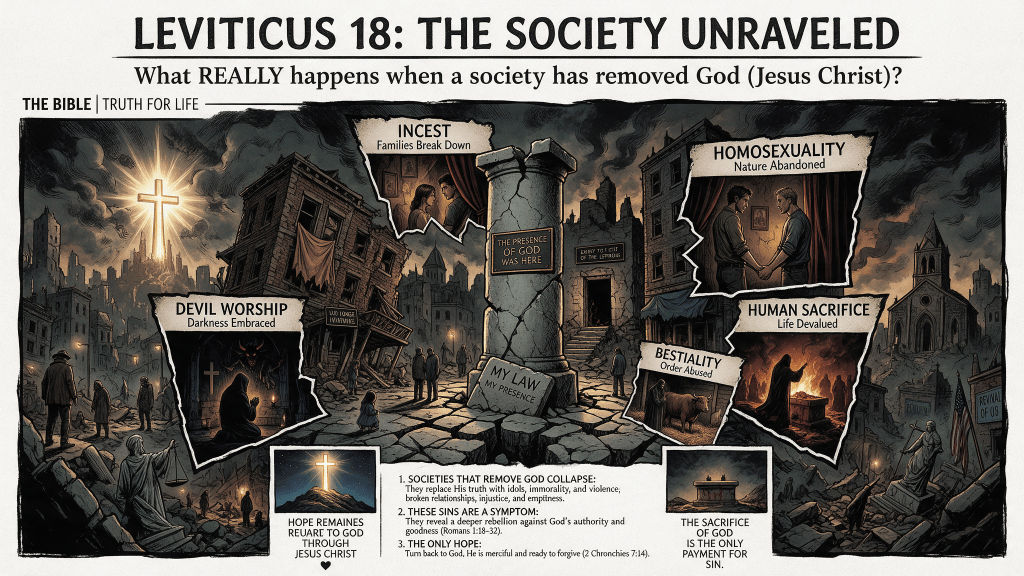
The Canaanite Experiment: What the Biblical Record Shows When a Society Casts Off the Lord? Christianity in decline means society is getting better right? No Christians in government is a good thing, right? No more moral laws from the bible is a great thing, right?
No.
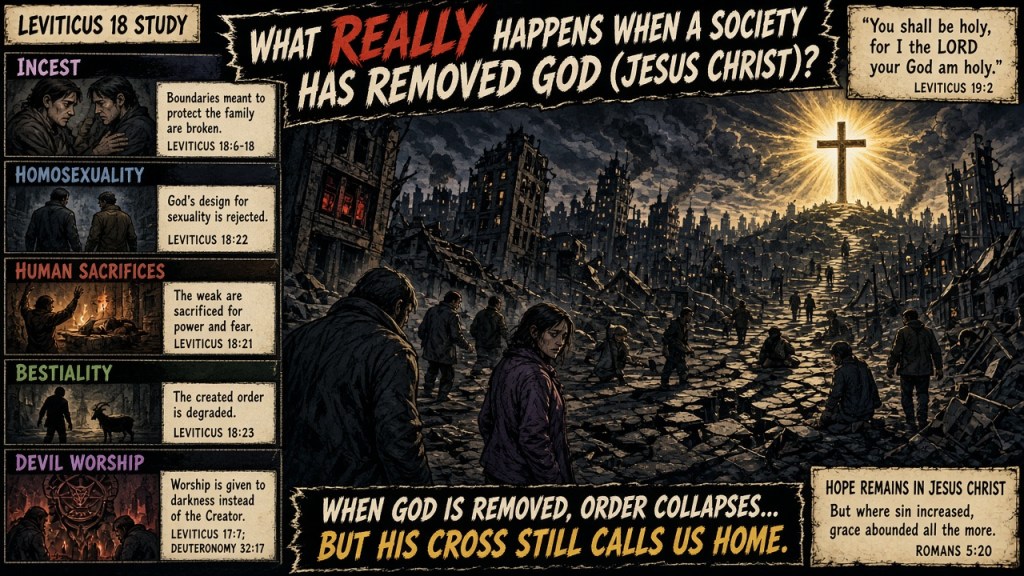
Secular atheists have long insisted that the removal of Christianity—or any residual belief in the God of Scripture—would liberate society into a golden age of reason, tolerance, and progress. The claim appears in countless opinion pieces, academic monographs, and social-media threads: religion, particularly the biblical kind, has held humanity back; without it, science, ethics, and human flourishing would accelerate unimpeded.
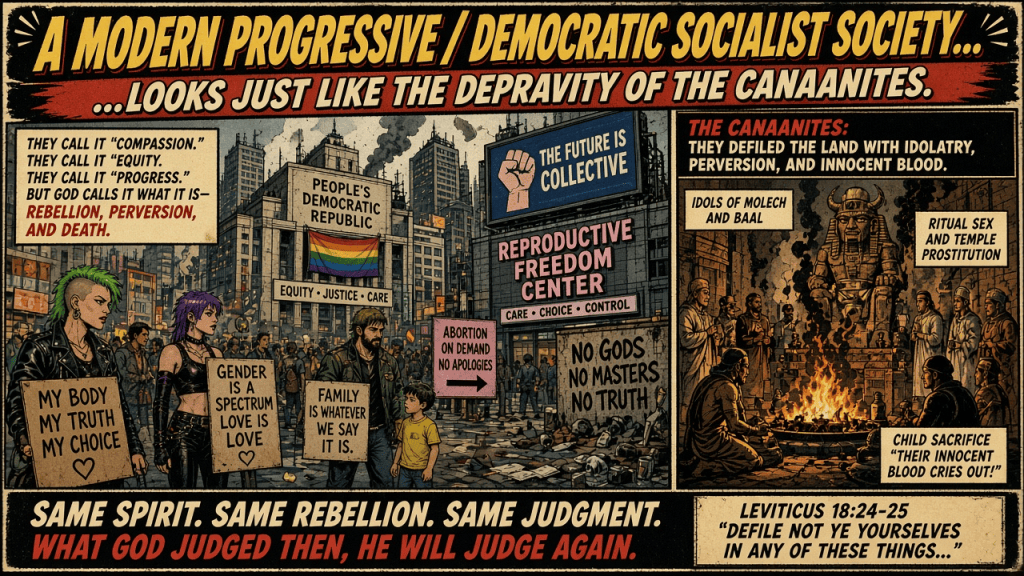
The assertion is presented as self-evident, a settled fact of Enlightenment history. It is, however, a lie contradicted by the plain testimony of the Bible itself. Leviticus 18 and 20 furnish a detailed case study of precisely such a society—the Canaanites—who had cast off the Lord, adopted their own ordinances, and produced a culture of systematic sexual perversion, child sacrifice, and occult practice.
The result was not advancement. It was defilement so complete that the land itself was said to vomit them out under divine judgment.
The chapter opens with an unmistakable contrast. The Lord commands Moses to tell Israel: “After the doings of the land of Egypt, wherein ye dwelt, shall ye not do: and after the doings of the land of Canaan, whither I bring you, shall ye not do: neither shall ye walk in their ordinances. Ye shall do my judgments, and keep mine ordinances, to walk therein: I am the Lord your God” (Leviticus 18:3–4).
The Canaanites had removed the true God from the center of their life and substituted their own statutes. What followed is catalogued without euphemism. Near-kin sexual relations are forbidden in exhaustive detail: a man is not to uncover the nakedness of his mother, his father’s wife, his sister (full or half), his granddaughter, his aunt by blood or marriage, his daughter-in-law, his brother’s wife, a woman and her daughter, or a wife’s sister while the first wife lives (18:6–18). These are not isolated excesses; they are listed as the ordinary “doings” of the land.
Adultery is prohibited next (18:20). Then comes the explicit ban on child sacrifice: “Thou shalt not let any of thy seed pass through the fire to Molech, neither shalt thou profane the name of thy God” (18:21). Male homosexual acts are named with particular force: “Thou shalt not lie with mankind, as with womankind: it is abomination” (18:22). Bestiality is condemned for both men and women as “confusion” (18:23). The summary is unsparing: “Defile not ye yourselves in any of these things: for in all these the nations are defiled which I cast out before you: And the land is defiled: therefore I do visit the iniquity thereof upon it, and the land itself vomiteth out her inhabitants” (18:24–25).
Leviticus 20 supplies the judicial consequences that Israel was to apply so that the same pattern would not take root among them. Giving one’s seed to Molech required death by stoning; if the people refused to execute the sentence, God Himself would cut off the offender, his family, and all who followed him in “whoredom with Molech” (20:2–5). Adultery carried the death penalty for both parties (20:10). Lying with a father’s wife, a daughter-in-law, or mankind as with a woman likewise required death; the latter is again labeled “abomination” (20:11–13).
A man who took a wife and her mother was to be burned with fire, “that there be no wickedness among you” (20:14). Bestiality demanded the death of the human and the slaughter of the animal (20:15–16). Other incestuous relations brought cutting off or childlessness (20:17–21). Mediums and wizards—those who consulted familiar spirits—were to be stoned (20:27).
The closing exhortation returns to the nations: “Ye shall not walk in the manners of the nation, which I cast out before you: for they committed all these things, and therefore I abhorred them” (20:23). Israel was to keep the statutes “that the land… spue you not out” (20:22) and to remain holy because the Lord is holy and had severed them from other peoples (20:26).
This is the biblical description of a society that had removed the Lord. It did not produce a refined ethic or technological superiority. It produced incest across multiple degrees of kinship, the ritual killing of children offered to a false god, homosexual acts classified as abomination, bestiality classified as confusion, and occult consultation. The text treats these not as regrettable private vices but as the public ordinances that defiled the land itself.

The Canaanites’ removal of God was not a neutral or progressive step; it was the precondition for the practices that brought expulsion. The same pattern is warned against for Israel: imitation would produce the same result.
Secular atheists who claim that casting off biblical standards improves society are therefore not arguing against a vague religious sensibility. They are arguing against the explicit historical and theological record preserved in these chapters. The Canaanites stand as the nearest biblical analogue to the experiment they propose—people who no longer ordered their sexual, familial, and religious life by the Lord’s judgments and who, as a direct consequence, practiced the very acts the text enumerates.
The outcome was not an enlightened order. It was a defilement so thorough that the land was pictured as physically rejecting its inhabitants. When modern advocates insist that further distance from the God of Scripture will yield greater justice, equality, or human flourishing, they do so while ignoring or dismissing the only detailed ancient case study the Bible provides of precisely that condition. The text does not describe the Canaanites as victims of incomplete science or insufficient tolerance. It describes them as practitioners of abominations who were driven out because of those abominations.
The penalties in Leviticus 20 underscore the seriousness with which the text regards the practices. Death by stoning or burning is not presented as arbitrary cruelty; it is the stated judicial response to acts that defile both people and land. “Their blood shall be upon them” appears repeatedly, indicating that the sentence is deserved and that the community incurs no guilt by carrying it out. Cutting off and childlessness for lesser degrees of incest still mark the acts as incompatible with remaining in the community. These sanctions exist so that Israel would not become like the nations God was casting out.
The secular claim that societies improve by discarding such distinctions therefore requires the additional assertion that the biblical authors were simply wrong about the moral character of the acts and about the consequences of institutionalizing them. That assertion is not an argument from evidence internal to the text; it is a rejection of the text’s authority in favor of a later, competing standard.
Nor does the biblical account support the idea that the Canaanites were somehow more advanced in other domains while merely regrettable in sexual ethics. The chapters present the sexual and cultic practices as the defining ordinances of the land—the very things that rendered the people abhorrent and the territory uninhabitable under divine judgment. There is no countervailing description of Canaanite progress that offsets the defilement. The narrative is one of cumulative iniquity culminating in expulsion (see also the earlier notice in Genesis 15:16 that the Amorites’ iniquity was not yet full).
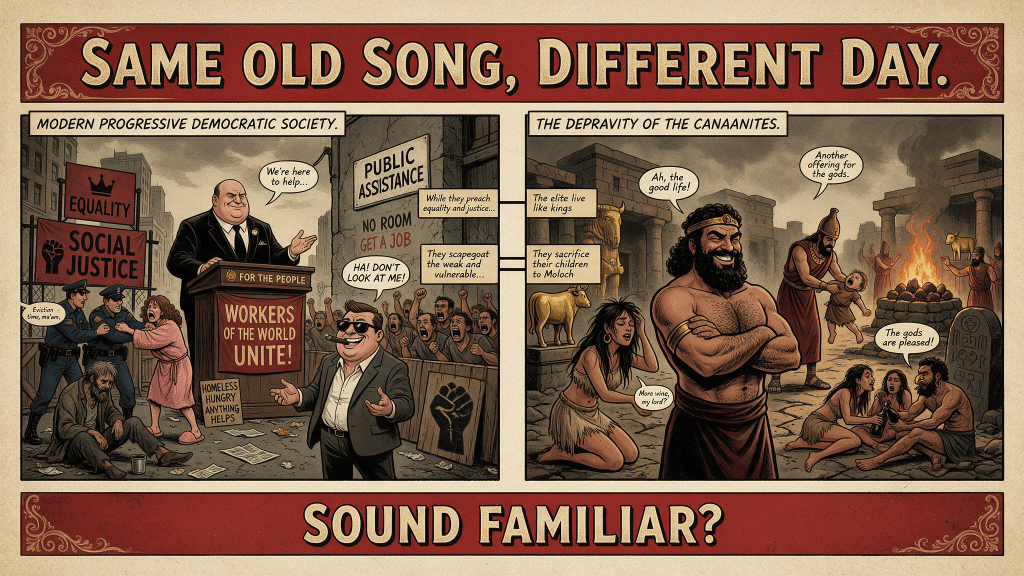
When secular writers treat the removal of biblical sexual boundaries as an unambiguous gain, they reverse the causal sequence the text records: the removal precedes and produces the practices, and the practices precede and produce the judgment.
The contemporary persistence of the atheist claim is therefore not a triumph of historical scholarship. It is a refusal to treat Leviticus 18 and 20 as data. Those chapters do not merely list private sins; they describe the public character of a society that had substituted its own ordinances for the Lord’s and the result that followed. Incest, adultery, Molech sacrifice, homosexual acts labeled abomination, bestiality labeled confusion, and occult consultation are the recorded content of that substitution. The punishments—death, burning, cutting off—are the recorded measures required to prevent the same pattern from taking root. The land’s vomiting out of its inhabitants is the recorded consequence.

Any assertion that society improves by further distancing itself from the God who issued these statutes must explain why the biblical case study of such distancing produced the opposite result. Until that explanation is offered on the text’s own terms, the claim remains what the chapters themselves portray the Canaanite path to have been: a delusion that ends in defilement rather than deliverance.



Leave a Reply