
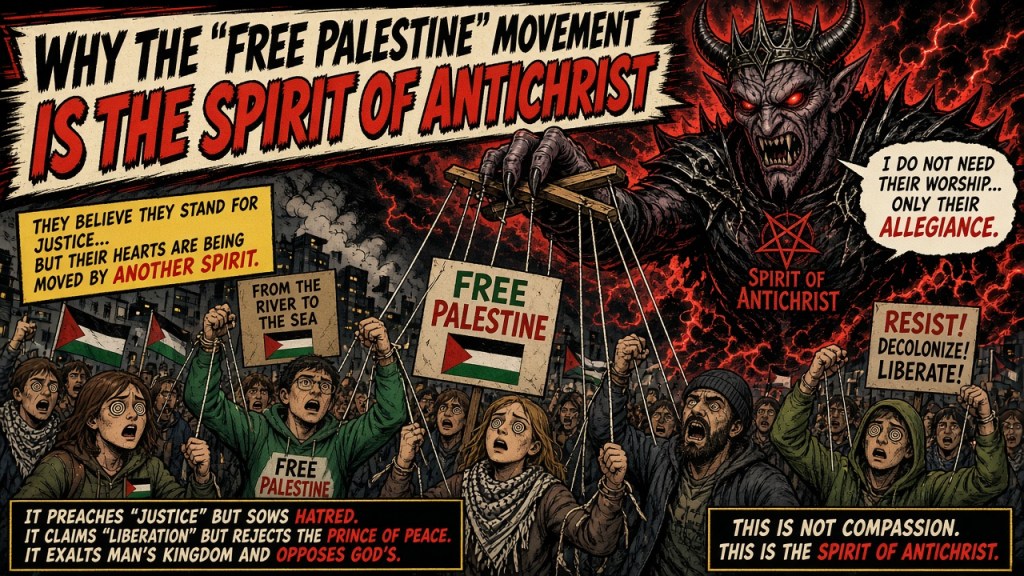
By any serious reading of the New Testament, the “spirit of antichrist” is not a distant eschatological abstraction. The apostle John defined it in the plainest terms: it is the denial that Jesus is the Christ, the rejection of the Father and the Son, and the active work of deception that replaces the gospel with a counterfeit.
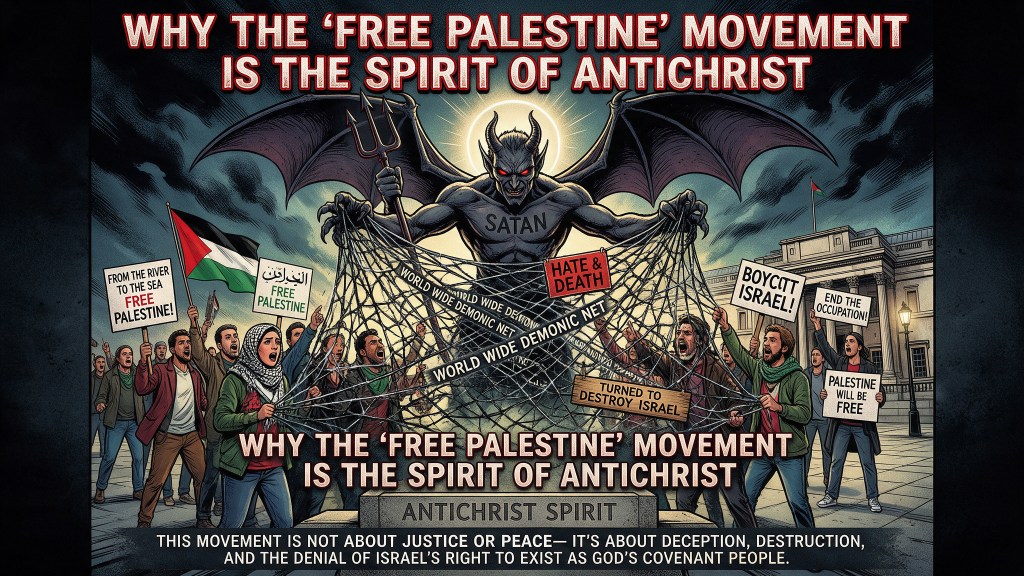
That spirit is not confined to the first century. It has taken many forms across history. In the present moment, one of its most visible and effective expressions is the Western “Free Palestine” movement, which has spent the last several years laundering an eliminationist Islamic project into the language of human rights, decolonization, and social justice.
The movement’s core documents and the statements of its most powerful organized actors leave little room for ambiguity. Hamas’s 1988 Covenant declared that “Israel will exist and will continue to exist until Islam will obliterate it,” cited the hadith in which Muslims fight and kill the Jews until the Day of Judgment, and framed the entire land as an Islamic endowment that cannot be bargained away. The 2017 document of principles softened the antisemitic phrasing for external consumption while preserving the same territorial claim: the territory from the Jordan River to the Mediterranean Sea as a single unit, the refusal to recognize any Jewish state, and the continuation of armed resistance until “liberation” is complete.
Palestinian Islamic Jihad has been more consistent still, rejecting any political compromise short of Israel’s destruction and the establishment of Islamic rule over the whole of historic Palestine. Leaders of these groups have repeatedly stated, in Arabic and on their own platforms, that the goal is the annihilation or expulsion of the Jews, that October 7 will be repeated “time and again until Israel is annihilated,” and that Palestinian lives are expendable martyrs in that cause.
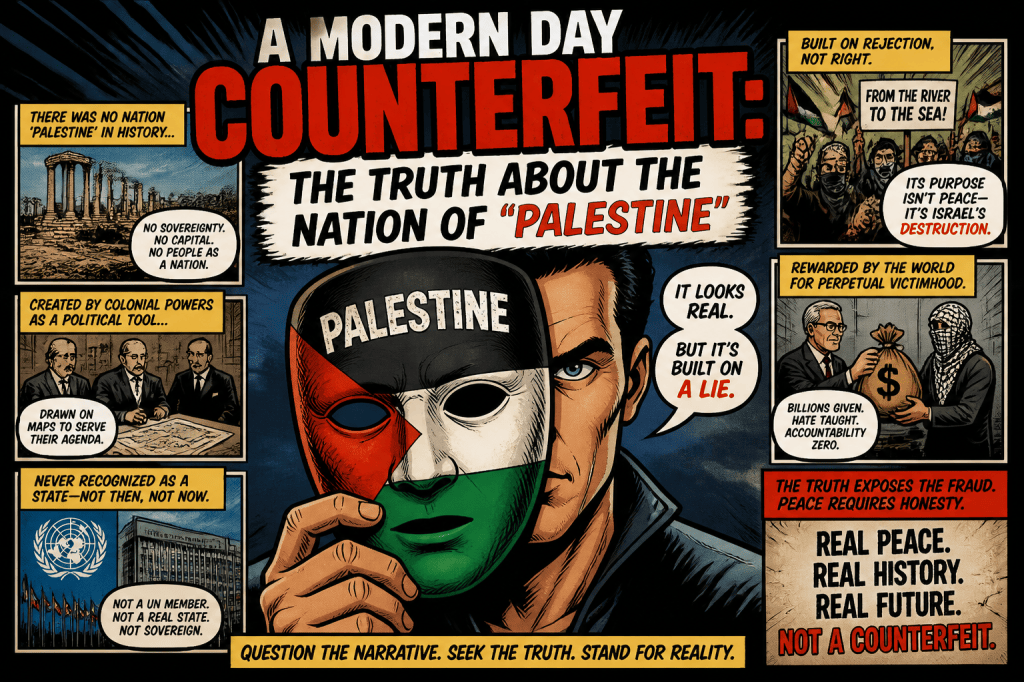
Western activists and their institutional allies have translated these positions into a vocabulary acceptable to progressive audiences. “From the river to the sea” is presented as a demand for equality or an end to occupation. In the historical and linguistic context in which the phrase developed—among the PLO and later among Hamas—it has meant the replacement of Israel with a single Palestinian polity.
Campus organizations, faculty departments, and protest coalitions rarely quote the 1988 Covenant’s hadith, the public calls by Hamas officials for the slaughter of Jews, or the explicit rejection of Jewish self-determination. October 7 is reframed as “resistance” or as the inevitable result of occupation; the deliberate murder of civilians, the sexual violence, and the hostage-taking are minimized, contextualized, or dismissed as Israeli claims.
The result is a sanitized product. Audiences in New York, London, and Berkeley encounter a cause that speaks the language of human rights while the groups that govern Gaza and conduct the bulk of the armed campaign continue to act on documents and statements that treat the Jewish presence itself as the problem to be solved.

This is not merely a political disagreement. It is a theological one, and it tracks the biblical description of the antichrist spirit with uncomfortable precision. The New Testament’s warning is not limited to those who openly worship Satan. It concerns those who deny the identity and work of Jesus Christ and who substitute a different message in its place. Islamic sources, from the Quran’s denial of the crucifixion to the eschatological roles assigned to the Mahdi and to Isa, systematically invert the biblical account of Jesus’s death, burial, and resurrection and replace the covenant with Isaac with a claim centered on Ishmael.
The Western Free Palestine movement does not usually quote these texts. It does not need to. By adopting the maximalist territorial claim, by refusing to distinguish itself from groups whose founding documents treat the conflict as a religious duty of jihad, and by presenting the elimination of the Jewish state as a matter of justice, it advances the practical outcome of that inversion without requiring its participants to affirm the underlying theology.
The institutional and financial scaffolding of this effort is not mysterious. Qatar has long hosted Hamas leaders and funded media and academic projects that shape Western coverage of the conflict. Iran supplies weapons, training, and strategic direction to the rejectionist factions. These states have an interest in keeping the conflict alive and in framing it as a moral cause for Western audiences. The progressive institutions that amplify the message—university departments, certain NGOs, and segments of the press—rarely subject the funding sources or the Arabic-language statements of their partners to the same scrutiny they apply to Israeli policy.
The result is a feedback loop in which eliminationist goals are repackaged as liberal concern, and liberal concern is then cited as evidence that the eliminationist goals must be reasonable. None of this requires the claim that every person who utters the phrase “Free Palestine” is a conscious agent of deception. Many participants are motivated by images of civilian suffering, by opposition to settlements, or by a general commitment to self-determination.
Polling among Palestinians themselves shows that support for a two-state outcome exists alongside substantial support for armed struggle and for the decision to launch the October 7 attacks. The distinction is real. It is also insufficient. Organized movements are judged by their dominant documents, their alliances, and the outcomes they consistently refuse to rule out.
When the groups that control territory and conduct the majority of attacks maintain charters and public statements that treat the Jewish state as illegitimate and temporary, and when Western institutions adopt the same territorial framing while declining to quote those statements, the practical effect is the same as if the religious rejectionism had been stated openly.

The biblical texts that describe the spirit of antichrist do not require a conspiracy theory. They describe a pattern: the denial of Christ’s person and work, the substitution of another message, and the capacity of that message to deceive. The Free Palestine movement, in its dominant Western form, fits the pattern. It takes an Islamic rejection of the Jewish people’s right to a state in the land of their historic connection—itself an inversion of the biblical narrative—and presents that rejection as the moral position.
It does so with the assistance of states that have their own strategic reasons for prolonging the conflict and with the enthusiastic participation of Western institutions that have grown accustomed to treating certain forms of religious and national particularity as illegitimate while treating others as sacred. The result is not a debate about borders or security arrangements. It is the active promotion of a project whose stated end, in the documents and statements of its principal armed representatives, is the end of Israel and the removal or subjugation of its Jewish population.
Those who continue to treat this movement as a straightforward human-rights cause are not merely mistaken about the facts on the ground. They are participating in the long work of replacing one account of reality with another. The New Testament’s warning was written for precisely this kind of substitution. It does not require one to accept every detail of a particular prophetic timeline to recognize the pattern. The denial is public. The documents are available. The statements of the leaders have been recorded. The Western translation of those statements into the language of justice has been consistent and effective.

Whether one regards that translation as naïveté, as ideology, or as something more deliberate, the outcome is the same: an eliminationist religious claim is advanced under a banner that progressive audiences find difficult to reject. That is the spirit of antichrist at work in plain sight.


Leave a Reply