
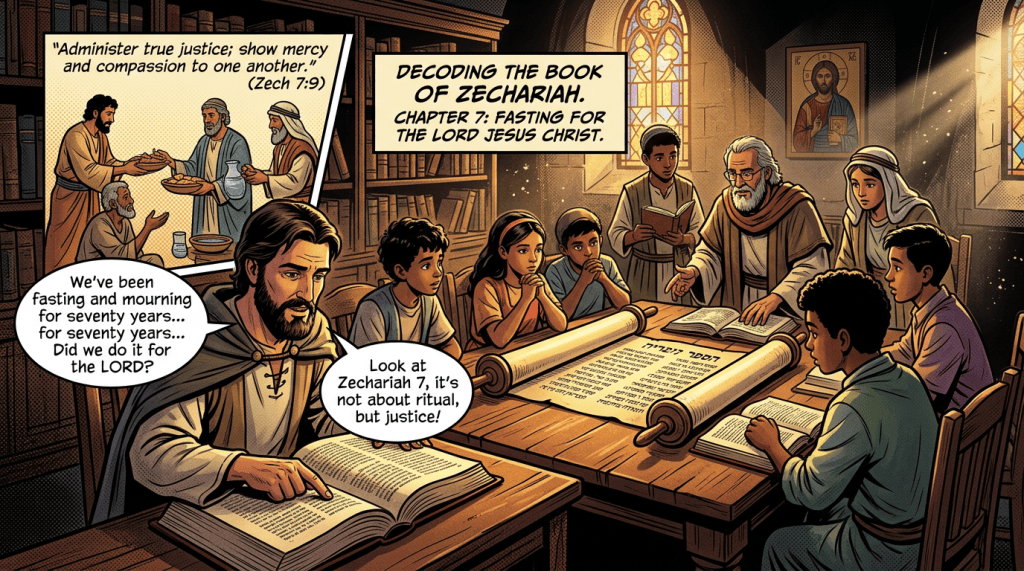
Zechariah 7 (KJV) records a question about fasting sent from Bethel and the LORD’s reply. The LORD of hosts is Jesus Christ, Jerusalem and Judah as the land and people corresponding to modern Israel, and the former scattering as the work of the nations that carried them to Babylon (core territory modern Iraq).

1 And it came to pass in the fourth year of king Darius, that the word of the LORD came unto Zechariah in the fourth day of the ninth month, even in Chisleu;
The word of the LORD comes to Zechariah on the fourth day of the ninth month (Chisleu), in the fourth year of Darius. The date is still within the Persian period (imperial center in the region of modern Iran), about two years after the opening visions.
2 When they had sent unto the house of God Sherezer and Regemmelech, and their men, to pray before the LORD,
Sherezer, Regemmelech, and their men are sent to the house of God to entreat the LORD. The delegation comes with a religious question.
3 And to speak unto the priests which were in the house of the LORD of hosts, and to the prophets, saying, Should I weep in the fifth month, separating myself, as I have done these so many years?
They ask the priests in the house of the LORD of hosts and the prophets whether they should continue to weep and fast in the fifth month, as they had done for many years. The fifth-month fast commemorated the burning of the temple by the Babylonians (2 Kings 25:8–9).
4 Then came the word of the LORD of hosts unto me, saying,
The LORD of hosts answers through Zechariah.

5 Speak unto all the people of the land, and to the priests, saying, When ye fasted and mourned in the fifth and seventh month, even those seventy years, did ye at all fast unto me, even to me?
He tells Zechariah to address all the people of the land and the priests: during the seventy years, when they fasted and mourned in the fifth and seventh months, were they truly fasting to Him? The seventy years match the indignation of Zechariah 1:12, the Babylonian exile (Iraq).
6 And when ye did eat, and when ye did drink, did not ye eat for yourselves, and drink for yourselves?
When they ate and drank, they did so for themselves. Both the fasting and the feasting are judged as self-directed rather than directed to the LORD.
7 Should ye not hear the words which the LORD hath cried by the former prophets, when Jerusalem was inhabited and in prosperity, and the cities thereof round about her, when men inhabited the south and the plain?
They ought to have heard the words the LORD cried through the former prophets, when Jerusalem (Israel) was inhabited and prosperous, with its surrounding cities, and when people lived in the south (Negev) and the lowland (Shephelah). The standard was already given before the exile.
8 And the word of the LORD came unto Zechariah, saying,
A further word comes.

9 Thus speaketh the LORD of hosts, saying, Execute true judgment, and shew mercy and compassions every man to his brother:
The LORD of hosts requires true judgment, and mercy and compassion from each man to his brother. The demand is ethical, not merely ritual.
10 And oppress not the widow, nor the fatherless, the stranger, nor the poor; and let none of you imagine evil against his brother in your heart.
They are not to oppress the widow, the fatherless, the stranger, or the poor, and none is to plot evil against his brother in his heart. The same protections appear throughout the Law and the earlier prophets.
11 But they refused to hearken, and pulled away the shoulder, and stopped their ears, that they should not hear.
The earlier generation refused to listen, turned a stubborn shoulder, and stopped their ears.
12 Yea, they made their hearts as an adamant stone, lest they should hear the law, and the words which the LORD of hosts hath sent in his spirit by the former prophets: therefore came a great wrath from the LORD of hosts.
They made their hearts like adamant (flint) so they would not hear the law or the words the LORD of hosts sent by His Spirit through the former prophets. Therefore great wrath came from the LORD of hosts.
13 Therefore it is come to pass, that as he cried, and they would not hear; so they cried, and I would not hear, saith the LORD of hosts:
As He called and they would not hear, so when they called He would not hear, says the LORD of hosts. The refusal is answered in kind.

14 But I scattered them with a whirlwind among all the nations whom they knew not. Thus the land was desolate after them, that no man passed through nor returned: for they laid the pleasant land desolate.
He scattered them with a whirlwind among all the nations they did not know. The land (Israel) was left desolate after them, with no one passing through or returning, because they had made the pleasant land desolate. The scattering nations include Babylon (Iraq) as the immediate agent of the exile already dated in the chapter.
Chapter 7 therefore rejects fasting that is not directed to the LORD, restates the demand for true judgment and mercy that the former prophets had already given, and traces the exile and the desolation of the land to the refusal to hear. The seventy years and the scattering among the nations are the historical links to the Babylonian captivity;





Leave a Reply