
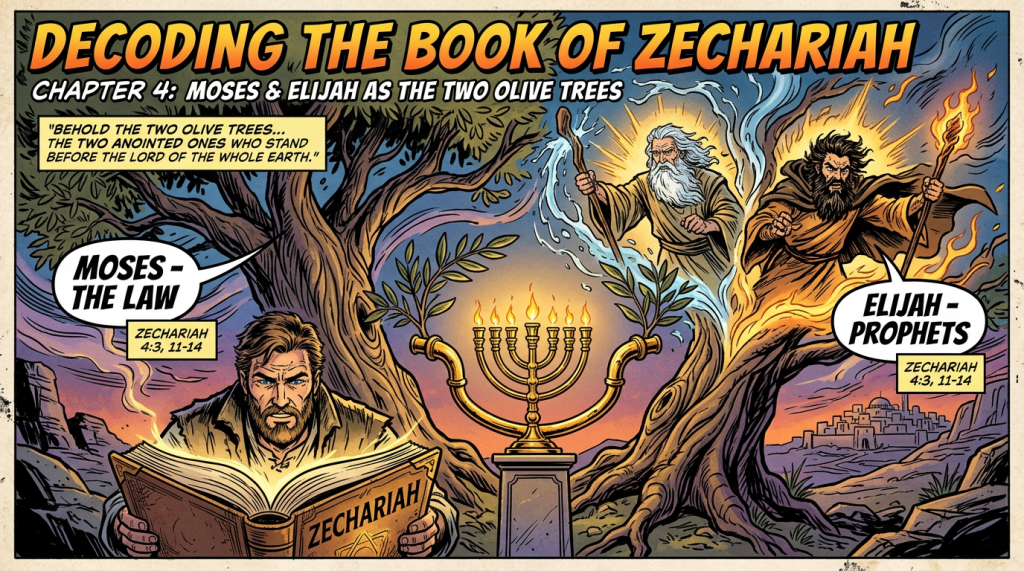
Zechariah functions as the Old Testament counterpart to Revelation. Both books are apocalyptic visions given through an interpreting angel, packed with recurring symbols found almost nowhere else.
Zechariah 4 (KJV) is the vision of the golden lampstand and the two olive trees. Revelation 11:4 directly identifies the two witnesses as “the two olive trees, and the two candlesticks standing before the God of the earth,” quoting the language of this chapter. Those two olive trees are Moses (the Law) and Elijah (the Prophets). The LORD is taken as Jesus Christ; Jerusalem remains the land corresponding to modern Israel.
1 And the angel that talked with me came again, and waked me, as a man that is wakened out of his sleep,
The interpreting angel returns and awakens Zechariah, as a man is awakened from sleep. The vision sequence continues from the preceding night visions.
2 And said unto me, What seest thou? And I said, I have looked, and behold a candlestick all of gold, with a bowl upon the top of it, and his seven lamps thereon, and seven pipes to the seven lamps, which are upon the top thereof:
Zechariah sees a lampstand entirely of gold, with a bowl on top, seven lamps on it, and seven pipes feeding the seven lamps. The imagery recalls the tabernacle lampstand (Exodus 25:31–40). Revelation 1:12–13 and 4:5 likewise place lampstands and seven lamps before the throne.
3 And two olive trees by it, one upon the right side of the bowl, and the other upon the left side thereof.
Two olive trees stand beside the bowl, one on the right and one on the left. These are the trees later identified in verse 14 as the two anointed ones. Revelation 11:4 equates the two witnesses with these two olive trees.
4 So I answered and spake to the angel that talked with me, saying, What are these, my lord?
Zechariah asks the interpreting angel the meaning of what he sees.
5 Then the angel that talked with me answered and said unto me, Knowest thou not what these be? And I said, No, my lord.
The angel asks whether he already knows; Zechariah says he does not.
6 Then he answered and spake unto me, saying, This is the word of the LORD unto Zerubbabel, saying, Not by might, nor by power, but by my spirit, saith the LORD of hosts.
The word of the LORD (Jesus Christ) to Zerubbabel is that the work will be accomplished not by might or power, but by the Spirit of the LORD of hosts. Zerubbabel was the governor leading the post-exile rebuilding of the temple in Jerusalem (Israel).
7 Who art thou, O great mountain? before Zerubbabel thou shalt become a plain: and he shall bring forth the headstone thereof with shoutings, crying, Grace, grace unto it.
The opposing “great mountain” will become level ground before Zerubbabel. He will bring out the capstone amid shouts of “Grace, grace unto it.” The obstacle to completing the house is removed by the same Spirit.
8 Moreover the word of the LORD came unto me, saying,
A further word from the LORD arrives.
9 The hands of Zerubbabel have laid the foundation of this house; his hands shall also finish it; and thou shalt know that the LORD of hosts hath sent me unto you.
Zerubbabel’s hands laid the foundation of the house; his hands will also finish it. The completion will confirm that the LORD of hosts has sent the speaker. Historically this concerns the second temple; the vision places the guarantee in the LORD’s sending.
10 For who hath despised the day of small things? for they shall rejoice, and shall see the plummet in the hand of Zerubbabel with those seven; they are the eyes of the LORD, which run to and fro through the whole earth.
Those who despised the day of small beginnings will rejoice when they see the plumb line in Zerubbabel’s hand together with “those seven.” The seven are the eyes of the LORD that range through the whole earth. Zechariah 3:9 already placed seven eyes on the stone; Revelation 5:6 identifies the Lamb’s seven eyes as the seven Spirits of God sent into all the earth.
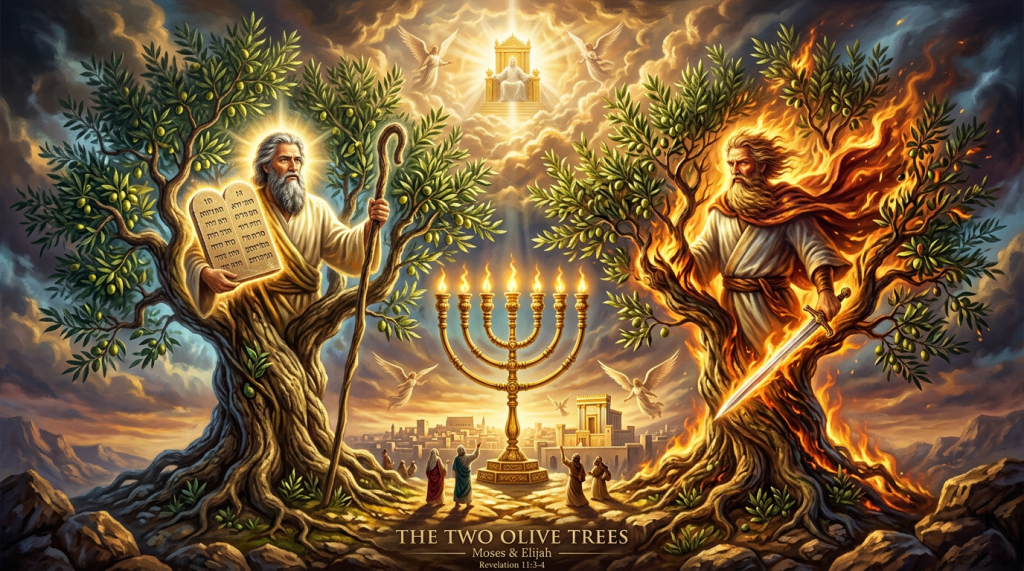
11 Then answered I, and said unto him, What are these two olive trees upon the right side of the candlestick and upon the left side thereof?
Zechariah returns to the two olive trees standing on either side of the lampstand.
12 And I answered again, and said unto him, What be these two olive branches which through the two golden pipes empty the golden oil out of themselves?
He asks specifically about the two olive branches that empty golden oil through two golden pipes.
13 And he answered me and said, Knowest thou not what these be? And I said, No, my lord.
The angel again asks if he knows; Zechariah again says no.
14 Then said he, These are the two anointed ones, that stand by the Lord of the whole earth.
The two are “the two anointed ones” (literally, sons of oil) who stand by the Lord of the whole earth. Revelation 11:3–4 takes up this identification: the two witnesses prophesy 1,260 days, and “these are the two olive trees, and the two candlesticks standing before the God of the earth.”
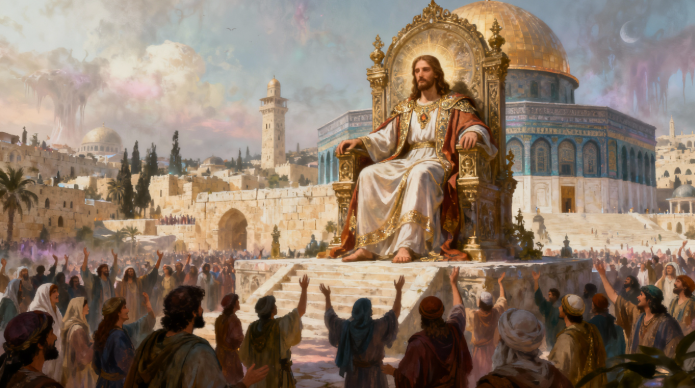
The two anointed ones / two witnesses are Moses (representing the Law) and Elijah (representing the Prophets). That reading rests on the Transfiguration appearance of Moses and Elijah (Matthew 17:3), the miracles of Revelation 11 (shutting heaven, turning waters to blood) that match Elijah and Moses, and Malachi 4:4–5, which pairs the Law of Moses with the sending of Elijah before the great day of the LORD. The chapter itself calls them the two anointed ones who stand by the Lord and who supply the oil; it does not insert the later names.
Chapter 4 therefore centers on the Spirit-enabled completion of the house by Zerubbabel, the seven eyes of the LORD surveying the earth, and the two olive trees that continuously supply oil to the lampstand. Those trees are the figures Revelation later calls the two witnesses, as Moses and Elijah.


Leave a Reply