
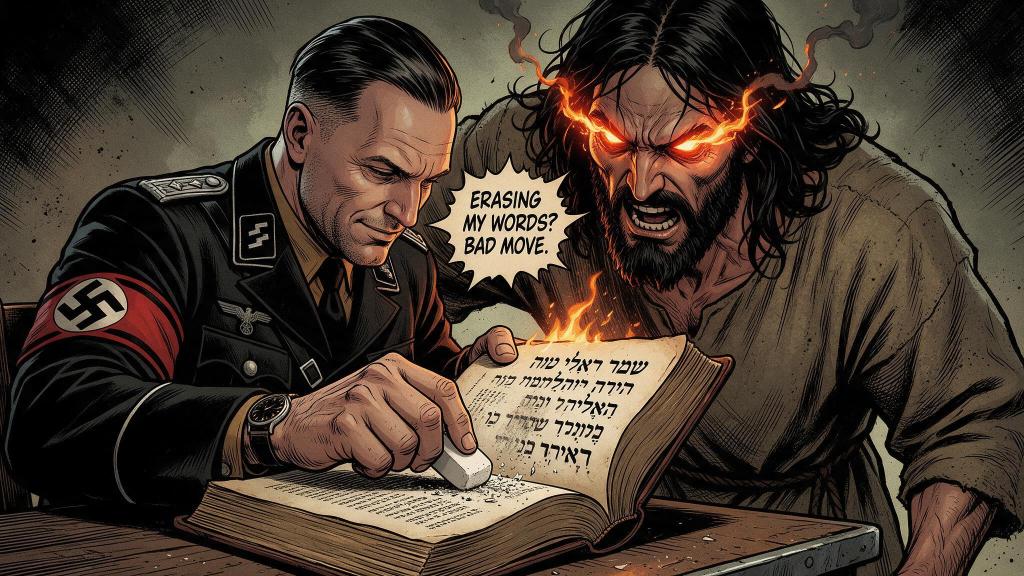
There is a special kind of confidence that only historical illiteracy can buy. It is the confidence of the man who opens the New Testament, meets a Jewish Messiah on the first page, and decides the Jewish part is the problem. He wants Jesus without Judah, Christ without David, a gospel without Abraham. He wants the fruit and the severed root at the same time. He calls this purification. It is vandalism.
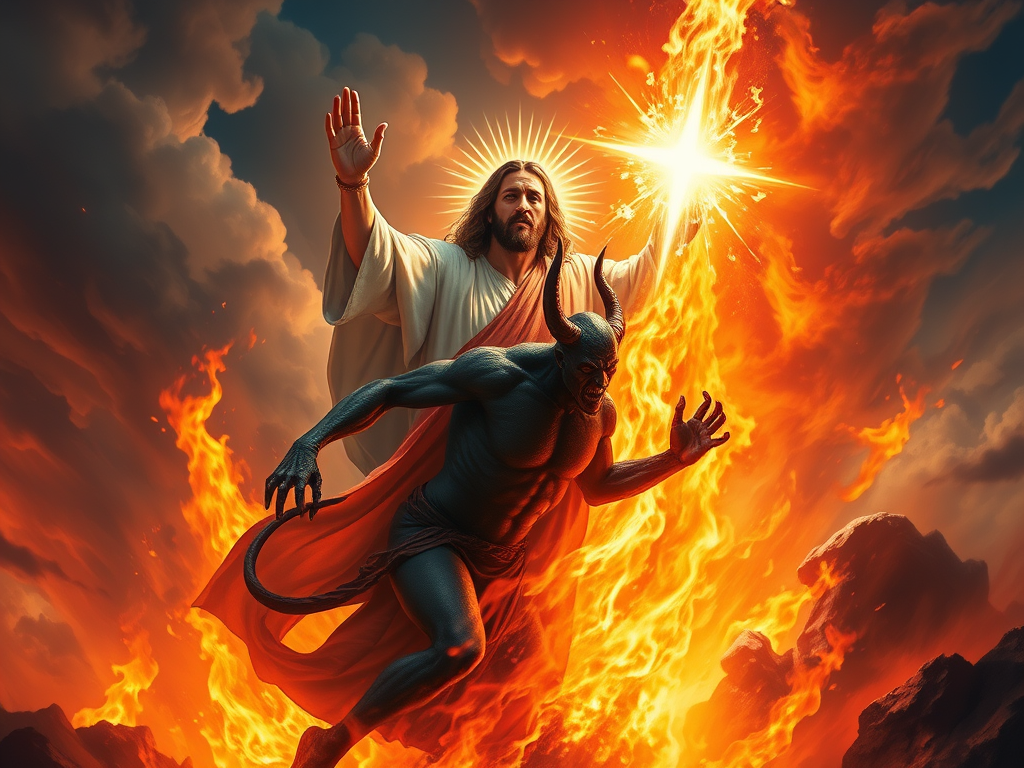
The project is not merely unkind. It is not merely politically useful to this faction or that. It is moronic in the strict sense: it requires you to mutilate the document you claim to revere, then pretend the remaining scraps are still the same book. Matthew does not ease you into the difficulty. “The book of the generation of Jesus Christ, the son of David, the son of Abraham.” That is the doorway. Remove it and you have not edited a preface. You have denied the claim the book exists to make.
The rest of the text is no more cooperative. Paul says the Son “was made of the seed of David according to the flesh.” He says of Israel, “of whom as concerning the flesh Christ came, who is over all, God blessed for ever.” The writer to the Hebrews finds it “evident that our Lord sprang out of Juda.” John records Jesus telling a Samaritan woman that “salvation is of the Jews.” The risen Christ, at the end of the canon, will not even leave the point to His biographers: “I am the root and the offspring of David.” A religion that needs those sentences gone is not protecting Jesus. It is shopping for another one.
People attempt the theft anyway, and they have been attempting it for a very long time. Around 140AD, a wealthy shipowner named Marcion arrived in Rome with a donation large enough to embarrass the congregation and a theology large enough to split it. The God of the Hebrew Scriptures, he taught, was not the Father of Jesus. The Old Testament was the wrong book. Luke and Paul could stay, provided the Jewish seams were cut out. In 144 the church in Rome put him out and gave him his money back. He built a rival church with bishops, rites, and a pocket Bible. Polycarp, who had known the apostolic generation, is said to have called him the firstborn of Satan. The insult was doctrinal, not decorative. Marcion was not refining Christianity. He was replacing its God.

The impulse never required a second-century dualist to survive. Thomas Jefferson took a razor to the Gospels and produced a Jesus of admirable morals and no Messiahship: no genealogy, no fulfilled prophecy, no “Christ cometh of the seed of David,” no resurrection. The Enlightenment did not need two gods. It needed a teacher who would not embarrass reason. The effect on the narrative was the same. The Jewish promises were the embarrassment.
In 1939 German Protestant churches helped found an institute in Eisenach whose name dispensed with euphemism: the Institute for the Study and Elimination of Jewish Influence on German Church Life. Under Walter Grundmann it issued Die Botschaft Gottes, a New Testament without the Old, without the Davidic genealogies, without “salvation is of the Jews,” with “Messiah” sanded down to “the Promised One,” and with Jesus recast as a Galilean fighter against Judaism. Hymns lost Zion, Jerusalem, Hallelujah. A catechism explained that Jesus could not have been a Jew. Two hundred thousand copies later, the fool’s errand had industrial distribution. It remained a fool’s errand. You cannot Aryanize Matthew 1:1. You can only lie about it.
The contemporary versions are shabbier and no less serious. “Jesus was a Palestinian” is seasonal midrash for Muslims who need the Holy Family to endorse a modern map. Online apostles of blood and soil discover that the Son of God “cannot” be Jewish, as if incarnation were a racial inconvenience. Islamic polemic keeps a prophet named Isa and denies the crucifixion, the sonship, and the reliability of the books that identify the crucified man as David’s heir. The costumes change. The edit does not. Always the same deletion: this Jesus may not be that Messiah.

Call the thing by its biblical name. The New Testament does not treat “Christ” as a floating honorific. It is the office promised to Israel. To deny that Jesus is that Christ, John says, is the liar’s work, and “he is antichrist, that denieth the Father and the Son.” The same letter gives the test of spirits: every spirit that will not confess “Jesus Christ is come in the flesh” is the spirit of antichrist, already in the world. The flesh in question is not generic tissue. It is the flesh of Abraham’s seed, Judah’s line, David’s house, born of a woman, made under the law. A phantom Jesus fails the test. A racially reassigned Jesus fails it too. Both refuse the incarnation as written. Both clear space for a substitute.
That is what anti means here: not only against, but instead of. “If another shall come in his own name, him ye will receive.” Paul feared the serpent’s old subtlety—another Jesus, another gospel—and warned that Satan himself is transformed into an angel of light. De-Jewifying the Bible is how the counterfeit is assembled from Christian vocabulary. Keep the name. Lose the covenants. Delete the genealogy. Teach the nations a christ who never needed Israel and therefore never fulfills Israel’s Book. What remains can be conscripted by empire, race, ideology, or sentiment. It cannot save, because it is not the one God sent.
The ridicule writes itself. The Bible’s most frequent human name after the divine name is Israel. Its plot runs from a promise to Abraham to a king from Judah to a child in Bethlehem of Juda to a cross outside Jerusalem to a Lord who will return to the same geography the revisionists keep trying to sand off. To “remove Jews from the Bible” is like removing Rome from a history of Caesar and insisting you have improved the style. It is not interpretation. It is a different work bound in a stolen cover.

But folly on this point is not harmless. Scripture attaches consequence to the handling of the text and to the identity of the Son. “Ye shall not add unto the word… neither shall ye diminish ought from it.” “If any man shall take away from the words of the book of this prophecy, God shall take away his part out of the book of life.” “Though we, or an angel from heaven, preach any other gospel unto you… let him be accursed.” “He that believeth not the Son shall not see life; but the wrath of God abideth on him.” “It is a fearful thing to fall into the hands of the living God.”
Christ is not a mascot who shrugs when men unmake Him. The New Testament’s own high claim is that the man from Nazareth is God manifest in the flesh, the Son in whom the Father is confessed or denied. To invent a Jesus who is not the Messiah of the Jews is to deny the Son. To deny the Son is to lose the Father. That is not a metaphor about bad taste. It is the wrath of God in the only sense that finally matters: not a mood, but the settled opposition of the Holy One to the lie that would unchrist Christ.
The remedy is humiliatingly simple, which is why the sophisticated keep missing it. Leave the sentences alone. Jesus is a Jew. He is the son of David. He is the Christ. The God of Abraham is His Father. The Scriptures cannot be broken. Every school, razor, institute, and slogan that says otherwise is not advancing the faith. It is picking a fight with the Lord of the Book, and the Book has already told you how that fight ends.



Leave a Reply